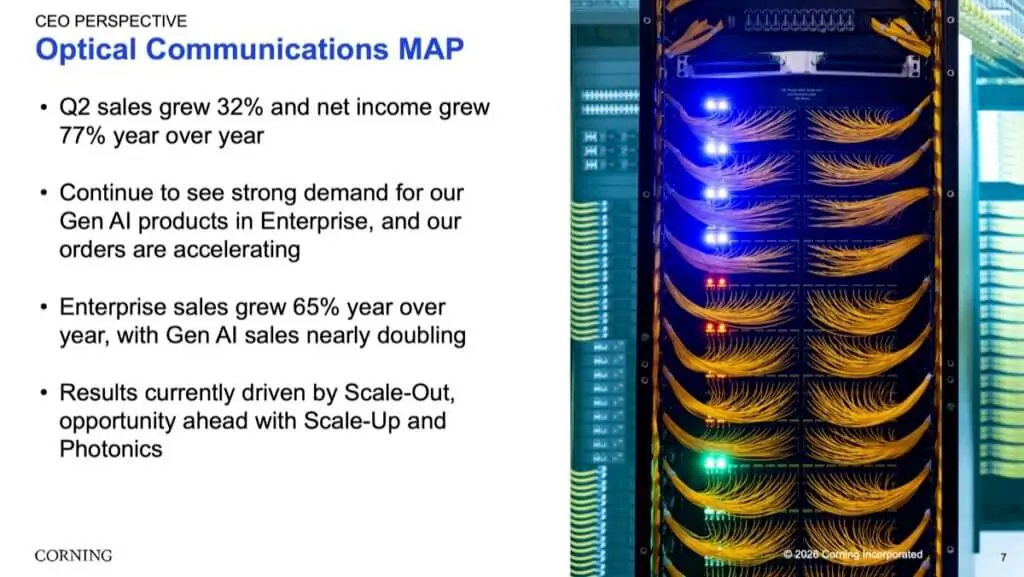
Corning reported strong second-quarter 2026 financial results, with AI infrastructure demand continuing to accelerate growth in its Optical Communications business. Core sales increased 17% year over year to $4.74 billion, while core earnings per share rose 30% to $0.78. Optical Communications revenue climbed 32% to $2.07 billion, driven by a 65% increase in Enterprise Networks as demand for GenAI optical connectivity products continued to expand.
The results mark an early milestone in Corning’s upgraded Springboard Plan, unveiled at its May 2026 Investor Day. The company now targets an annualized revenue run rate of $20 billion by the end of 2026, $30 billion by the end of 2028, and $40 billion by the end of 2030. Management expects revenue to grow at a 19% compound annual growth rate from the fourth quarter of 2026 through the fourth quarter of 2030 while increasing earnings faster than revenue, improving returns on invested capital, and generating substantially higher free cash flow.
The quarter also underscored Corning’s expanding role in AI infrastructure. During Q2, Amazon signed a multiyear, multibillion-dollar agreement for Corning to supply optical fiber, cable, and connectivity solutions supporting Amazon’s expanding U.S. data center infrastructure. Corning also announced a long-term partnership with NVIDIA under which the company will expand its U.S. optical connectivity manufacturing capacity by 10x and increase domestic optical fiber production by more than 50% to support AI factory deployments.
“Our second-quarter results demonstrate strong progress on our upgraded Springboard Plan,” said Wendell P. Weeks, chairman, chief executive officer and president. “We continue to deepen our long-term customer partnerships with industry leaders, most recently with Amazon and NVIDIA. These partnerships provide strong proof points supporting our exciting Springboard Plan.”
Beyond Optical Communications, Corning’s newly created Solar segment nearly doubled revenue, growing 90% year over year to $438 million despite completing an extended maintenance shutdown and equipment upgrade at its solar wafer manufacturing facility. Management expects Solar profitability to improve beginning in the third quarter as production ramps toward a business exceeding $3 billion in annual revenue.
For the third quarter, Corning expects core sales between $4.9 billion and $5.0 billion, representing approximately 16% year-over-year growth, with core EPS between $0.85 and $0.89, up about 28%.
• Core sales: $4.74 billion, up 17% year over year • Core EPS: $0.78, up 30% • GAAP sales: $4.51 billion • Optical Communications revenue: $2.07 billion, up 32% • Optical Communications operating income: $438 million, up 77% • Enterprise Networks revenue: up 65% • Solar revenue: $438 million, up 90% • Core gross margin: 39.6%, up 120 basis points • Core operating margin: 20.9%, up 190 basis points • Adjusted free cash flow: $1.42 billion • Q3 outlook: core sales of $4.9-$5.0 billion; core EPS of $0.85-$0.89 • Springboard targets: • $20 billion annualized revenue run rate by end of 2026 • $30 billion by end of 2028 • $40 billion by end of 2030
Wendell Weeks — Chairman, President and CEO Ed Schlesinger — Executive Vice President and CFO Chris Keenan — Director of Investor Relations
•
Separate photonics coverage: CEO Wendell Weeks outlined key elements of Corning’s photonics roadmap and the associated opportunity in data center and enterprise networking. That discussion, including optical scale-up and potential fiber-content expansion, is the subject of a separate Converge Digest article.
•
Corning said orders in Enterprise Networks continue to accelerate, with the portion of enterprise revenue tied to AI data centers nearly doubling during the quarter.
•
Management indicated that Corning could reach its $20 billion annualized sales run-rate objective during the third quarter, approximately one quarter ahead of the formal year-end target. The company said its Q3 guidance does not imply a slowdown in underlying growth.
•
Corning expects long-term customer agreements eventually to cover the majority of its Optical Communications business. Management said major capacity expansions will generally require customer commitments that share investment risk and improve long-term demand visibility.
•
Optical Communications profitability reflects increased sales of high-density fiber, cable and connectivity systems rather than primarily higher prices for standard fiber. Corning said these products can reduce installation costs, accelerate deployment and improve network reliability.
•
Demand continues to exceed available production capacity for some of Corning’s most advanced optical connectivity products. Management said the company could sell additional volume if it could manufacture more of these products.
•
Carrier Networks revenue increased only 1% during the quarter because of project timing, but first-half 2026 carrier revenue increased approximately 17% from the first half of 2025. Corning continues to expect mid-single-digit long-term carrier growth from fiber-to-the-home and data center interconnect deployments.
•
Corning plans approximately $2 billion in 2026 capital expenditures, with the investment rate increasing during the third and fourth quarters. The spending will primarily support Optical Communications capacity associated with customer-backed expansion programs.
•
Corning distinguished between its internal Springboard operating plan and a more conservative, risk-adjusted outlook. The high-confidence plan targets annualized revenue of $27 billion by the end of 2028 and $35 billion by the end of 2030, compared with internal targets of $30 billion and $40 billion.
•
Since the fourth-quarter 2023 Springboard starting point, Corning said it increased sales by 45%, expanded operating margin by 460 basis points, doubled EPS and improved return on invested capital by 610 basis points.
•
Management expects operating margin to remain at or above 20% while Corning funds capacity expansion. The company also expects return on invested capital to rise from approximately 15% toward the high teens and plans to provide an updated operating-margin framework later in 2026.
•
Solar manufacturing incurred approximately $30 million of additional expense during the quarter because of an extended factory maintenance shutdown, equipment upgrades and conversion to a permanent power system. Corning expects solar revenue and profitability to improve beginning in the third quarter.
•
Corning continues to target approximately $3 billion in annual solar revenue, with profitability above the corporate average. Management said long-term customer commitments now cover polysilicon, wafers and modules.
•
Corning plans to increase the proportion of its polysilicon production directed toward semiconductor-grade applications, particularly the highest-purity material used by semiconductor manufacturers. Solar will remain the larger market by volume.
•
Higher memory prices are expected to reduce global handheld-device unit shipments by a mid-teens percentage during 2026. Corning expects Gorilla Glass revenue to outperform the device market because of its premium-product exposure and increased content per device, including glass ceramics and materials for foldable displays.
•
In television displays, higher component costs are encouraging manufacturers to emphasize larger and higher-priced sets. Corning said this trend benefits its Gen 10.5 display-glass manufacturing position.
•
Automotive demand remains comparatively muted, although Corning expects content growth from larger and higher-resolution vehicle displays and new emissions-control products. Diesel-related revenue increased sequentially as North American Class 8 truck orders improved.
🌐 Analysis
Corning’s Optical Communications segment has become the primary engine of the company’s growth as hyperscale AI infrastructure investment accelerates. The 32% year-over-year revenue increase significantly outpaced Corning’s overall corporate growth, while the 77% increase in segment earnings demonstrates the operating leverage associated with AI-related optical networking demand. Enterprise Networks, which includes data center connectivity products, grew 65%, reflecting rapid deployment of optical interconnects inside AI clusters.
The company’s recently announced agreements with Amazon and NVIDIA reinforce Corning’s strategic position in the AI supply chain. Rather than supplying active optical modules, Corning provides the underlying fiber, cable assemblies, connectors, and optical connectivity infrastructure required for hyperscale AI data centers. NVIDIA’s commitment to support a 10-fold expansion in Corning’s U.S. optical connectivity manufacturing capacity and more than 50% additional domestic fiber production illustrates how AI infrastructure demand is reshaping the optical communications ecosystem well beyond transceivers and networking silicon.