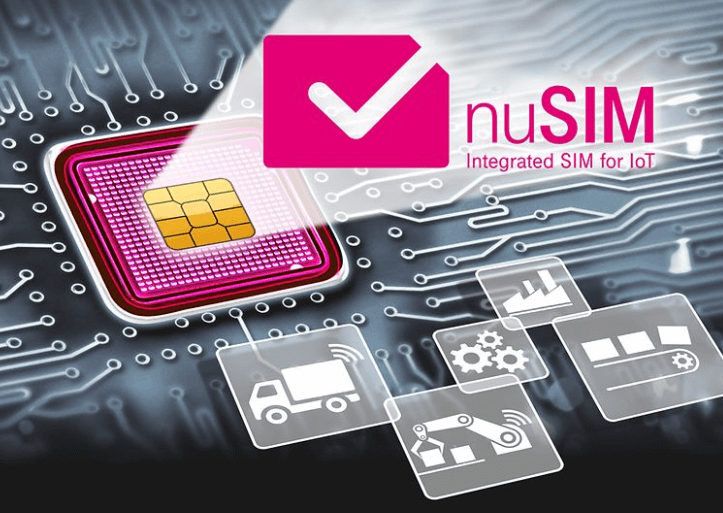
Deutsche Telekom, working in partnership with industry partners, has led the development of nuSIM, which moves the SIM functionality from the physical SIM card directly to the chipset.
nuSIM is specifically designed for low-cost devices used in mobile IoT applications with a long life-span, such as asset trackers or smart motion or temperature sensors. It will be commercially available in the second half of 2019.
for modules: Quectel Wireless Solutions, Sierra Wireless, Telit, u-blox, Nordic Semiconductor.
for digital security: Giesecke+Devrient Mobile Security.
“Deutsche Telekom has built a solid track record in IoT technology innovation over the past years. The most important success driver for us is to anticipate customer needs to make sure we enable their business success,” says Ingo Hofacker, Senior Vice President, responsible for the IoT business at Deutsche Telekom. “nuSIM, our rigorously optimized SIM solution for the cost-sensitive mobile IoT market is our latest endeavor and an important building block for our offering moving forward.”
Share this article
Help others discover this reporting.
Editorial responsibility
Staff
Editor & Publisher
Every article published by Converge Digest is researched, curated, fact-checked and editorially reviewed by Jim Carroll, Editor & Publisher. AI-assisted drafting may be used to accelerate production, but all content is reviewed, refined and approved prior to publication.
You just read about Deutsche Telekom. One of the companies whose work it now carries:
VoiceStream Wireless built National GSM mobile operator in the United States. What became of it?
VoiceStream Wireless brought National GSM mobile operator in the United States to Telecom. That work was distinctive enough to lead to its acquisition by Deutsche Telekom for US$35B. The standalone name now passes into the archive — but the team and technology continue inside Deutsche Telekom today. One of 430 names here whose work outlived the company.
You just read about All. A technology from the archive that helped get us here:
Google/Alphabet Project Loon served 2011–2021. What ultimately replaced it?
Google/Alphabet Project Loon solar-powered balloons drifting in the stratosphere (~20 km), steering by rising and falling into different wind layers, relaying LTE from ground stations to phones far below. Its job passed to Unit economics — but the problem it solved, and the ideas it proved, live on in what replaced it. The standard rests here in the archive. One of 198 technologies here that opened a door and then held it for the next.