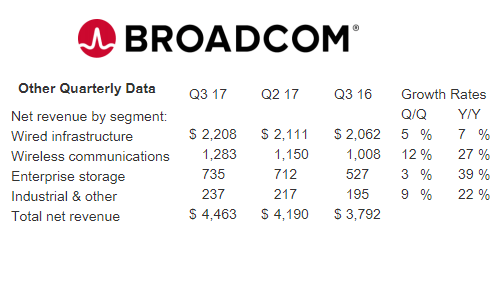
Broadcom posts quarterly revenue of US$4.463 billion, up 18% yoy
Broadcom reported quarter net revenue of $4,463 million, an increase of 7 percent from $4,190 million in the previous quarter and an increase of 18 percent from $3,792 million in the same quarter last year. Gross margin was $2,149 million, or 48.2 percent of net revenue. Operating income was $648 million, or 14.5 percent of net revenue. This compares with operating income of $474 million, or 11.3 percent of net revenue, in the prior quarter, and operating loss of $264 million, or 7.0 percent of net revenue, in the same quarter last year.
“We continue to execute consistently and delivered strong financial results for our third fiscal quarter, with revenue growth of 6 percent and EPS growth of 11 percent sequentially” said Hock Tan, President and CEO of Broadcom Limited. “We are expecting revenue growth to further accelerate in the fourth fiscal quarter, led by robust content gains and seasonal strength in our wireless segment.”
Every article published by Converge Digest is researched, curated, fact-checked and editorially reviewed by Jim Carroll, Editor & Publisher. AI-assisted drafting may be used to accelerate production, but all content is reviewed, refined and approved prior to publication.
You just read about Broadcom. One of the companies whose work it now carries:
NetLogic Microsystems built Network processors, knowledge-based processors and PHYs. What became of it?
NetLogic Microsystems brought Network processors, knowledge-based processors and PHYs to Semiconductor. That work was distinctive enough to lead to its acquisition by Broadcom for US$3.7B. The standalone name now passes into the archive — but the team and technology continue inside Broadcom today. One of 430 names here whose work outlived the company.
You just read about All. A technology from the archive that helped get us here:
Google/Alphabet Project Loon served 2011–2021. What ultimately replaced it?
Google/Alphabet Project Loon solar-powered balloons drifting in the stratosphere (~20 km), steering by rising and falling into different wind layers, relaying LTE from ground stations to phones far below. Its job passed to Unit economics — but the problem it solved, and the ideas it proved, live on in what replaced it. The standard rests here in the archive. One of 198 technologies here that opened a door and then held it for the next.