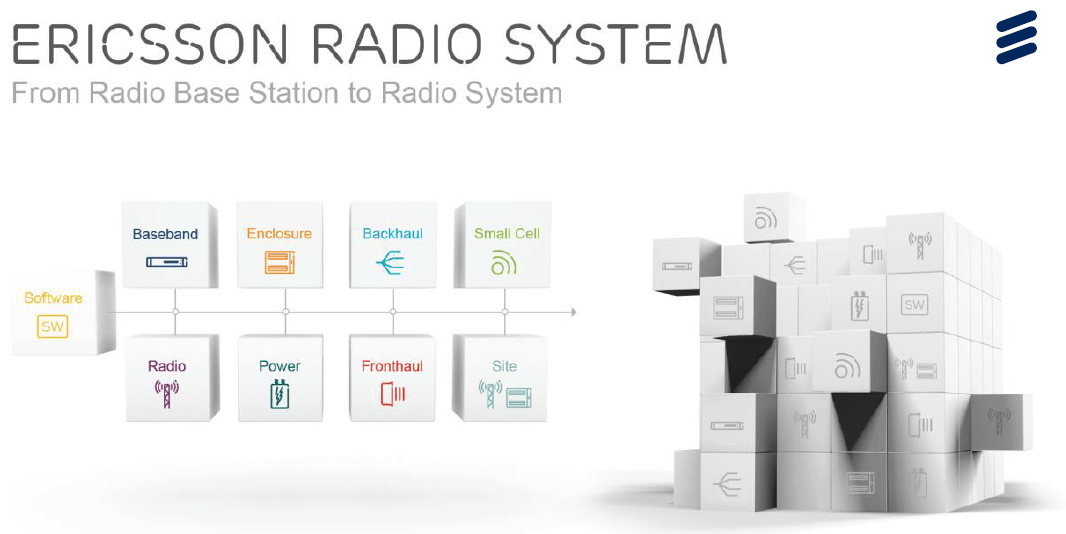
 Ericsson introduced its next generation Radio System modular architecture, aiming to provide greater flexibility in how mobile networks are built and operated.
Ericsson Radio System features multi-standard, multi-band and multi-layer technology. It delivers three times the capacity density with 50 percent improvement in energy efficiency compared to current systems. It is fully backward-compatible with Ericsson’s existing RBS 6000 portfolio and offers the ability for network operators to upgrade their current sites with a simple “one-bolt” installation an zero floor footprint. The radio modules can be mounted vertically or horizontally on a rail, flat on a cable ladder or behind an antenna. Thanks to a 5-time reduction potential in wind load, the equipment is lighter and more durable for tower deployment.

The new Ericsson Radio System brings an upgraded and powerful baseband unit (Baseband 5216). On one board, it is able to handle twice as many cells as existing baseband units; supports both LTE FDD and TDD modes simultaneously; and supports up to 80,000 subscribers.
Ericsson anticipates first deployments during Q3 201. The new system will run Ericsson Networks Software 15B. Twice-annual software updates simplify the upgrade process and the entire system is run by a common management system, Ericsson Network Manager.
 Ericsson also took the wraps off its new Router 6000 series advanced radio integrated transport for high-performance backhaul with precise synchronization required LTE Advanced, 5G and M2M.
The new Router 6000 series is a key element in Ericsson’s next-generation portfolio, a comprehensive suite of platforms running one network operating system (IPOS), spanning from cell-site routers to edge, mobile core and data centers. The architecture will integrate SDN capabilities and, when matched with the new Ericsson Virtual Router, will enable distributed cloud applications. New Ericsson Network Manager capabilities will bring application aware traffic engineering with plug-and-play installation.
“The Ericsson Router 6000 series is a game changer since it responds directly to operators’ challenges of dramatic increase in the number of connected devices, and the video explosion driving the demand for traffic scale and higher quality of experience,” said Anders Lindblad, Senior Vice President, Head of Business Unit Cloud and IP at Ericsson.
Some highlights of the Ericsson Router 6000 series:
- Integrated into the new Ericsson Radio System that supports a multi-standard, multi-band, multi-layer architecture
- Series consists of the Router 6672 for access, the Router 6675 for pre-aggregation and the Router 6274 for metro aggregation.
- First access router with 100GE interfaces in a single Rack Unit (RU) — more capacity and higher density of 10GE/100GE interfaces in a compact form factor.
- Support for Segment Routing provides an evolutionary migration from IP/MPLS to SDN, offering user-defined policy routing, faster roll out of revenue generating services and optimal usage of network resources.