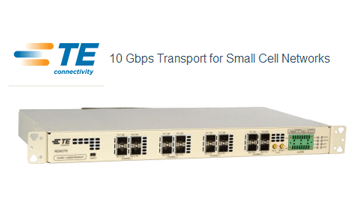
TE Connectivity introduced a 10 Gbps optical transport Serial Link Combiner (SLC) for small cell backhaul.

TE’s SLC is a CPRI rate muxponder that can support up to 225 MHz of spectrum over a single fiber pair. The SLC combines up to three 3.072 Gbps fiber links to a single 9.8304 Gbps (10 Gbps) single-mode or multi-mode fiber pair. And each SLC chassis supports four 10 Gbps links for a combined 900 MHz of available transport capacity.
The company said its new muxponder is significant in that it reduces fiber needed from up to three fiber pairs (six fiber strands) to a fiber pair (two fiber stands). This reduces fiber leasing requirements by up to 150%, reducing operational expenses.
Each SLC chassis supports four 10 Gbps links; each 10 Gbps link supports up to 225 MHz of RF spectrum transported over a single 10 Gbps fiber pair (two fiber strands). The design allows for fiber reuse of existing fiber infrastructure.
The platform could be used as an optical multiplexing solution for multiband and multi-operator mobile networks where it is necessary to transport full-band, multi-band RF to a designated service area, such as a large public venue or urban core, where there is high sectorization and capacity strain on the network. The four composite 10 Gbps fiber links can also be multiplexed by utilizing WDM, CWDM and DWDM to further reduce the amount of fiber needed. SLC works with any solution that transports at the 3.072 Gbps data rate, including TE’s digital DAS solutions or remote radio heads, and small form pluggable (SFP) and SFP+ optical transceivers to transport high amounts of capacity several kilometers away.