Colt Technology Services has begun offering 100 Gigabit Ethernet (GbE) services over its pan-European long-haul fiber network using the Infinera DTN platform.
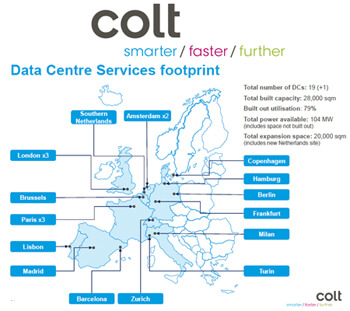
Colt operates a 22-country, 43,000km network that includes metropolitan area networks in 39 major European cities with direct fiber connections into 18,000 buildings and 20 carrier neutral Colt data centers.
Colt can now offer 100GbE services across this infrastructure.
“As the company continues to transform from a traditional B2B telecoms operator to a provider of integrated IT and network services, enhancing our Ethernet services capabilities is key to delivering an end to end service experience that matches our customer’s agenda,” said Luke Broome, CTO at Colt. “Our use of the Infinera DTN to deliver 100GbE services on our long distance network will support customers with the highest performance demands in achieving their business priorities.”
Infinera noted that Colt first deployed its DTN in 2009 and that an early trial of 100GbE services over the London to Frankfurt route was completed in 2010.
Every article published by Converge Digest is researched, curated, fact-checked and editorially reviewed by Jim Carroll, Editor & Publisher. AI-assisted drafting may be used to accelerate production, but all content is reviewed, refined and approved prior to publication.
You just read about Infinera. One of the companies whose work it now carries:
Coriant built Optical transport, OTN switching and control software. What became of it?
Coriant brought Optical transport, OTN switching and control software to Optical. That work was distinctive enough to lead to its acquisition by Infinera for US$430M. The standalone name now passes into the archive — but the team and technology continue inside Infinera today. One of 430 names here whose work outlived the company.
You just read about Ethernet. Here is what it replaced:
ARCNET served 1977–1990. What ultimately replaced it?
ARCNET a token-passing bus/star LAN where a token circulated by station address (not physical position), giving predictable performance over coax at 2.5 Mbit/s. Its job passed to Ethernet — but the problem it solved, and the ideas it proved, live on in what replaced it. The standard rests here in the archive. One of 198 technologies here that opened a door and then held it for the next.