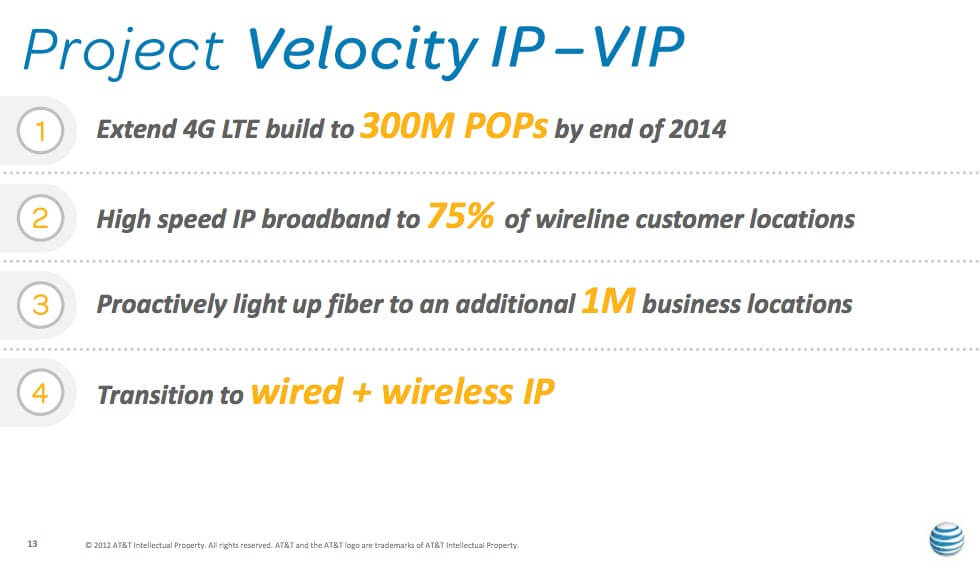
 AT&T unveiled Project Velocity IP (VIP) — its plan to invest $14 billion over the next three years to significantly expand and enhance its wireless and wireline IP broadband network. The plan adds $8 billion for wireless initiatives and $6 billion for wireline initiatives. It also makes a distinction between areas where the company believes are better served wirelessly rather the through a traditional copper network or deploying a fiber infrastructure.
Total capital spending is now expected to be approximately $22 billion for each of next three years. The company said a stronger balance sheet has provided it the financial footing to invest. AT&T is also increasing its quarterly dividend 2.3 percent and is predicting EPS will grow by mid-single digits for the next 3 years with opportunity for stronger growth going forward.
“This is a major commitment to invest in 21st Century communications infrastructure for the United States and bring high-speed Internet connectivity — 4G LTE mobile and wireline IP broadband — to millions more Americans,” said Randall Stephenson, AT&T chairman and chief executive officer. “We have the opportunity to improve AT&T’s revenue growth and cost structure for years to come, and create substantial value for shareowners.
AT&T highlights the following aspects of Project VIP:
4G LTE Expansion. AT&T plans to expand its 4G LTE network to cover 300 million people in the United States by year-end 2014, up from its current plans to deploy 4G LTE to about 250 million people by year-end 2013. In AT&T’s 22-state wireline service area, the company expects its 4G LTE network will cover 99 percent of all customer locations.
Spectrum. AT&T has acquired spectrum through more than 40 spectrum deals this year (some pending regulatory review) and has plans to buy additional wireless spectrum to support its 4G LTE network. Much of the additional spectrum came from an innovative solution in which AT&T gained FCC approval to use WCS spectrum for mobile broadband. Between what the company already owns and transactions pending regulatory approval, AT&T expects to have about 118Mhz of spectrum nationwide. The company will continue to advocate with the FCC for release of additional spectrum for the industry’s long-term needs.
Densification & Small Cell Technology. As part of Project VIP, AT&T expects to deploy small cell technology, macro cells and additional distributed antenna systems to increase the density of its wireless network, which is expected to further improve network quality and increase spectrum efficiency.
Investing in Wireline IP Network Growth. AT&T plans to expand and enhance its wireline IP network to 57 million customer locations (consumer and small business) or 75 percent of all customer locations in its wireline service area by year-end 2015. This network expansion will consist of:
- U-verse. AT&T plans to expand U-verse (TV, Internet, Voice over IP) by more than one-third or about 8.5 million additional customer locations, for a total potential U-verse market of 33 million customer locations¹. The expansion is expected to be essentially complete by year-end 2015.
- U-verse IPDSLAM. The company plans to offer U-verse IPDSLAM service (high-speed IP Internet access and VoIP) to 24 million customer locations in its wireline service area by year-end 2013.
- Speed Upgrades. The Project VIP plan includes an upgrade for U-verse to speeds of up to 75Mbps and for U-verse IPDSLAM to speeds of up to 45Mbps, with a path to deliver even higher speeds in the future.
- In the 25 percent of AT&T’s wireline customer locations where it’s currently not economically feasible to build a competitive IP wireline network, the company said it will utilize its expanding 4G LTE wireless network — as it becomes available — to offer voice and high-speed IP Internet services. The company’s 4G LTE network will cover 99 percent of all in-region customer locations. AT&T’s 4G LTE network offers speeds competitive with, if not higher than, what is available on wired broadband networks today. And in many places, AT&T’s 4G LTE service will be the first high speed IP broadband service available to many customers.
- Fiber to Multi-Tenant Business Buildings. AT&T plans to proactively expand its fiber network to reach an additional one million business customer locations – 50 percent of the multi-tenant business buildings² in its wireline service area. AT&T expects the proactive fiber deployment to increase business revenue growth, accelerate provisioning and facilitate the installation of distributed antennas systems and small cell technology to help offload wireless network traffic.