Blue Origin announced TeraWave, a space-based communications network designed to deliver symmetrical data rates of up to 6 Tbps globally, targeting enterprise, data center, and government users with high-performance connectivity requirements. The system adds a satellite layer to existing terrestrial infrastructure, extending high-capacity networking to locations where fiber deployment remains costly, slow, or impractical.
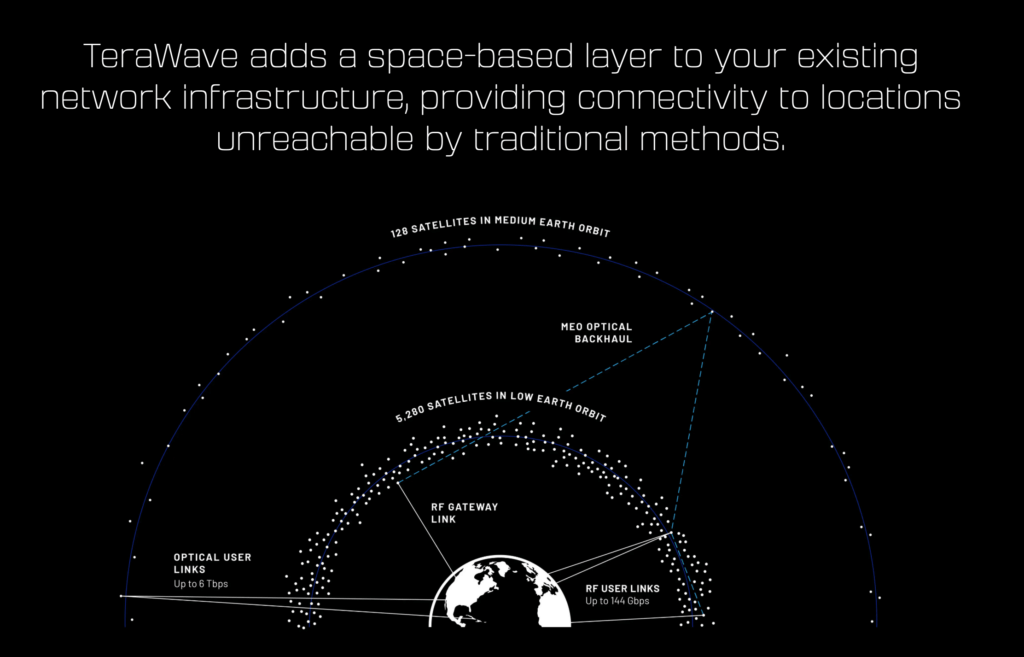
TeraWave uses a multi-orbit architecture combining low Earth orbit (LEO) and medium Earth orbit (MEO) satellites to balance capacity, latency, and global reach. The planned constellation includes 5,280 LEO satellites delivering RF-based user links and 128 MEO satellites providing high-capacity optical backhaul. According to Blue Origin, this design supports point-to-point connectivity as well as enterprise-grade internet access, while integrating with existing data center and carrier infrastructure to add route diversity and improve resilience.
Enterprise and gateway terminals are designed for rapid global deployment and support both RF and optical connectivity. Individual customers can access up to 144 Gbps via Q/V-band RF links from the LEO layer, while aggregate throughput of up to 6 Tbps becomes available through optical links connected to the MEO layer. Blue Origin plans to begin deploying the TeraWave constellation in Q4 2027.
- Symmetrical data rates of up to 6 Tbps via space-based optical backhaul
- Multi-orbit constellation with 5,280 LEO satellites and 128 MEO satellites
- Up to 144 Gbps per customer using Q/V-band RF user links
- Designed to integrate with existing fiber and data center infrastructure
- Supports point-to-point connectivity and enterprise-grade internet access
- Initial constellation deployment scheduled for Q4 2027
“TeraWave is purpose-built to meet the unmet needs of enterprise and government customers who require high throughput, symmetrical performance, and global reach, while integrating seamlessly with existing network infrastructure,” states the Blue Origin website.
🌐 Analysis
TeraWave positions Blue Origin as a direct entrant into the high-capacity satellite networking market, differentiating itself from consumer-focused LEO systems by emphasizing symmetrical throughput, optical backhaul, and enterprise-scale capacity. The inclusion of an MEO optical layer aligns with broader industry interest in hybrid-orbit architectures, as competitors explore optical inter-satellite links and higher-frequency RF bands to support data center interconnect, cloud expansion, and government workloads.
Blue Origin is a privately held aerospace company headquartered in Kent, Washington, founded in 2000 by Jeff Bezos, who currently serves as founder and Executive Chairman, providing long-term strategic oversight while not managing day-to-day operations. The company’s mission is to enable millions of people to live and work in space through reusable launch systems and space infrastructure. Blue Origin’s core technologies include reusable rockets and advanced propulsion, highlighted by the New Shepard system for suborbital research and human spaceflight, the heavy-lift New Glenn, and the methane-fueled BE-4, which is also used by United Launch Alliance’s Vulcan rocket. The company is led operationally by CEO Dave Limp, formerly head of Amazon Devices & Services, and operates major manufacturing and launch facilities across Washington, Florida, Alabama, and Texas. Key milestones include multiple crewed New Shepard flights, selection by NASA for lunar lander programs, and ongoing preparations for New Glenn’s initial orbital missions, underscoring Blue Origin’s ambition to become a foundational provider of commercial space infrastructure.
Amazon’s low Earth orbit broadband effort, dubbed Amazon Leo and previously known as Project Kuiper, positions Amazon as a global satellite connectivity provider tightly integrated with its cloud and logistics ecosystem, with the company emphasizing affordable user terminals, mass manufacturing, and deep linkage to AWS for edge compute, backhaul, and enterprise services. By contrast, Jeff Bezos appears to have deliberately placed TeraWave within Blue Origin rather than under an Amazon LEO umbrella to preserve strategic neutrality and long-term optionality: a Blue Origin–owned network can connect equally to AWS, Microsoft Azure, Google Cloud, and on-premises data centers without being perceived as a captive extension of Amazon’s cloud, which is critical for winning hyperscaler, carrier, and government customers that compete with AWS. Housing TeraWave inside Blue Origin also strengthens the company’s vertical integration story—linking launch, spacecraft, and space-based networking—and may enhance the case for a future Blue Origin IPO by creating a diversified, recurring-revenue services business alongside launch systems. In effect, while an Amazon LEO network would naturally optimize for AWS pull-through, a Blue Origin–branded TeraWave can position itself as cloud-agnostic, infrastructure-grade connectivity, turning neutrality itself into a competitive advantage in the global data center and enterprise networking market.
🌐 We’re tracking the latest developments in satellite and space-based networking infrastructure. Follow our ongoing coverage at: https://convergedigest.com/category/space