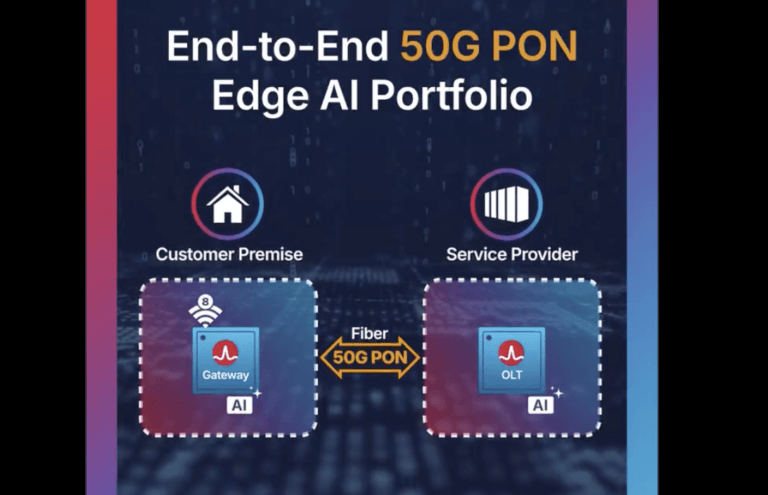
Broadcom introduced a new set of broadband silicon platforms that combine optimized 10G PON with Wi-Fi 8 to address cost-sensitive, high-volume residential deployments. The announcement centers on a new PON gateway SoC and integrated dual-band Wi-Fi 8 radios designed to help operators transition from legacy copper and cable networks to fiber-based, multi-gigabit services while maintaining tight cost controls.
The new BCM68565 gateway SoC integrates a 10-Gbps fiber WAN interface supporting XGS-PON, GPON, and Active Ethernet, alongside a high-performance CPU complex, dedicated network processing engine, and multi-gigabit Ethernet PHYs. Broadcom positions the chip for service providers deploying open middleware stacks such as RDK and prplWare, with support for DDR4/DDR5 memory and a dedicated security processor. The platform targets balanced system-level optimization across compute, memory, and networking to enable scalable fiber gateway deployments.
Complementing the gateway SoC, the BCM67142 and BCM67192 Wi-Fi 8 radios integrate 2.4 GHz and 5 GHz bands on a single die, reducing board footprint and bill of materials. The radios include hardware offload engines, integrated power amplifiers, and third-generation digital pre-distortion that lowers peak power by 25%. Broadcom said the combined architecture enables improved throughput, lower latency, and higher reliability, while reducing energy consumption and system cost for mass-market broadband rollouts.
- BCM68565 integrates 10 Gbps PON (XGS-PON, GPON, Active Ethernet) with CPU, NPU, and security processor
- Supports open software stacks including RDK and prplWare for operator flexibility
- Multi-memory support: DDR4, LPDDR4, DDR5, LPDDR5
- BCM67142 / BCM67192 integrate dual-band Wi-Fi 8 (2.4 GHz + 5 GHz) on single silicon
- Integrated power amplifiers and hardware offload reduce BOM and CPU load
- Digital pre-distortion cuts peak power by 25%
- Target: mass-market fiber gateways with multi-gig performance at lower cost
- Status: sampling to early access customers and partners
“With our latest Wi-Fi 8 and PON products, Broadcom is making ‘Ultra-High Reliability’ accessible in hyper-competitive broadband markets,” said Mark Gonikberg, senior vice president and general manager of Broadcom’s Wireless and Broadband Communications Division. “The highly-optimized, single-chip dual-band radios and a cost-optimized PON SoC catalyze the adoption of Wi-Fi 8 in high-volume markets, ensuring faster, more reliable and affordable wireless broadband for the global consumer.”
🌐 Analysis: Broadcom is extending its long-standing broadband silicon strategy by collapsing more functionality into tightly integrated gateway platforms, directly targeting operator margins in fiber rollouts. The combination of 10G PON and Wi-Fi 8 aligns with industry migration toward multi-gig access, where fiber backhaul and advanced Wi-Fi must scale together to support AI-driven applications, cloud gaming, and dense device environments.
| Category | Wi-Fi 6 / 6E (IEEE 802.11ax) | Wi-Fi 7 (IEEE 802.11be) | Wi-Fi 8 (pre-standard / IEEE 802.11bn) |
|---|---|---|---|
| Standards Status | Ratified | Final approval expected 2024–2025 | Under development (focus on reliability) |
| Primary Design Goal | Spectral efficiency and capacity | Higher throughput and lower latency | Consistent performance, reliability, and coordination |
| Peak Theoretical PHY Rate | Up to ~9.6 Gbps | Up to ~46 Gbps | Not a primary goal; expected to be similar to Wi-Fi 7 |
| Maximum Channel Width | 160 MHz | 320 MHz | 320 MHz (no increase expected) |
| Frequency Bands | 2.4 GHz, 5 GHz, 6 GHz (6E) | 2.4 GHz, 5 GHz, 6 GHz | 2.4 GHz, 5 GHz, 6 GHz with improved coordination |
| Modulation | 1024-QAM | 4096-QAM | 4096-QAM (no new modulation defined) |
| Multi-Link Operation (MLO) | Not supported | Core feature (simultaneous multi-band links) | Enhanced MLO reliability and coordination (in study) |
| Latency Characteristics | Lower than Wi-Fi 5 | Significantly reduced with MLO | More deterministic latency and reduced jitter |
| AP / Network Coordination | Limited (basic coordination) | Improved via MLO | Inter-AP coordination is a primary IEEE 802.11bn focus |
| Telemetry & Observability | Standard counters and statistics | More granular metrics | Vendor-specific hardware telemetry (not standardized) |
| AI / ML Role | External analytics and cloud optimization | AI-assisted radio optimization (implementation-specific) | AI-driven optimization encouraged but not defined by IEEE |
| Typical Deployment Focus | Enterprise, broadband gateways | High-performance residential, XR, gaming | Highly reliable, dense, and managed environments |