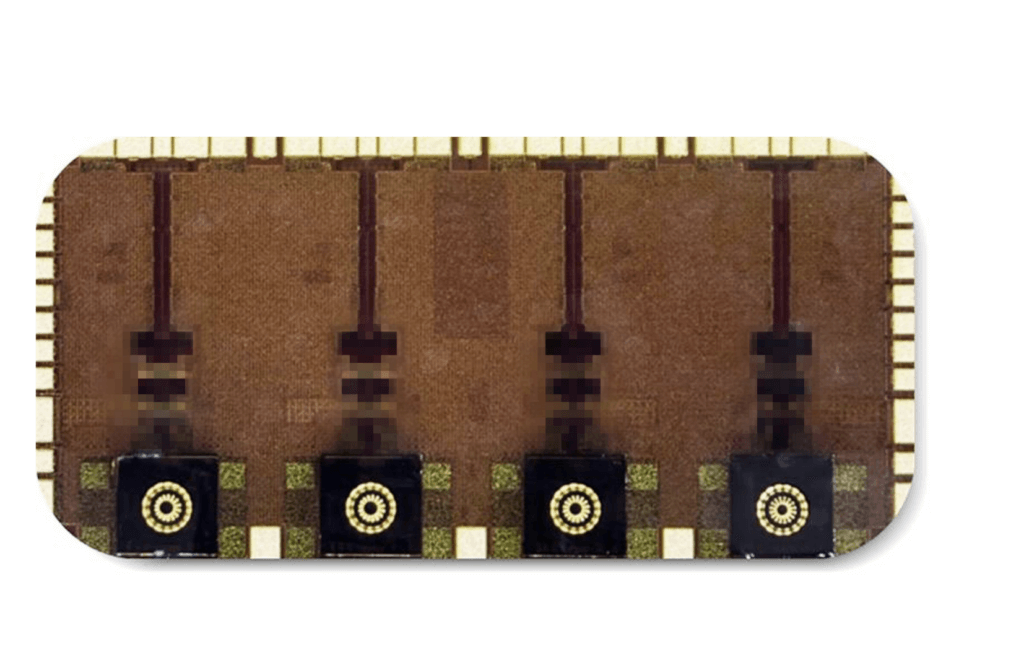
Coherent Corp. announced a 224Gbps quad-channel transimpedance amplifier (TIA) designed to support next-generation 800G and 1.6T optical transceivers used in AI and cloud infrastructure. The device targets high-speed optical interconnects deployed in hyperscale data centers where bursty traffic patterns and dynamic power-saving states place new performance demands on optical modules.
The new CHR1074 device integrates a fast-settling architecture that restores full link performance within 50 nanoseconds when transitioning from idle to active states. Conventional TIAs can introduce latency during these transitions, particularly in networks that rely on aggressive power-management schemes. Coherent said the new device maintains signal integrity while reducing noise and power consumption, enabling system designers to scale bandwidth while preserving energy efficiency in compact optical module form factors.
The quad-channel TIA is designed to support optical transceiver platforms operating at 224Gbps electrical signaling, a key building block for emerging 800G and 1.6T pluggable modules used in hyperscale AI clusters and cloud fabrics. Coherent plans to begin general availability of the CHR1074 at the end of the next quarter, with samples available now for customer evaluation.
• 224Gbps quad-channel transimpedance amplifier designed for next-generation optical transceivers
• Supports 800G and 1.6T optical modules used in hyperscale AI and cloud infrastructure
• Fast-settling architecture restores link performance in 50 nanoseconds after idle states
• Designed for burst-mode traffic and advanced power-management environments in data centers
• Samples available now, with general availability expected at the end of next quarter
• Demonstrations planned at OFC 2026 at Coherent Booth 1401
“AI-driven infrastructure is redefining performance and power requirements across the optical interconnect ecosystem,” said Beck Mason, Executive Vice President of Semiconductor Devices at Coherent. “With the CHR1074, Coherent strengthens its leadership in high-speed optical ASICs by delivering both breakthrough performance and system-level efficiency. Together with our silicon photonics driver portfolio, this solution positions Coherent as a strategic partner for customers building the next generation of 224Gbps transceivers.”
🌐 Analysis
The transition to 224Gbps electrical signaling marks a key milestone for the optical module ecosystem as hyperscale operators prepare for 800G and 1.6T pluggable optics in AI fabrics and large-scale GPU clusters. Components such as TIAs and drivers must support faster wake-up times and improved power efficiency as data center networks increasingly rely on burst-mode traffic patterns and dynamic link states.
Coherent has expanded its semiconductor device portfolio alongside its established optical components business, targeting the growing market for high-speed optical ASICs used in silicon photonics and pluggable modules. Competitors including Broadcom, Semtech, and MaxLinear are also developing 224G-class analog front-end components to support the next generation of AI-scale data center interconnects.