Deutsche Telekom reaches 20 million broadband lines at up to 250 Mbps
Deutsche Telekom is now serving 20 million residential and business broadband lines at up to 250 Mbps. Lines to over 1.5 million households and business locations have been added in the past 4 weeks alone. Some 75,000 street cabinets have been fitted with super vectoring technology.
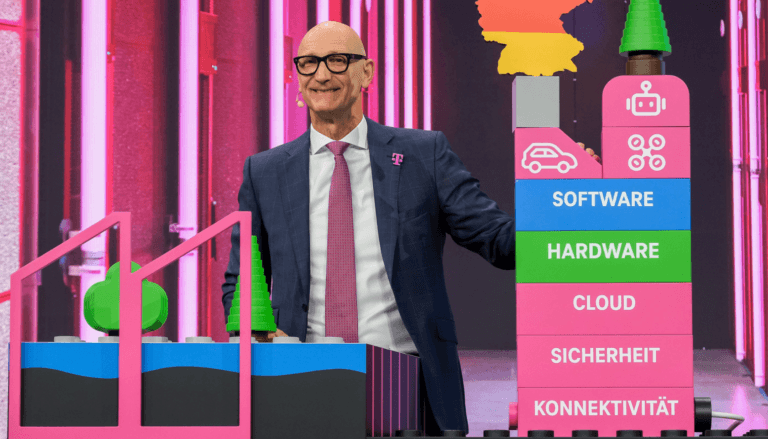
“20 million households and businesses are now able to #takepart and benefit from our super vectoring build-out,” says Timotheus Höttges, CEO of Deutsche Telekom. “To achieve that figure we have fitted at least one line card into over 75,000 street cabinets within 15 months. We’re building broadband for millions.”
Using other technologies, Deutsche Telekom has sped up lines of a further 105,000 households to up to 100 Mbps. The total number of households equipped to order a speed of 100 Mbps or faster has now reached 28 million.
Share this article
Help others discover this reporting.
Editorial responsibility
Staff
Editor & Publisher
Every article published by Converge Digest is researched, curated, fact-checked and editorially reviewed by Jim Carroll, Editor & Publisher. AI-assisted drafting may be used to accelerate production, but all content is reviewed, refined and approved prior to publication.
You just read about Deutsche Telekom. One of the companies whose work it now carries:
VoiceStream Wireless built National GSM mobile operator in the United States. What became of it?
VoiceStream Wireless brought National GSM mobile operator in the United States to Telecom. That work was distinctive enough to lead to its acquisition by Deutsche Telekom for US$35B. The standalone name now passes into the archive — but the team and technology continue inside Deutsche Telekom today. One of 430 names here whose work outlived the company.
You just read about All. A technology from the archive that helped get us here:
Google/Alphabet Project Loon served 2011–2021. What ultimately replaced it?
Google/Alphabet Project Loon solar-powered balloons drifting in the stratosphere (~20 km), steering by rising and falling into different wind layers, relaying LTE from ground stations to phones far below. Its job passed to Unit economics — but the problem it solved, and the ideas it proved, live on in what replaced it. The standard rests here in the archive. One of 198 technologies here that opened a door and then held it for the next.


 “20 million households and businesses are now able to #takepart and benefit from our super vectoring build-out,” says Timotheus Höttges, CEO of Deutsche Telekom. “To achieve that figure we have fitted at least one line card into over 75,000 street cabinets within 15 months. We’re building broadband for millions.”