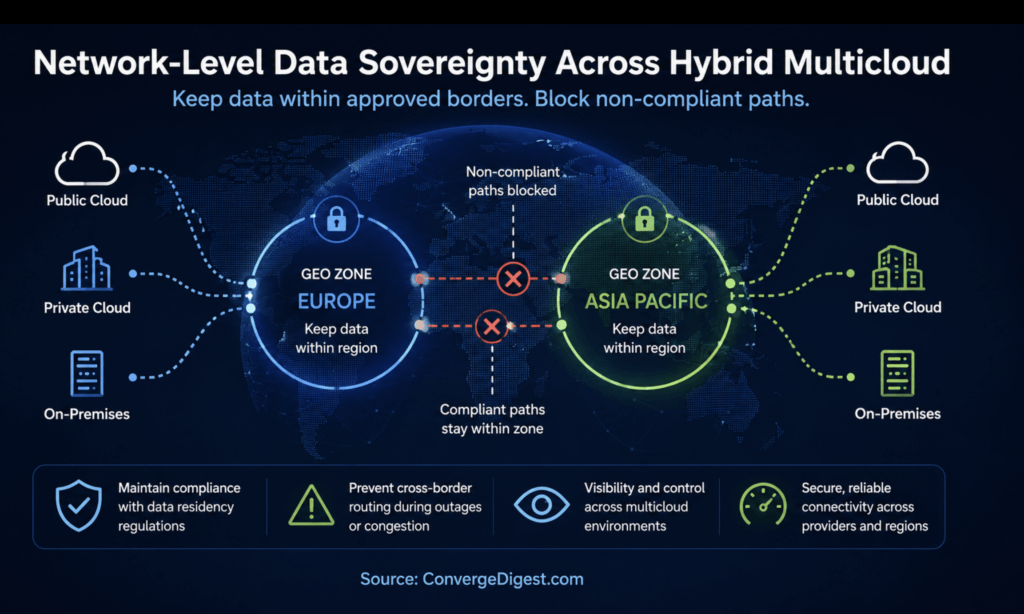
Equinix today expanded its Equinix Fabric Geo Zones service globally, positioning the platform as the first network-level multicloud sovereignty enforcement layer designed to keep enterprise data within legally mandated geographic boundaries across hybrid and multicloud environments. The announcement comes as enterprises face increasing regulatory scrutiny around data residency, sovereign AI deployments, and cross-border routing exposure driven by frameworks such as GDPR in Europe, LGPD in Brazil, and APRA in Australia. Equinix said the capability operates natively within the Equinix Fabric software-defined interconnection platform spanning 77 metro markets worldwide.
Unlike cloud-native sovereignty controls or software overlay approaches, Fabric Geo Zones enforces geographic restrictions directly at the network layer. Equinix said the service blocks traffic paths that violate jurisdictional requirements instead of relying on application-level routing preferences. The platform addresses situations where outages, failovers, congestion events, or automated rerouting inadvertently move sensitive enterprise traffic across borders, potentially triggering compliance violations. Equinix positioned the offering as particularly relevant for financial services, healthcare, government, and sovereign AI deployments that require deterministic control over network paths between multiple cloud providers and enterprise environments.
The rollout forms part of Equinix’s broader strategy to build infrastructure optimized for distributed AI and hybrid multicloud architectures. The company linked the announcement to its previously launched Fabric Intelligence and Distributed AI Hub initiatives, which target AI inference, data mobility, and interconnection orchestration across distributed infrastructure environments. Fabric Geo Zones entered preview availability immediately across Australia, Brazil, Canada, Japan, Switzerland, the U.K., and the U.S., with European Union availability scheduled for June 2026. Equinix said the service carries premium pricing and is bundled within its Unlimited Ports and Unlimited Ports Plus offerings.
| Profile: Equinix Fabric Geo Zones | Details |
|---|---|
| Primary Function | Network-level sovereign routing enforcement across hybrid multicloud environments |
| Underlying Platform | Equinix Fabric software-defined interconnection platform |
| Global Reach | 77 metro markets worldwide |
| Preview Availability | Australia, Brazil, Canada, Japan, Switzerland, U.K., U.S. |
| EU Availability | Scheduled for June 2026 |
| Key Use Cases | Sovereign AI, regulated financial transactions, healthcare data residency, government workloads |
| Core Differentiator | Enforces geographic boundaries directly within the network fabric instead of application or cloud software layers |
| Compliance Targets | GDPR, LGPD, APRA and regional sovereignty requirements |
| Business Model | Premium-tier service included with Unlimited Ports and Unlimited Ports Plus packages |
| Related AI Initiatives | Fabric Intelligence, Distributed AI Hub |
“Sovereignty can’t be a setting you configure inside a single cloud. Global enterprises must enforce sovereignty at the network layer, across every cloud, provider and path simultaneously,” said Arun Dev, Vice President of Digital Interconnection at Equinix. “Equinix Fabric Geo Zones is the only solution that enforces geographic boundaries as a property of the network itself. Traffic either flows along compliant paths or it’s blocked.”
🌐 Analysis: Equinix is moving beyond traditional colocation and interconnection services toward policy-aware infrastructure designed for sovereign AI and regulated multicloud computing. As AI inference becomes more distributed across regional facilities and edge environments, enterprises increasingly need deterministic control over where data flows, especially when workloads span multiple hyperscalers and jurisdictions. The announcement also reflects a broader industry shift where networking platforms are evolving into compliance and orchestration layers for AI-era infrastructure.
🌐 Competitively, the move positions Equinix against hyperscaler-native sovereignty offerings from companies such as Microsoft, Google Cloud, and Amazon Web Services, while differentiating through infrastructure neutrality and cross-cloud interconnection. Equinix appears to be leveraging its global metro footprint and dense carrier ecosystem to create policy-aware networking services that hyperscalers operating within single-cloud domains may find harder to replicate across heterogeneous environments.
🌐 We’re tracking the latest developments in AI infrastructure and data center networking. Follow our ongoing coverage at: https://convergedigest.com/category/data-center/