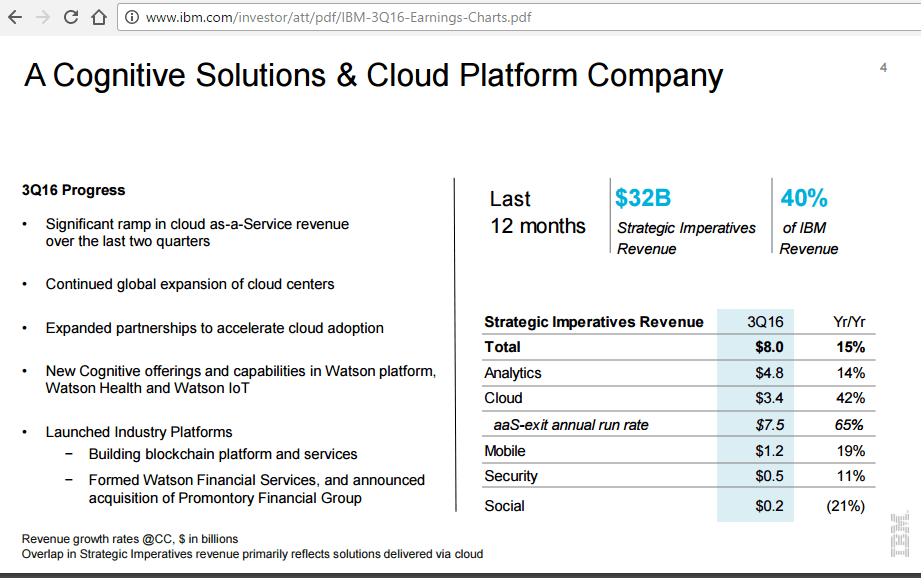
IBM reported Q3 revenue from continuing operations of $19.2 billion with diluted EPS (GAAP) of $2.98. Strategic imperatives revenue amounted to $8.0 billion in the quarter, up 16 percent year to year.
“IBM’s third-quarter performance, led by continued double-digit growth in our strategic imperatives, is a testament to our leadership in cognitive solutions and cloud,” said Ginni Rometty, IBM chairman, president and chief executive officer. “Our ability to apply deep expertise and breakthrough technology, led by Watson and the IBM Cloud, to massive amounts of data is enabling us to build new markets and transform industries.
Some highlights:
Cloud revenues (public, private and hybrid) for the quarter increased 44 percent (up 42 percent adjusting for currency).
Cloud revenue over the trailing 12 months was $12.7 billion.
The annual run rate for cloud as-a-Service revenue — a subset of total cloud revenue — increased to $7.5 billion from $4.5 billion in the third quarter of 2015.
Revenues from analytics increased 15 percent (up 14 percent adjusting for currency).
Revenues from mobile increased 19 percent and revenues from security increased 11 percent.
Every article published by Converge Digest is researched, curated, fact-checked and editorially reviewed by Jim Carroll, Editor & Publisher. AI-assisted drafting may be used to accelerate production, but all content is reviewed, refined and approved prior to publication.
You just read about IBM. One of the companies whose work it now carries:
Vallent built Service assurance and network-performance software for mobile and fixed communications providers. What became of it?
Vallent brought Service assurance and network-performance software for mobile and fixed communications providers to Telecom. That work was distinctive enough to lead to its acquisition by IBM. The standalone name now passes into the archive — but the team and technology continue inside IBM today. One of 430 names here whose work outlived the company.
You just read about All. A technology from the archive that helped get us here:
Google/Alphabet Project Loon served 2011–2021. What ultimately replaced it?
Google/Alphabet Project Loon solar-powered balloons drifting in the stratosphere (~20 km), steering by rising and falling into different wind layers, relaying LTE from ground stations to phones far below. Its job passed to Unit economics — but the problem it solved, and the ideas it proved, live on in what replaced it. The standard rests here in the archive. One of 198 technologies here that opened a door and then held it for the next.