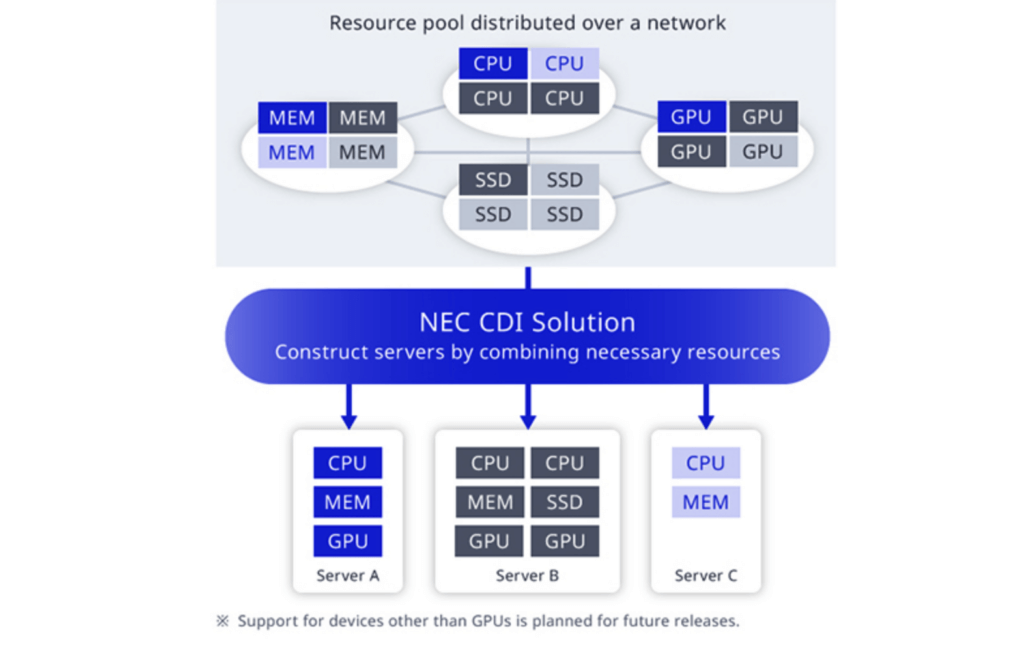
NEC Corporation announced the launch of its NEC Composable Disaggregated Infrastructure Solution in Japan, targeting data centers and research institutions that need more flexible and energy-efficient ways to deploy servers and GPUs. The solution enables distributed placement of computing resources across data center networks, addressing growing cost and scalability pressures driven by AI, generative AI, and data-intensive workloads.
NEC positions the platform as a response to over-provisioning challenges common in traditional data center designs, where systems are built for peak demand and left underutilized for much of their lifecycle. By separating CPUs, GPUs, and other components from fixed server enclosures, the solution allows resources to be dynamically allocated and reconfigured. NEC validated the approach through joint verification with Osaka University and deployments at the NEC Inzai Data Center, with technical results published on NEC’s website.
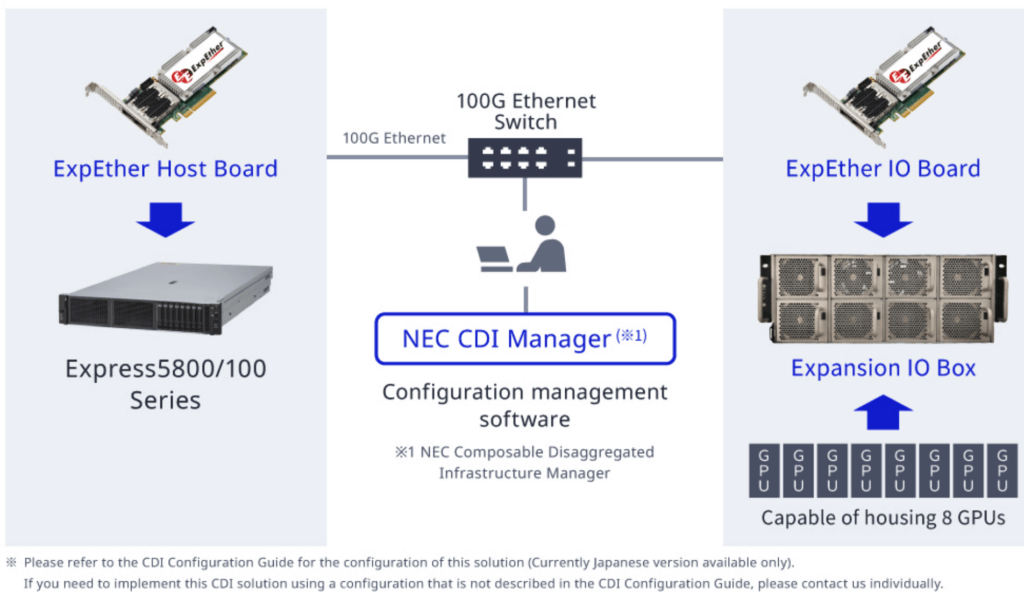
At the core of the solution is NEC’s proprietary ExpEther technology, designed for reliable, low-latency transmission of IT equipment signals over Ethernet. The architecture supports large-scale distribution of compute resources across floors or buildings based on available power and cooling, while enabling incremental, per-device upgrades to reduce upfront capital costs and extend system lifecycles.
- Uses ExpEther boards with a 100G ExpEther IP core supporting 100Gbps Ethernet optical connectivity
- Includes an expansion IO box capable of housing up to eight GPUs
- Managed by NEC Composable Disaggregated Infrastructure Manager for centralized resource orchestration
- Enables dynamic allocation of CPUs and GPUs to avoid idle capacity during off-peak periods
- Allows unused resources to be powered down to reduce energy consumption and operating costs
“By disaggregating computing resources and managing them flexibly over data center networks, we aim to improve utilization efficiency while reducing both capital and operational costs,” NEC stated in its announcement.
🌐 Analysis
NEC’s move aligns with broader industry interest in composable and disaggregated infrastructure as AI workloads strain traditional server architectures. Competitors across the data center ecosystem are also exploring CXL-based memory pooling, GPU disaggregation, and fabric-attached accelerators, but NEC’s approach emphasizes Ethernet-based transport and proprietary low-latency signaling. The initial Japan-only launch suggests NEC will refine deployments with domestic partners before pursuing broader adoption in global data center markets.