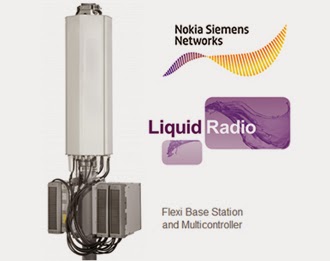
Nokia Solutions and Networks introduced a TD-LTE 8-pipe radio module for Band 41 spectrum at 2.6 GHz. The new base station component is the industry’s highest capacity 8-pipe radio module.
NSN said its new radio module is ready for the evolution of carrier aggregation and capable of supporting an unprecedented 120 MHz of bandwidth that can deliver more than 1.2 Gbps of total site throughput from a single unit. It supports three sectors in a single unit even for remote configurations, unlike conventional remote radio modules that run only one sector per module. It needs no air conditioning and can be pole-mounted or placed near the antenna tower base, substantially reducing installation and maintenance costs.

Countries adopting the 2.6 GHz LTE TDD spectrum include Brazil, China, India, Japan, Russia and the USA.
Sprint will be using the new 8-pipe radio module for its LTE TDD deployment in Band 41 spectrum range.
“For subscribers, quality means everything. With our high-capacity base stations, mobile subscribers will have the outstanding service experience they are looking for,” said Marc Rouanne, executive vice president, Mobile Broadband, at NSN. “We are introducing the industry’s most powerful TD-LTE 8-pipe radio module with support of 120 MHz bandwidth and 160 Watts transmission power. As the new NSN radio module is capable of supporting LTE-Advanced technology with the possibility to aggregate up to three carriers, three-fold peak cell data rates can be achieved compared to the performance of the currently deployed commercial networks. This enables the world’s leading operators to provide unrivalled data speeds to their customers and also showcases NSN’s global leadership in the LTE domain, as proven by the first deployments of carrier aggregation in South Korea last summer.”