NTT, together with six partners, KDDI Research, Sumitomo Electric Industries, Fujikura, Furukawa Electric, NEC and Chiba Institute of Technology (CIT), announced a demonstration of what is claimed as the highest transmission capacity of 118.5 Tbit/s using a multi-core fibre with four optical paths within the same diameter as currently used fibre.
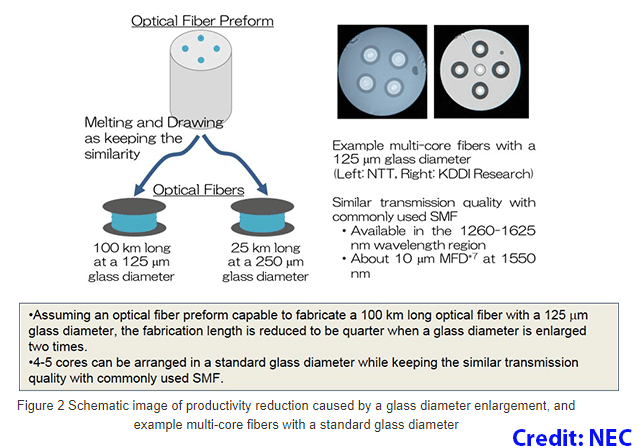
NTT noted that a conventional glass diameter of 125 µm in accordance with the international standard enables the use of existing fibre fabrication and optical connector technologies. The demonstration is designed to validate the concept of multi-core fibre-based long-haul and high capacity transmission system comprising multiple vendor technologies and advance the application of multi-core fibre technology.
 In the new fibre, 4-5 cores can be arranged within a 125 µm diameter while maintaining the same transmission quality as current optical fibre, with a 316 km multi-core transmission line realised with a 0.21 dB/km average loss, concatenating standard diameter multi-core fibre with 4 cores fabricated by multiple vendors.
As part of the new design, Sumitomo Electric, Fujikura and Furukawa each fabricated a multi-core fibre with 4 cores and more than 100 km length. All multi-core fibres can be used in the 1260 to 1625 nm wavelength region and provide similar transmission properties to current SMF with mode filed diameter at 1550 nm of 9-10 µm).
The fabricated multi-core fibres were divided into a 20-40 km sections and three transmission spans with a length of 104-107 km were re-constructed by splicing the multi-core fibres provided by different vendors. A satisfactory low loss comparable to conventional SMF was achieved, with average loss of four cores in each span 0.22 dB/km or less, including splicing losses.
In addition, three multi-core optical amplifiers fabricated by NEC, KDDI Research, NTT and Furukawa were inserted at each end of three spans to compensate the signal attenuation. Cladding pumping type multi-core optical amplifiers designed to reduce power consumption were used, enabling a 16% improvement in power usage.
To confirm the performance of the constructed multi-core transmission line to beyond 100 Tbit/s transmission, 16QAM-based 116-wavelength signals were prepared and the output signal quality over 316 km transmission was examined.
Additionally, Fan-In/Fan-Out devices developed by NTT and Furukawa were used to input/output signals to and from each core of the multi-core fibre. Pluggable optical connectors with existing MU-type or SC-type interfaces from CIT and NTT were used to connect the input/output end of the multi-core transmission lines and Fan-In/Fan-Out devices.
The work was partially based on work commissioned by the National Institute of Information and Communications Technology (NICT), and the companies stated that they aim to introduce the standard diameter multi-core fibre by the early 2020s. The achievement was reported in early August as a post deadline paper at the Opto Electronics and Communications Conference (OECC 2017) in Singapore.