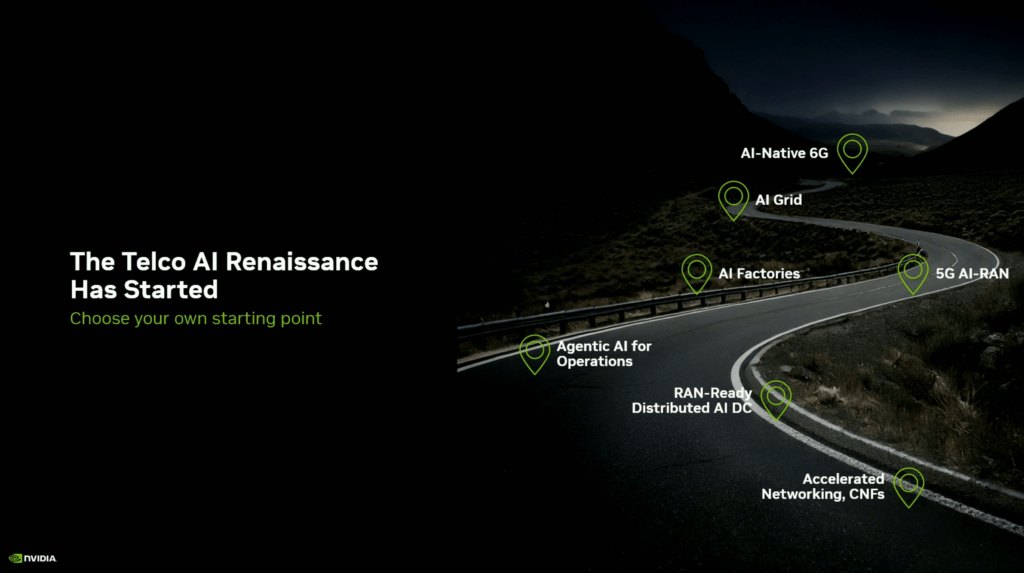
At GTC 2025 in San Jose, Ronnie Vasishta, SVP of Telecommunications at NVIDIA, outlined the company’s vision for a sweeping transformation of the telecom industry—one powered by AI-driven infrastructure and agent-based automation. In a presentation that blended technical insights with real-world case studies, Vasishta framed this moment as a pivotal turning point, calling it the beginning of a “Telco AI Renaissance.”
NVIDIA’s journey into telecom AI has accelerated rapidly. Vasishta revealed that 90% of the world’s top 50 telcos are already deploying AI tools to modernize operations, improve customer experiences, and unlock new revenue streams. NVIDIA is partnering with more than 150 global telcos, pushing AI beyond just service optimization and into the heart of next-generation network architectures like AI-RAN and AI Factories.
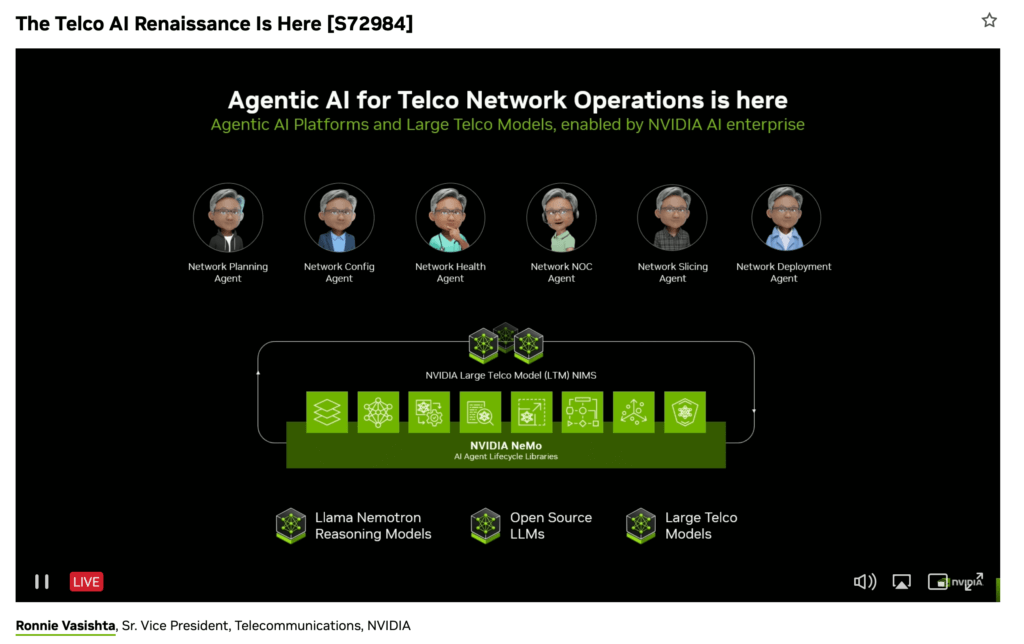
One of the key highlights of the presentation was the application of agentic AI—AI systems capable of autonomous decision-making and collaboration within telecom environments. Vasishta showcased how partners like SoftBank and Indosat Ooredoo Hutchison are already leveraging NVIDIA’s NeMo framework and inference microservices (NIMs) to automate complex network management tasks that traditionally took days, now completed in minutes.
NVIDIA is also enabling telcos to become regional AI infrastructure leaders. Through the NVIDIA Cloud Partner Program (NCP), telcos like TELUS, Telenor, and IOH are standing up sovereign AI Factories that power workloads in healthcare, research, and enterprise applications—all while keeping data within national borders. At the infrastructure level, Vasishta emphasized the convergence of AI and RAN, detailing how AI-RAN architectures—running on NVIDIA’s Aerial platform—will fundamentally improve spectral efficiency, reduce costs, and prepare telcos for AI-native 6G networks.
Key Points from Ronnie Vashishta’s GTC 2025 Presentation:
• AI Transformation: 90% of top 50 telcos are already on their AI journey with NVIDIA.
• Agentic AI: AI agents are solving operational and customer experience challenges autonomously.
• SoftBank & IOH Use Cases: Real-world deployments reducing network management tasks from days to minutes.
• AI Factories: 15+ telcos are building NVIDIA-powered AI Factories as sovereign, regional AI infrastructure.
• TELUS Partnership: TELUS became the first North American telco to join the NVIDIA Cloud Partner Program.
• AI Grid Vision: Distributed AI infrastructure will scale across millions of locations for edge inference and low-latency AI services.
• AI-RAN Architecture: NVIDIA is leading efforts to unify AI and RAN on GPU-accelerated platforms to boost efficiency and ROI.
• 6G Collaboration: NVIDIA is working with global telecom leaders to shape AI-native 6G blueprints.
• Developer Ecosystem: NVIDIA’s 6G Developer Program has surpassed 2,000 members, providing tools for AI-powered network research.
• New Tools Announced:
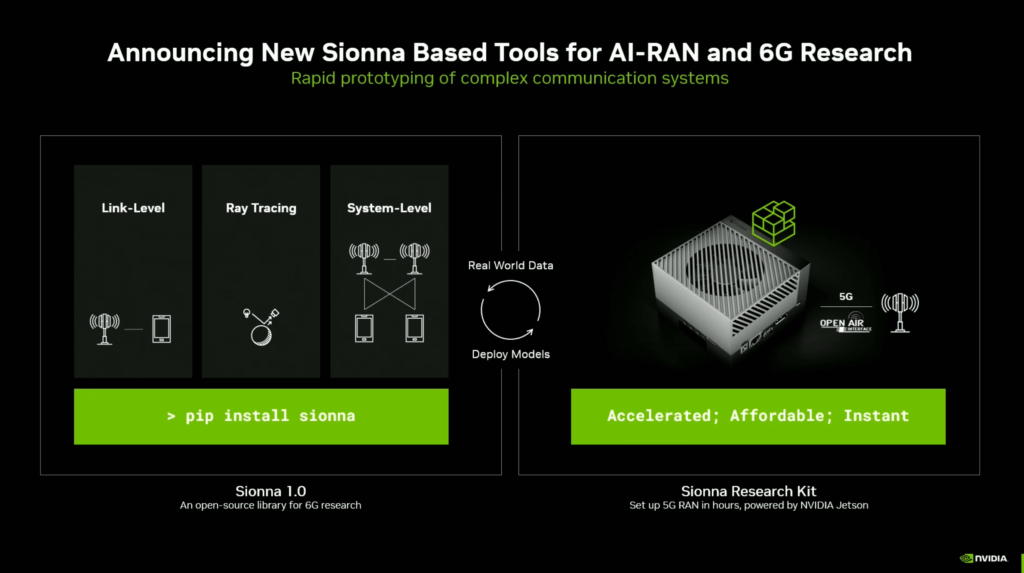
• Sionna 1.0: A differentiable link-level simulator with accelerated ray tracing (150k+ downloads).
• Sionna Research Kit: A hardware platform using NVIDIA Jetson GPUs for AI-based telecom research.
• Aerial Omniverse Digital Twin: Now available via DGX Cloud and public cloud platforms for RAN simulation and optimization.
Understanding NVIDIA’s Sionna Architecture
Sionna is an open-source, AI-driven framework specifically designed to accelerate research and development of wireless communications and next-generation RAN architectures (e.g., AI-RAN, 6G). It provides telecom engineers and researchers with a powerful suite of tools for simulating, training, and deploying AI models within wireless systems.
Major Components of Sionna:
1. Sionna Link-Level Simulator (Sionna 1.0):
• A differentiable simulator for physical-layer (Layer 1) wireless systems.
• Built for training and evaluating neural networks within communications systems (e.g., channel estimation, equalization, and modulation).
• Features accelerated ray tracing and EM solvers for realistic RF propagation modeling.
• Supports integration with PyTorch and TensorFlow for AI training workflows.
2. Sionna Research Kit:
• A hardware development platform based on NVIDIA’s Jetson GPU series.
• Enables real-time testing of AI-powered wireless algorithms developed in Sionna 1.0.
• Acts as a bridge between simulated environments and physical-layer prototyping.
3. AI-Native Design:
• Supports differentiable programming for optimizing AI-driven baseband processing and signal chain components.
• Facilitates development of neural network models that operate within wireless protocols and physical channels.
4. Integration with Aerial Omniverse Digital Twin:
• Sionna is integrated with NVIDIA’s Aerial Omniverse Digital Twin platform, allowing users to simulate RAN deployments in photorealistic, physics-accurate 3D environments.
• Supports full-stack simulations from UE mobility patterns to beamforming and multi-user MIMO scenarios.
Sionna enables a full AI-infused workflow from training → simulation → deployment, helping telecom researchers optimize performance, spectral efficiency, and network resilience in real and virtualized environments.