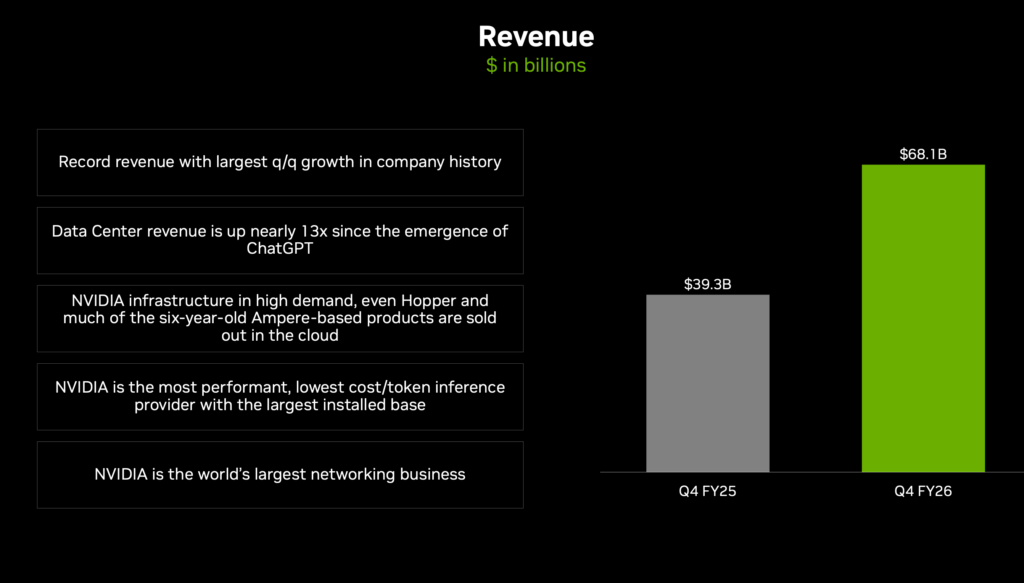
AI infrastructure spending accelerated again as NVIDIA posted record results and laid out a roadmap centered on inference economics, next-generation platforms, and “AI factory” buildouts. The company reported Q4 fiscal 2026 revenue of $68.1 billion (ended January 25, 2026), up 20% sequentially and 73% year over year, with Data Center revenue at $62.3 billion, up 22% sequentially and 75% year over year. For the full fiscal year, revenue reached $215.9 billion (up 65%), driven primarily by Data Center revenue of $193.7 billion (up 68%), underscoring that large-scale training and inference clusters remain the dominant growth engine for the broader AI stack.
NVIDIA used the earnings release to frame the next leg of demand around agentic AI and inference at scale, positioning the Vera Rubin platform as a step-change in cost-per-token and throughput targets for cloud and enterprise deployments. The company said the Rubin platform comprises six new chips and targets up to a 10x reduction in inference token cost versus Blackwell, while also highlighting “Blackwell Ultra” performance and cost claims relative to Hopper. Alongside GPUs, NVIDIA continues to push an end-to-end “factory” architecture that couples accelerated compute with networking, data processing (DPUs), and storage primitives—calling out BlueField-4 powering an “Inference Context Memory Storage Platform” as a way to move more context and data closer to inference execution as model sizes and context windows expand.
Forward guidance also reinforces a critical macro trend: AI demand remains strong enough that NVIDIA is now explicitly modeling around geopolitical constraints. For Q1 fiscal 2027, NVIDIA guided revenue to $78.0 billion ±2% and stated it assumes no Data Center compute revenue from China in that outlook. On profitability and operating leverage, Q4 GAAP gross margin rose to 75.0% (non-GAAP 75.2%) and GAAP operating income reached $44.3 billion on GAAP operating expenses of $6.8 billion. NVIDIA also signaled a reporting change beginning Q1 fiscal 2027: it will include stock-based compensation in non-GAAP measures, with Q1 fiscal 2027 non-GAAP operating expenses expected at about $7.5 billion including $1.9 billion of stock-based compensation expense.
• Q4 FY26 revenue: $68.127B (Q/Q +20%, Y/Y +73%)
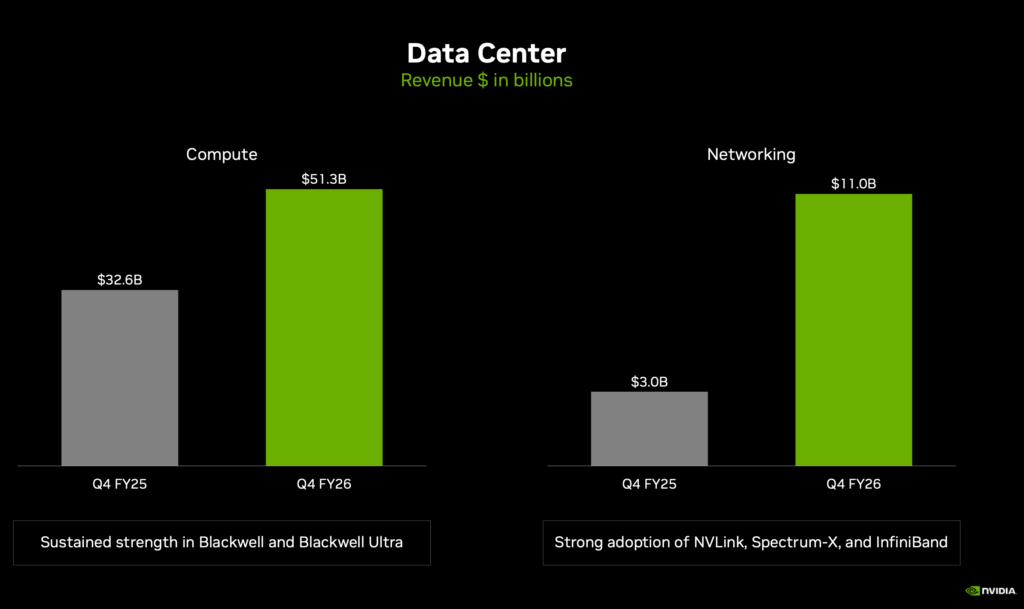
• Q4 FY26 Data Center revenue: $62.3B (Q/Q +22%, Y/Y +75%)
• FY26 revenue: $215.938B (Y/Y +65%)
• FY26 Data Center revenue: $193.7B (Y/Y +68%)
• Q4 GAAP gross margin: 75.0% (Q3: 73.4%); Q4 non-GAAP gross margin: 75.2%
• Q4 GAAP operating income: $44.299B; Q4 GAAP net income: $42.960B
• Q4 diluted EPS: GAAP $1.76; non-GAAP $1.62
• FY26 GAAP operating cash flow: $102.718B; FY26 free cash flow: $96.575B
• FY26 shareholder returns: $41.1B (buybacks + dividends); remaining repurchase authorization: $58.5B
• Balance sheet signals scale-out demand: accounts receivable $38.466B, inventories $21.403B, property & equipment $10.383B (as of Jan. 25, 2026)
• Q1 FY27 outlook: revenue $78.0B ±2%; assumes no China Data Center compute revenue
• Q1 FY27 outlook: GAAP gross margin 74.9%, non-GAAP 75.0%; GAAP opex ~$7.7B, non-GAAP opex ~$7.5B
• Non-GAAP methodology change: starting Q1 FY27, stock-based compensation will be included in non-GAAP measures
“Computing demand is growing exponentially — the agentic AI inflection point has arrived. Grace Blackwell with NVLink is the king of inference today — delivering an order-of-magnitude lower cost per token — and Vera Rubin will extend that leadership even further,” said Jensen Huang, founder and CEO of NVIDIA.
Addendum — Earnings call takeaways
- Data Center growth expanded beyond hyperscalers: management emphasized a “diverse and expanding” set of buyers including AI model makers, enterprises, and sovereign customers, with non-top-5 demand described as a growing contributor alongside the top five cloud providers that still represent ~50% of Data Center revenue.
- Networking emerged as a first-order AI infrastructure driver: the company cited quarterly Networking revenue of $11B (up more than 3.5x Y/Y) and full-year Networking revenue above $31B, framing Spectrum-X Ethernet and NVLink fabrics as core to unifying distributed sites into “gigascale AI factories.”
- Blackwell deployment scale: Kress said nearly 9 gigawatts of Blackwell infrastructure is already deployed and consumed, and that Hopper and even older Ampere products remain sold out in the cloud—an indicator that capacity, not just performance, continues to gate AI buildouts.
- Demand visibility extended into 2027: NVIDIA pointed to inventory and supply commitments (and rising purchase commitments) that extend into calendar 2027, which management framed as longer-than-usual visibility driven by sustained customer urgency to stand up compute.
- “Compute equals revenues” became the organizing thesis: Huang repeatedly tied customer CapEx to token generation and monetization, arguing that inference capacity directly drives revenue growth for frontier model makers and cloud platforms.
- Platform cadence: management committed to delivering a full AI infrastructure “every single year,” explicitly positioning innovation velocity (annual platform refreshes and system-level codesign) as the mechanism to sustain performance-per-watt advantages and preserve gross margin structure over time.
- Rubin program specifics from the call: NVIDIA described Rubin as a six-chip platform (Vera CPU, Rubin GPU, NVLink 6, ConnectX-9, BlueField-4, Spectrum-6), said first Vera Rubin samples shipped “earlier this week,” and reiterated production shipments targeted for the second half of the year; it also emphasized modular, cable-free trays to improve resiliency/serviceability versus prior generations.
- Sovereign AI scaled into a meaningful segment: Kress said Sovereign AI more than tripled Y/Y to over $30B in FY26, with named activity across Canada, France, the Netherlands, Singapore, and the UK; management also stated it expects sovereign demand to grow at least in line with AI infrastructure spend proportional to GDP over the long run.
- Frontier model-maker commitments and ecosystem investments: management highlighted deepening engagement with OpenAI (including comments around GPT-5.3 Codex running on Grace Blackwell / NVLink 72) and announced a $10B investment in Anthropic, positioning both as capacity-hungry agentic AI drivers that reinforce NVIDIA’s “full-stack” strategy across training, inference, and scale-out.
- China remained a structural uncertainty: NVIDIA said it has approvals for small amounts of H200 for China-based customers but “has yet to generate any revenue,” and warned that local China competitors—bolstered by recent IPOs—could disrupt global AI industry structure over time; it reiterated ongoing government engagement as it navigates export controls and market access.
- Physical AI as the next demand wave: management asserted “physical AI is here,” citing more than $6B in FY26 revenue tied to physical AI and projecting exponential robotaxi ride growth and a trajectory from thousands of vehicles to millions over the next decade—implying sustained multi-domain compute demand beyond data centers.
- Gross margin driver (Kress): she argued the “single most important lever” is delivering generational performance leads (performance per watt and performance per dollar) that exceed Moore’s Law, linking margin durability to maintaining a clear architecture advantage rather than solely to pricing or cost controls.
🌐 Analysis: NVIDIA is increasingly steering the AI infrastructure conversation toward inference efficiency—cost per token, context handling, and system-level throughput—because agentic workloads can multiply inference volume far faster than training alone. The company’s explicit “no China Data Center compute revenue” assumption for Q1 FY27 highlights how demand planning and supply allocation now sit alongside platform cadence (Blackwell to Rubin) as the key variables shaping near-term cluster buildouts.
🌐 We’re tracking the latest developments in networking silicon. Follow our ongoing coverage at: https://convergedigest.com/category/semiconductors/