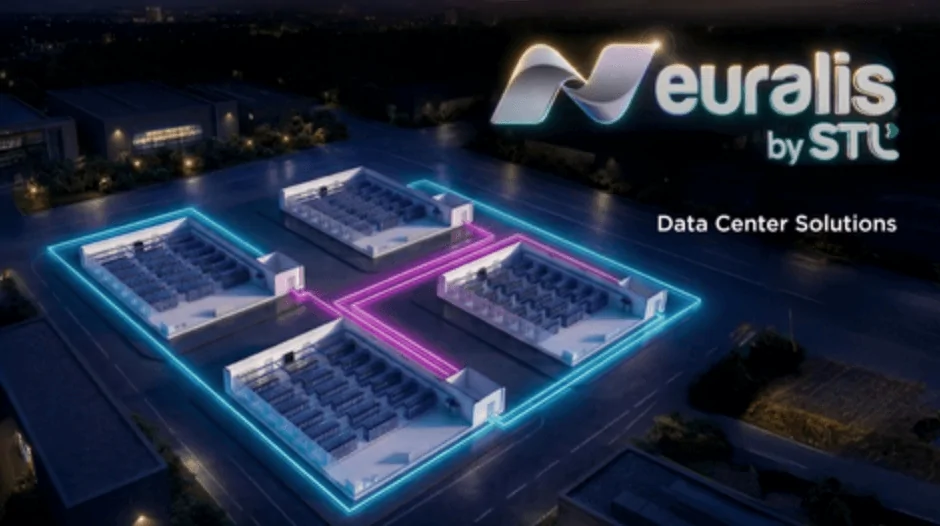
STL Optical Connectivity, the U.S. subsidiary of Sterlite Technologies Ltd., introduced its Neuralis data center connectivity portfolio at Data Center World 2026 in Washington, D.C., positioning the platform for AI-driven infrastructure deployments across North America. The offering targets hyperscale, neocloud, and enterprise operators facing rapid growth in AI workloads and corresponding demands on high-density fiber infrastructure.
Neuralis addresses the shift toward East-West traffic patterns in AI clusters, where GPU-to-GPU communication and distributed training workloads require dense, low-latency interconnects. STL structured the portfolio around two core areas: high-density cabling for maximizing rack-level fiber capacity and data center interconnect (DCI) solutions for campus and metro-scale connectivity. The system incorporates factory-terminated assemblies designed to reduce on-site complexity and accelerate deployment timelines.
A key component of the portfolio includes the Celesta IBR cable series, supporting up to 6,912 rollable ribbon fibers in a compact form factor. STL emphasized its vertically integrated manufacturing model—spanning preform, fiber draw, cabling, and connectorization—to deliver pre-tested, plug-and-play solutions tailored for AI infrastructure environments. Production capabilities in Lugoff, South Carolina support U.S.-based supply and deployment requirements.
• Introduced Neuralis suite for AI data center connectivity in the U.S.
• Focus on high-density MMC and MPO cabling for GPU cluster environments
• Celesta IBR cables support up to 6,912 fibers in compact designs
• Designed for East-West traffic patterns in AI training and inference workloads
• Factory-terminated assemblies aim to reduce deployment time and labor risk
• Vertical integration spans preform, fiber, cabling, and connectorization
• U.S. manufacturing presence in South Carolina supports regional deployments
“AI demands a level of precision and density that traditional cabling simply cannot meet. With STL Neuralis, we are providing the high-speed, low-latency foundation that allows GPU clusters to perform at their peak, moving complexity out of the field and into a controlled, high-precision factory environment,” said Ankit Agarwal, Managing Director, STL.
🌐 Analysis: STL’s Neuralis launch reflects broader industry alignment around ultra-high-density fiber systems to support AI cluster scaling, particularly as hyperscalers push toward larger GPU fabrics and disaggregated architectures. Competitors across the optical connectivity ecosystem—including CommScope, Corning, and Prysmian—are similarly emphasizing factory-terminated, high-fiber-count solutions to address deployment speed and labor constraints in AI data centers. STL’s vertical integration strategy could provide tighter control over cost and supply chain resilience as demand accelerates.