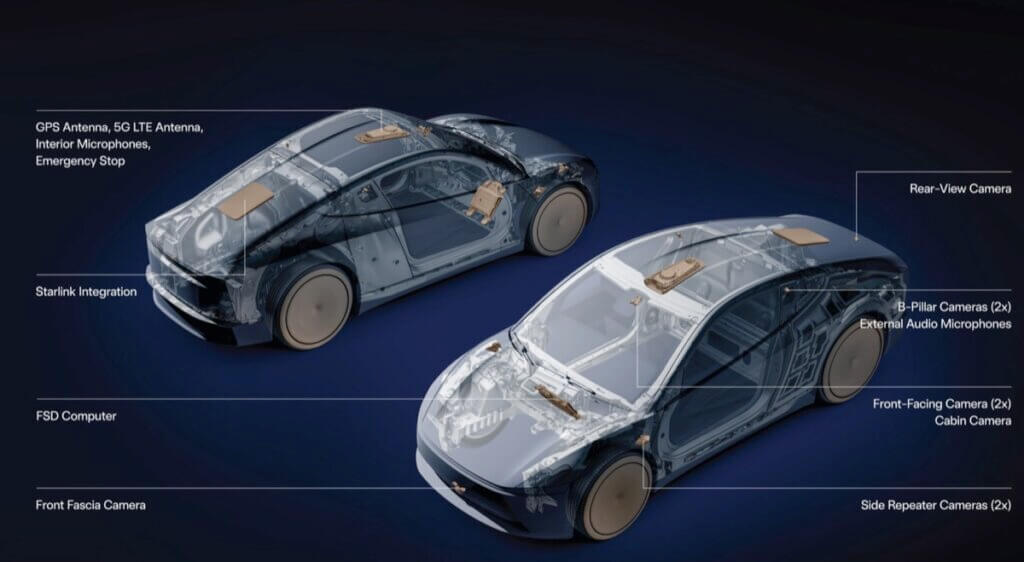
Tesla revealed that its upcoming Cybercab robotaxi will feature direct integration of SpaceX’s Starlink V5 satellite terminal, marking the first known Tesla vehicle with factory-integrated satellite broadband. The announcement came in a brief post on X from Tesla stating simply, “Starlink V5 directly integrated in Cybercab,” accompanied by an illustration showing the satellite terminal integrated alongside the vehicle’s GPS and 5G LTE antennas. The company provided no additional technical details, pricing, or deployment timeline.
The Cybercab architecture appears to combine multiple communications paths, including 5G LTE, GPS, and Starlink, giving the autonomous vehicle redundant connectivity options. While Tesla’s Full Self-Driving system performs inference locally on the vehicle, persistent network connectivity remains important for fleet management, software updates, diagnostics, mapping, telemetry, passenger services, and remote operations. Satellite connectivity could also improve coverage in rural areas or locations where terrestrial cellular service is unavailable.
Today’s announcement represents another step in the increasing convergence of terrestrial wireless and low Earth orbit (LEO) satellite communications. Tesla has relied primarily on cellular networks for connected vehicle services since introducing over-the-air software updates, while SpaceX has rapidly expanded Starlink into consumer broadband, aviation, maritime, enterprise, and direct-to-device applications. Integrating Starlink directly into Cybercab extends that ecosystem into autonomous transportation and provides another example of vertically integrated communications infrastructure across Elon Musk’s companies.
• Tesla announced the feature via an X post stating, “Starlink V5 directly integrated in Cybercab.”
• The vehicle diagram shows Starlink integration alongside GPS antennas and a 5G LTE antenna.
• Tesla disclosed no technical specifications, service plans, or activation timeline.
• Cybercab continues to include terrestrial cellular connectivity in addition to satellite communications.
• The announcement represents the first confirmed factory-integrated Starlink terminal in a Tesla vehicle.
“Starlink V5 directly integrated in Cybercab.” — Tesla on X (July 20, 2026).
🌐 Analysis
Tesla’s announcement does not indicate that Starlink replaces conventional cellular connectivity. Instead, Cybercab appears to implement a multi-network architecture that combines terrestrial 5G/LTE with satellite broadband, improving availability for autonomous fleet operations. As autonomous vehicles become more dependent on continuous software updates, fleet telemetry, HD map synchronization, passenger services, and remote assistance, hybrid terrestrial-satellite networking offers greater resilience than relying solely on mobile operators.
The announcement also highlights the growing intersection of automotive connectivity, satellite communications, and cloud infrastructure. Similar hybrid networking approaches are emerging across aviation, maritime, industrial IoT, and remote enterprise deployments, where LEO satellite systems increasingly complement—not replace—traditional cellular and fiber networks.