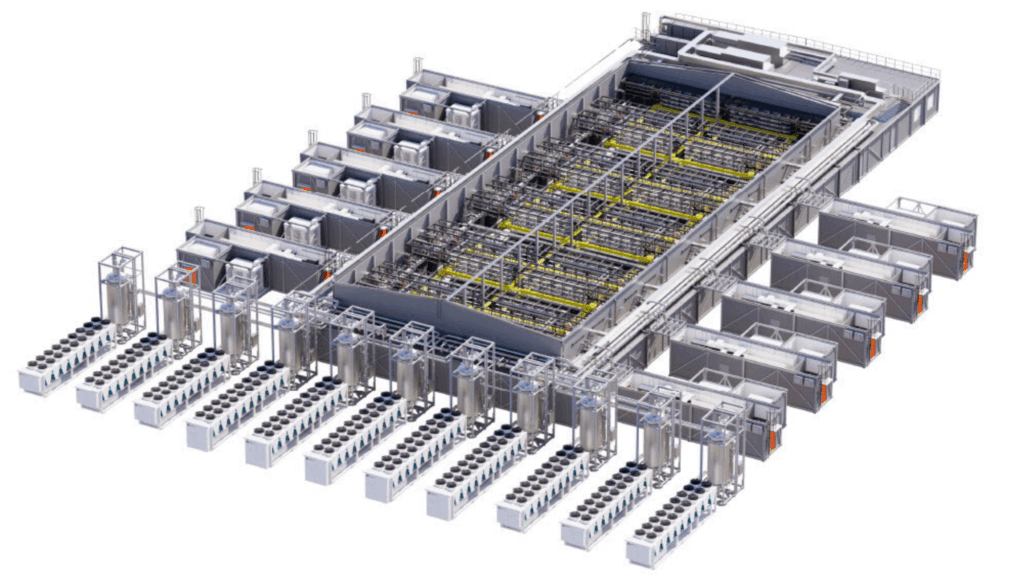
Vertiv announced a $50 million investment to expand its manufacturing operations in Ohio, targeting increased production of liquid cooling and chilled water systems for AI and high-density data centers. The expansion includes its facility in Ironton, Ohio, and enhancements to its headquarters campus in Westerville, with the initiative expected to create hundreds of jobs through 2029.
The Ironton facility upgrade, scheduled to become operational in Q2 2027, will increase production capacity for thermal management systems by approximately 45%. These systems are designed to support high-performance computing environments, including large-scale GPU clusters and AI model training infrastructure, where rising rack densities are driving demand for advanced cooling architectures beyond traditional air-based methods.
Vertiv stated that the investment will also expand engineering, logistics, service, and sales capabilities to better align with customer requirements for rapid deployment and scaling of AI infrastructure. The company’s Ohio footprint currently includes 14 facilities spanning manufacturing, R&D, testing, and training, reflecting its long-standing presence in precision cooling technologies dating back to the Liebert Corporation.
- $50 million investment across Ironton manufacturing and Westerville headquarters
- ~45% increase in production capacity for liquid cooling and chilled water systems
- Ironton expansion expected online in Q2 2027
- Focus on thermal management for GPU-intensive AI workloads and high-density computing
- Hundreds of new jobs anticipated through 2029
- Expanded capabilities across engineering, logistics, sales, and service operations
“Ohio operations remain integral to Vertiv’s strategy,” said Giordano (Gio) Albertazzi, CEO of Vertiv. “This investment expands our manufacturing capacity and strengthens the engineering, sales, service, and logistics capabilities that support customers building the next generation of digital infrastructure.”
🌐 Analysis: Vertiv’s investment aligns with a broader industry shift toward liquid cooling as AI workloads push rack power densities well beyond the limits of traditional air cooling. Competitors such as Schneider Electric, Eaton, and Johnson Controls are also expanding thermal management portfolios, while hyperscalers increasingly adopt direct-to-chip and immersion cooling for next-generation AI clusters. Vertiv’s focus on domestic manufacturing capacity may also reflect growing demand for supply chain resilience and regional sourcing in U.S.-based data center builds.