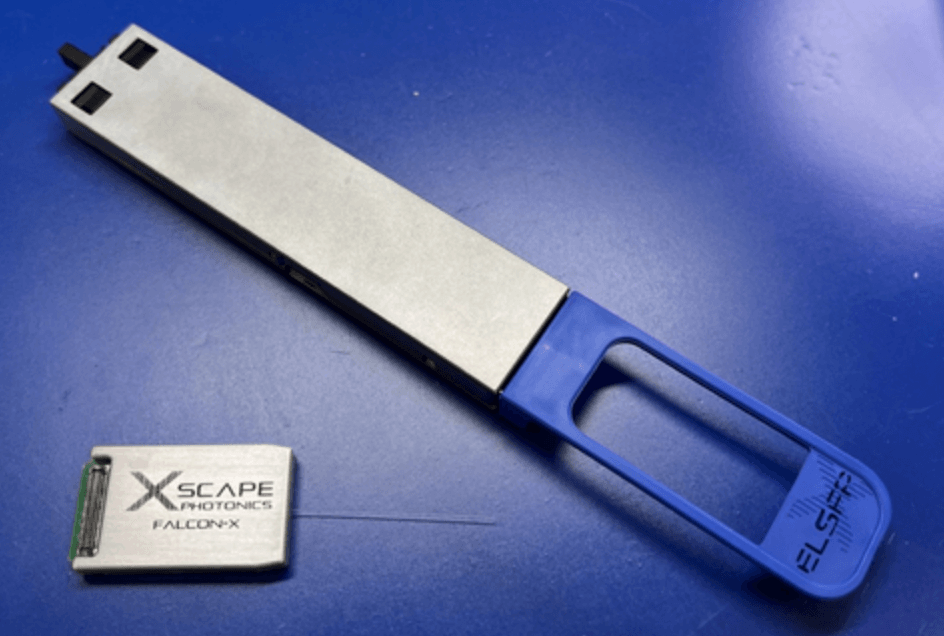
Xscape Photonics, a start-up based in Santa Clara, California, announced $37 million in new funding and launched FalconX, which it describes as the industry’s first fully redundant External Laser Small Form-factor Pluggable device capable of generating up to eight wavelengths of light for AI data center networks.
The company said FalconX is designed to address bandwidth bottlenecks emerging in large AI clusters where thousands of GPUs must exchange data continuously during distributed training workloads. The device functions as a pluggable comb-laser module capable of generating eight optical wavelengths on a single silicon photonics chip, enabling high-speed optical transmission between accelerators and memory systems.
Xscape said FalconX is designed for scale-up and scale-out fabric links used in modern AI infrastructure. The module is built to comply with industry MSA standards so it can be integrated into existing hyperscale infrastructure environments. The company also said FalconX is the first commercial product built on its ChromX programmable multi-wavelength photonics platform.
Key Points
• Xscape Photonics raised $37 million in new funding
• The company launched FalconX, an eight-wavelength comb-laser module
• FalconX is designed for scale-up and scale-out AI data center fabrics
• Device supports multi-wavelength optical signaling for high-bandwidth interconnects
• The technology is based on Xscape’s ChromX programmable photonics platform
• Company roadmap targets photonic systems supporting more than 128 wavelengths
“Rapidly increasing bandwidth, power and cost demands of AI workloads have created a critical hardware bottleneck, forcing developers to use just a fraction of their GPUs’ capacity, thereby limiting the revolutionary potential of AI itself,” said Vivek Raghunathan, CEO and co-founder of Xscape Photonics. “FalconX is the industry’s first comb-laser module in a pluggable form factor capable of generating eight wavelengths of light, enabling high-speed data movement and allowing the entire data center to function as one giant GPU.”
🌐 Analysis
Xscape Photonics is focused on a specific technical challenge emerging in large AI clusters: the bandwidth required to move data between accelerators during distributed training. The company’s approach centers on optical frequency comb technology integrated into a silicon photonics platform. A comb laser generates multiple precisely spaced wavelengths from a single optical source. Each wavelength can carry an independent data stream, allowing multiple high-speed channels to be transmitted simultaneously through a single optical fiber.
FalconX represents an attempt to bring this technology into practical data center deployment by packaging the comb-laser system into a pluggable optical module. This approach allows hyperscalers and infrastructure operators to deploy multi-wavelength optical links without redesigning entire networking systems.
The company was founded in 2022 by CEO Vivek Raghunathan together with photonics researchers Alexander Gaeta and Yoshi Okawachi. Raghunathan previously worked at Broadcom, Rockley Photonics, and Intel, where he helped commercialize silicon-photonics-based transceivers. Gaeta is a well-known researcher in nonlinear photonics and quantum optics, while Okawachi has led research in optical frequency comb technologies.