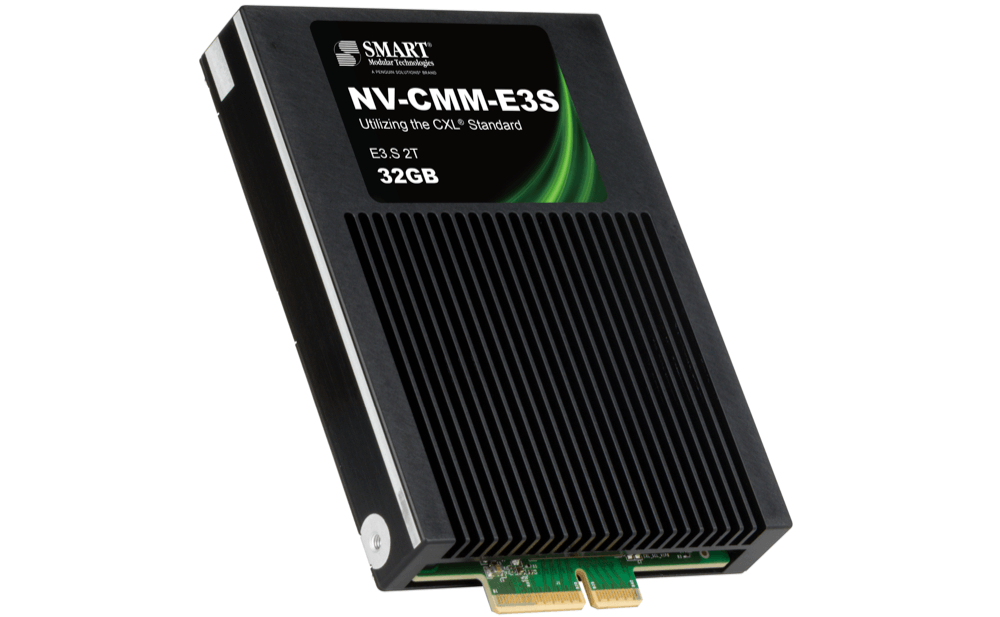
Penguin Solutions announced that its SMART Modular CXL NV-CMM E3.S 2T non-volatile memory module passed CXL compliance testing and has been added to the integrators list maintained by the CXL Consortium. The certification confirms interoperability with the Compute Express Link ecosystem as adoption of CXL-based memory expansion and pooling accelerates across AI and high-performance computing platforms.
The SMART Modular CXL NV-CMM E3.S 2T module supports the CXL 2.0 specification and targets use cases that require low latency, high bandwidth, and persistent memory behavior. Penguin Solutions positions the module for checkpointing, caching, and rapid data recovery in systems that depend on in-memory databases and fast restart following power loss or system interruptions.
With CXL moving from early deployments toward broader production use in AI servers and data centers, compliance testing has become a gating factor for platform qualification. The listing strengthens Penguin Solutions’ presence in the CXL memory ecosystem and aligns its SMART Modular portfolio with server OEMs and platform providers building next-generation composable architectures.
• Supports the CXL 2.0 standard for memory expansion and persistence
• E3.S 2T form factor designed for low latency and high bandwidth operation
• Targets AI/ML workloads, in-memory databases, and HPC applications
• Enables checkpointing, caching, and faster recovery after system failures
• Listed on the CXL Consortium Integrators List following compliance testing
“We are proud to have our SMART CXL NV-CMM E3.S 2T memory module recognized for its compliance with CXL standards,” said Andy Mills, vice president of Advanced Product Development for Integrated Memory at Penguin Solutions. “This achievement underscores our commitment to delivering high-quality, interoperable memory solutions that meet the evolving needs of our customers.”
🌐 Analysis
As AI training and inference clusters grow in scale, delays and disruptions tied to memory availability, restart times, and system recovery have become more costly for data center operators. CXL-attached persistent memory offers a way to reduce downtime exposure by improving checkpointing efficiency and speeding recovery after faults, which increasingly intersects with data center risk management and insurance considerations. At the same time, broader industry momentum around CXL—from CPU vendors, memory suppliers, and server OEMs—suggests compliance-certified modules will play a growing role in production AI infrastructure over the next 12–24 months.
| Specification Area | CXL 2.0 Details |
|---|---|
| Underlying Physical Layer | PCI Express Gen5 (32 GT/s per lane) |
| Link Width | x8 or x16 lanes (platform dependent) |
| Protocols Supported | CXL.io, CXL.cache, CXL.mem |
| Memory Semantics | Load/store access with cache coherency |
| Device Types Enabled | Type 1 (accelerator), Type 2 (accelerator + memory), Type 3 (memory expander) |
| Switching Support | Native CXL switching and fan-out topologies |
| Memory Pooling | Supported via CXL switches (shared memory resources) |
| Persistence Support | Supported when implemented with non-volatile media |
| RAS Capabilities | Advanced error detection, isolation, and recovery mechanisms |
| Primary Target Markets | AI infrastructure, HPC, in-memory databases, cloud data centers |