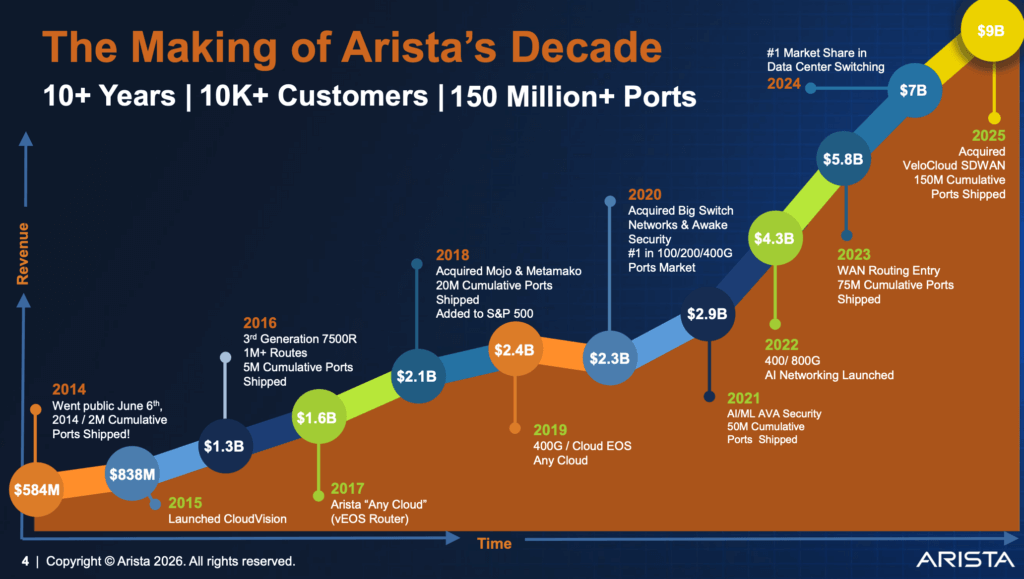
Arista Networks reported fourth quarter revenue of $2.488 billion, up 28.9% year over year, and fiscal 2025 revenue of $9.006 billion, up 28.6% from 2024. The company posted Q4 GAAP net income of $955.8 million ($0.75 per diluted share) and non-GAAP net income of $1.047 billion ($0.82 per diluted share). For the full year, GAAP net income rose to $3.511 billion ($2.75 per diluted share), while non-GAAP net income reached $3.806 billion ($2.98 per diluted share).
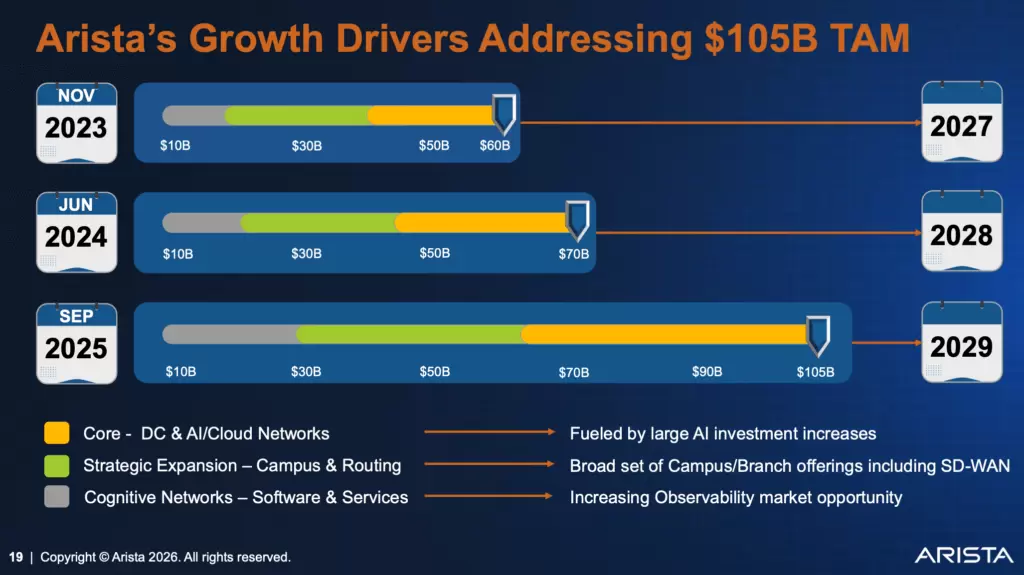
In its February 2026 investor presentation, Arista framed its opportunity around a $105 billion total addressable market spanning AI and cloud data center switching, campus and routing expansion, and subscription software and services. The deck also highlighted industry forecasts pointing to continued growth in high-speed Ethernet switching through 2030, including adoption of 400G, 800G, 1.6T, and emerging 3.2T platforms, and it reiterated Arista’s positioning in high-speed data center switching share trends versus Cisco.
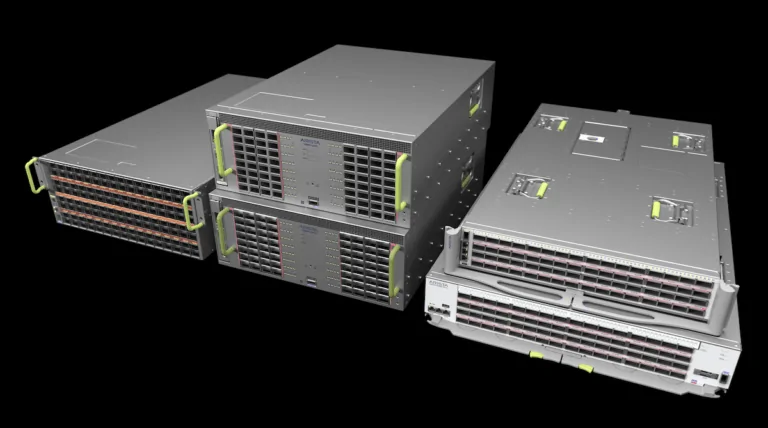
Operationally, Arista emphasized its R4 “AI Spine” portfolio and Distributed Etherlink architecture aimed at simplifying large AI clusters, alongside its multi-domain software stack (EOS, NetDL, CloudVision) and AI-assisted operations capabilities (AVA). For Q1 2026, the company guided to approximately $2.6 billion in revenue, with non-GAAP gross margin of 62–63% and non-GAAP operating margin around 46%.
• Q4 2025 revenue: $2.488B, +28.9% YoY
• FY2025 revenue: $9.006B, +28.6% YoY
• Q4 GAAP net income: $955.8M; non-GAAP net income: $1.047B
• FY2025 GAAP net income: $3.511B; non-GAAP net income: $3.806B
• Q1 2026 outlook: ~$2.6B revenue; 62–63% non-GAAP gross margin; ~46% non-GAAP operating margin
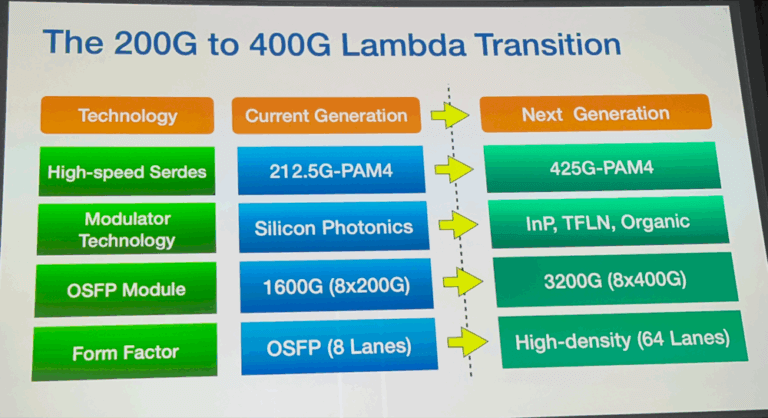
• Investor deck: $105B TAM framing; high-speed Ethernet evolution through 1.6T and 3.2T platforms
“Our Q4 results underscore the strong operating leverage inherent in our model, providing a powerful exit rate as we head into 2026,” said Chantelle Breithaupt, Arista’s CFO. “By pairing 29% revenue growth with a disciplined 47.5% operating margin, Arista achieved a historic milestone: surpassing $1 billion in quarterly net income.”
Addendum — Earnings call takeaways
• Customer mix and concentration (Jayshree Ullal): Arista said 2025 sector mix was 48% “cloud and AI titans,” 32% enterprise/financials, and 20% “AI and specialty providers” (including Apple and Oracle). Management reported two customers above 10% of revenue (Customer A at 16% and Customer B at 26%) and said it could add one or two more 10% customers in 2026, depending on demand timing, acceptance milestones, and shipment capacity.
• International growth (Jayshree Ullal; Chantelle Breithaupt): Ullal said Asia and Europe grew “north of 40%” in 2025, while Breithaupt reported Q4 international revenue of $528.3 million (21.2% of revenue), up sequentially, driven by larger global customers buying across international markets.
• AI revenue targets and 1.6T ramp signals (Jayshree Ullal): Ullal said Arista expects to “double” AI networking revenue from 2025 to 2026 to $3.25 billion and highlighted 800G adoption with more than 100 Etherlink customers and ongoing co-design work around AI racks as 1.6T switching “emerges this year.”
• Campus/branch expansion and SD-WAN integration (Jayshree Ullal; Chantelle Breithaupt): Ullal said Arista exceeded its 2025 campus/branch goal ($800M) and reiterated a $1.25B campus/branch goal for 2026, positioning VeloCloud (acquired July 2025) as part of a “client-to-branch-to-campus” approach with unified management domains.
• Scale-up timing tied to ESUN (Jayshree Ullal): In response to a scale-up question, Ullal said production-scale Ethernet scale-up depends on ESUN specification maturity and new product availability, with earliest timing “Q4 this year” for the spec and “real production level” centered in 2027 alongside 1.6T.
• Scale-across and coherent optics role (Jayshree Ullal): Ullal said power and distributed siting constraints push AI architectures toward multi-site “scale across,” increasing the role of coherent optics and high-injection-bandwidth DCI routing. She pointed to the 7800 spine chassis as a preferred platform for interconnecting regional data centers using VOQ/buffering and high-availability routing features.
• Accelerator diversity (Jayshree Ullal): Ullal said deployments shifted from “99% NVIDIA” a year ago to roughly 20–25% AMD in current deployments, and she framed that shift as favorable to open, multi-vendor configurations that pair best-of-breed NIC/network building blocks with open standards.
• Supply chain, memory pricing, and potential price actions (Jayshree Ullal; Chantelle Breithaupt): Management said memory shortages worsened into early 2026 and described memory pricing as materially higher, with Ullal indicating Arista expects a “one-time increase on selected… memory-intensive SKUs” if costs keep rising. Breithaupt said Arista still expects to hold its FY2026 non-GAAP gross margin range of 62–64% despite cost pressure, implying mitigation through mix, pricing, and cost controls.
• Working capital and backlog mechanics (Chantelle Breithaupt): Breithaupt reported cash and investments of ~$10.74B; Q4 operating cash flow of ~$1.26B; DSOs of 70 days (up from 59); inventory of $2.25B and turns of 1.5x; purchase commitments of $6.8B (up from $4.8B) tied largely to chips for new products and AI deployments; and deferred revenue of $5.4B (up from $4.7B). She emphasized that product deferred revenue can swing with customer-specific acceptance clauses, with acceptance windows cited as 6–18 months depending on deployment.
• Telemetry differentiation in AI ops (Ken Duda; Jayshree Ullal): CTO Ken Duda said Arista’s state-oriented EOS streams real-time network state into CloudVision and extends telemetry for AI by correlating in-network signals (RDMA counters, congestion/buffering metrics) with host-level RDMA/collectives telemetry from NICs and servers. He said the combined view helps operators debug complex host-network interactions and accelerates end-to-end cluster bring-up and stability.
🌐 Analysis: The earnings call adds detail on how Arista expects AI cluster deployments to broaden beyond a small set of hyperscalers into “AI specialty” providers and distributed, multi-site architectures, which increases the importance of routing, DCI, and telemetry-driven operations. Management also flagged memory and component constraints as a margin and shipment-timing variable, suggesting execution in 2026 depends as much on supply chain access and acceptance milestones as on demand signals.
🌐 We’re tracking the latest developments in AI infrastructure and data center networking. Follow our ongoing coverage at: https://convergedigest.com/category/data-center/
🌐 We’re launching the “Data Center Networking for AI” series on NextGenInfra.io and inviting companies building real solutions—silicon, optics, fabrics, switches, software, orchestration—to share their views on video and in our expert report. To get involved, send a note to [email protected] or [email protected].