

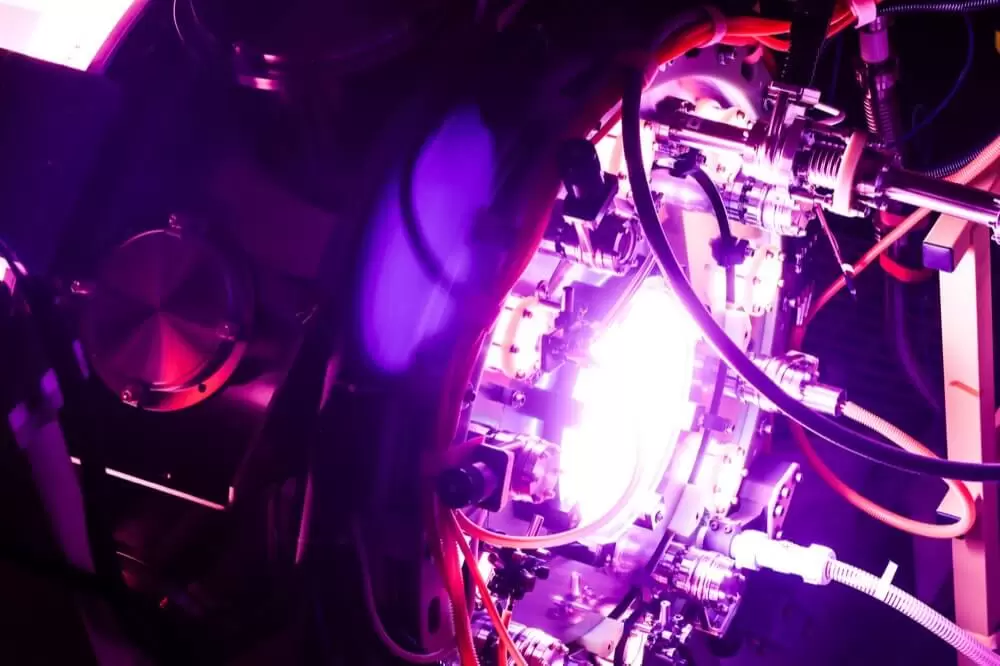
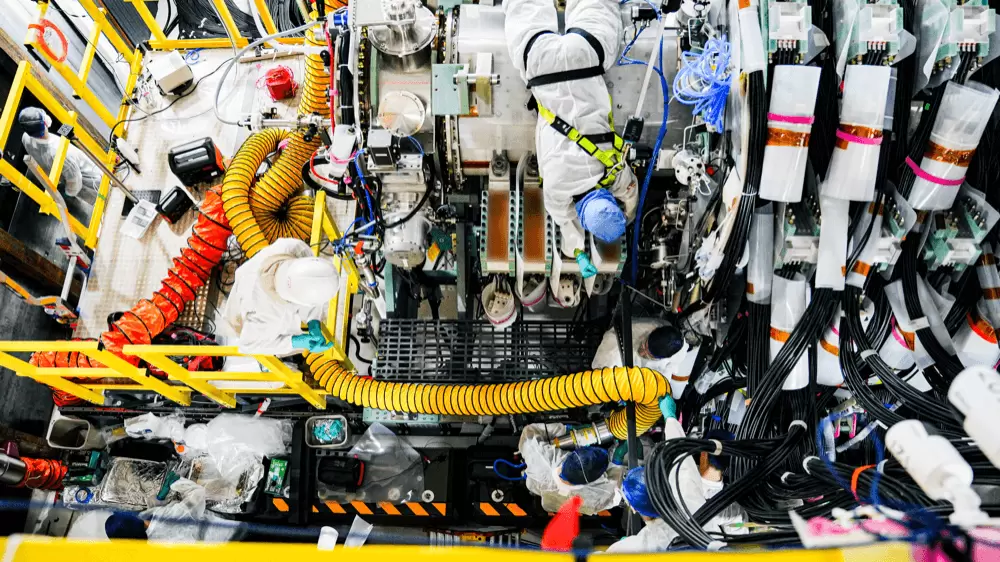
Helion, a fusion developer advancing a pulsed field-reversed configuration (FRC) approach to direct electricity generation, has demonstrated deuterium-tritium (D-T) fusion in its Polaris prototype and reached plasma temperatures of 150 million degrees Celsius (150MºC), setting new benchmarks for the private fusion sector. The company said Polaris is the first privately funded fusion machine to operate with D-T fuel and to achieve temperatures above the 100MºC threshold widely considered necessary for commercially relevant fusion systems.
Helion began operating Polaris, its seventh-generation prototype, at the end of 2024. In January 2026, the system became the first private fusion device to use D-T fuel following regulatory approval to possess and handle tritium for fusion energy demonstrations. The company reported measurable D-T fusion and plasma temperatures exceeding 13 keV, equivalent to 150MºC (approximately 270 million degrees Fahrenheit). Helion previously reached 100MºC with its sixth-generation Trenta prototype and plans to continue raising temperatures in Polaris to support future operation with deuterium-helium-3 fuel, which it intends to use in commercial systems.
Officials and external experts cited progress in both temperature and diagnostic validation. Jean Paul Allain, Associate Director for Fusion Energy Sciences at the U.S. Department of Energy’s Office of Science, said data from the Polaris campaign indicates record-setting temperatures and gains from the fuel mix. Ryan McBride, a specialist in inertial confinement fusion and pulsed power, confirmed evidence of D-T fusion and temperatures above 150MºC after reviewing diagnostic data. Helion has also started construction of Orion, its first commercial machine in Malaga, Washington, under an agreement to supply fusion-generated electricity to Microsoft.
• First privately funded fusion machine to operate with deuterium-tritium fuel
• Plasma temperatures reach 150 million degrees Celsius (≈270 million °F)
• Measurable D-T fusion demonstrated in Polaris prototype
• Surpasses prior 100MºC benchmark set by Trenta
• Commercial “Orion” fusion plant under construction in Washington state
“We believe the surest path to commercializing fusion is building, learning and iterating as quickly as possible,” said David Kirtley, co-founder and CEO of Helion. “The historic results from our deuterium-tritium testing campaign on Polaris validate our approach to developing high power fusion and the excellence of our engineering.”

🌐 Analysis: Helion’s D-T milestone places it among a limited group of organizations demonstrating thermonuclear fusion conditions outside large government facilities such as the National Ignition Facility. Private fusion companies are accelerating development cycles as capital flows into magnetic confinement, inertial confinement, and alternative configurations. Helion’s pulsed FRC architecture and direct energy conversion model distinguish it from tokamak-based approaches and align with its stated goal of delivering grid power later this decade.
Helion Energy is a privately held fusion energy company headquartered in Everett, Washington, focused on developing pulsed, magneto-inertial fusion systems designed to generate electricity directly from fusion reactions without the need for steam turbines. Founded in 2013 by David Kirtley (CEO) and Chris Pihl (CTO), Helion has built a series of increasingly capable prototypes based on field-reversed configuration (FRC) plasma physics, culminating in its Polaris machine. The company’s core intellectual property centers on high-repetition pulsed fusion, advanced capacitor-based energy recovery systems, and direct energy conversion architecture aimed at lowering the cost and complexity of commercial fusion power plants. Helion’s approach emphasizes rapid iteration—having constructed and operated multiple prototypes to validate plasma confinement, temperature, and fuel-cycle milestones, including deuterium-tritium operations. Backed by investors including Sam Altman and other technology-focused funds, Helion has secured more than $500 million in private capital, with additional commitments tied to technical milestones. In 2023, the company announced a power purchase agreement with Microsoft to supply fusion-generated electricity later this decade, marking one of the first commercial offtake agreements in the private fusion sector.