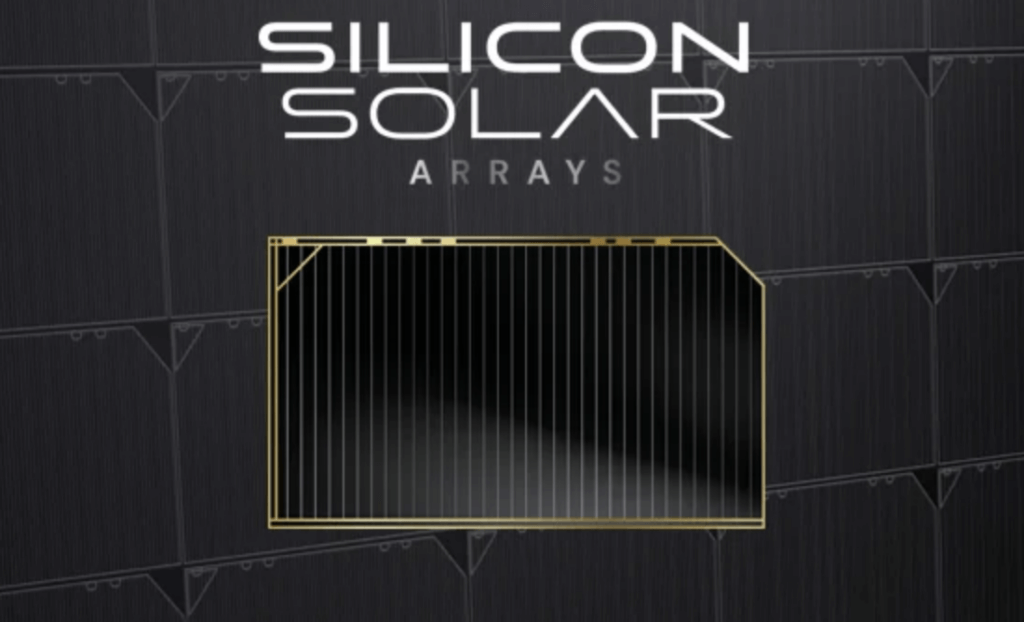
Rocket Lab unveiled advanced silicon solar arrays designed to support gigawatt-scale space-based data centers, positioning orbital compute as a potential extension of terrestrial AI infrastructure. The company said its mass-manufacturable, modular silicon arrays can scale economically to meet rising demand for on-orbit processing power as land, grid capacity, and water constraints limit Earth-based facilities.
The new arrays use radiation-hardened silicon solar cell modules engineered to withstand the space environment while enabling lightweight, flexible deployment architectures. Traditionally, satellites have relied on gallium arsenide and germanium solar cells for radiation tolerance and high efficiency, but those materials face supply chain constraints and geopolitical risks. Rocket Lab said the satellite industry could grow sevenfold by 2035, intensifying pressure on critical mineral supply chains. By adding silicon-based solutions alongside its existing gallium arsenide and germanium production, Rocket Lab aims to reduce reliance on constrained materials and lower cost per watt for constellation-scale deployments.
Rocket Lab also introduced a hybrid solar array architecture combining high-efficiency compound semiconductor cells with silicon cells. The company said the hybrid approach enables mission-specific tradeoffs between power density, cost, and production scale. The announcement builds on Rocket Lab’s October 2025 award of $23.9 million under the U.S. CHIPS and Science Act to expand semiconductor manufacturing in Albuquerque, New Mexico, supporting domestic production of space-grade power technologies.
• New product: radiation-hardened silicon solar arrays for orbital platforms
• Target applications: gigawatt-scale space-based data centers, mega-constellations
• Design features: lightweight, flexible modules; modular architecture; scalable manufacturing
• Hybrid option: combined silicon and high-efficiency compound semiconductor cells
• Strategic objective: reduce reliance on gallium arsenide and germanium supply chains
• CHIPS Act support: $23.9 million award announced October 2025 for semiconductor expansion in New Mexico
Peter Beck, Rocket Lab Founder and CEO, said: “Space-based data centers are the next frontier in computing infrastructure, and reliable solar power systems will form the backbone of this revolution. Rocket Lab’s silicon solar arrays are designed to meet the unique challenges of operating in space while delivering the performance needed to support the growing demand for data processing and storage beyond Earth’s atmosphere.”
🌐 Analysis
Rocket Lab extends its vertical integration strategy beyond launch and electro-optical payloads into space-grade power generation. As AI infrastructure operators confront terrestrial grid bottlenecks and cooling constraints, the concept of orbital compute powered by continuous solar exposure has re-entered strategic discussions. While space-based data centers remain in early conceptual stages, scalable power generation is a prerequisite for any commercial deployment.
The introduction of silicon arrays reflects broader semiconductor industry dynamics. Silicon benefits from mature, high-volume manufacturing ecosystems, unlike gallium arsenide and germanium, which depend on more concentrated supply chains. By aligning its solar array roadmap with domestic semiconductor expansion under the CHIPS Act, Rocket Lab positions itself to support both national security and commercial space compute initiatives while mitigating material risk exposure.
🌐 We’re tracking the latest developments in space infrastructure and satellite systems. Follow our ongoing coverage at: https://convergedigest.com/category/space