
By Fady Masoud, Senior Director, Solutions Marketing at Nokia
The massive scale of AI model training, inference and data movement between distributed compute clusters is dramatically increasing east-west and data center interconnect traffic. This, combined with surging traffic from telecommunications providers in metro and long-haul links is pushing optical pluggable design to new limits in the pursuit of higher-capacity and lower-power-per-bit.
While 800G ZR and ZR+ coherent pluggables are rapidly reshaping the market, the next evolutionary milestone is already on the horizon: 1600G (1.6 Tb/s) ZR and ZR+, which promise ultra-high capacity in standardized, interoperable form factors.
Delivering 1600G isn’t only a matter of “scaling up speed”. It requires evolving every aspect of coherent pluggable, from the use of advanced materials and modulators to digital signal processors (DSPs) and packaging. This article examines the core technologies underpinning 1600G ZR and ZR+ and how technology breakthroughs are enabling this leap.
Challenges scaling to 1600G
The successful design of any coherent pluggable relies on digital and optical components working in concert. To realize 1600 Gb/s throughput in a compact pluggable form factor, designers must address multiple challenges:
- Power consumption: As DSPs become more powerful and sophisticated to handle and modulate 1600 Gb/s bit streams operating at higher baud rate, their total power consumption increases, even as the power consumption per-bit drops. This becomes a major challenge as host devices support a limited pluggable socket power envelope.
- DSP complexity: Recovering high baud rate signals requires massive computational horsepower. Furthermore, when packaged inside a compact coherent pluggable, such as QSFP-DD1600 or OSFP1600, DSPs must operate within stringent space and thermal constraints, which limits the set supported capabilities.
- Spectral efficiency: Squeezing more bits per second into a given optical spectrum is key to ensure maximized fiber utilization.
- Noise and impairment management: As data rates increase, so does sensitivity to noise, dispersion, and nonlinearities, which can impact signal quality and integrity when they rise above acceptable thresholds.
- Heat and thermals: High-speed electronics and photonics generate heat that must be managed in compact pluggable form factors.
These challenges are driving innovation across digital processing, materials use and modulation formats.
Technology innovation enabling 1600G
While 1600G pluggables build on lessons learned from 800G, they require significant advances to succeed.
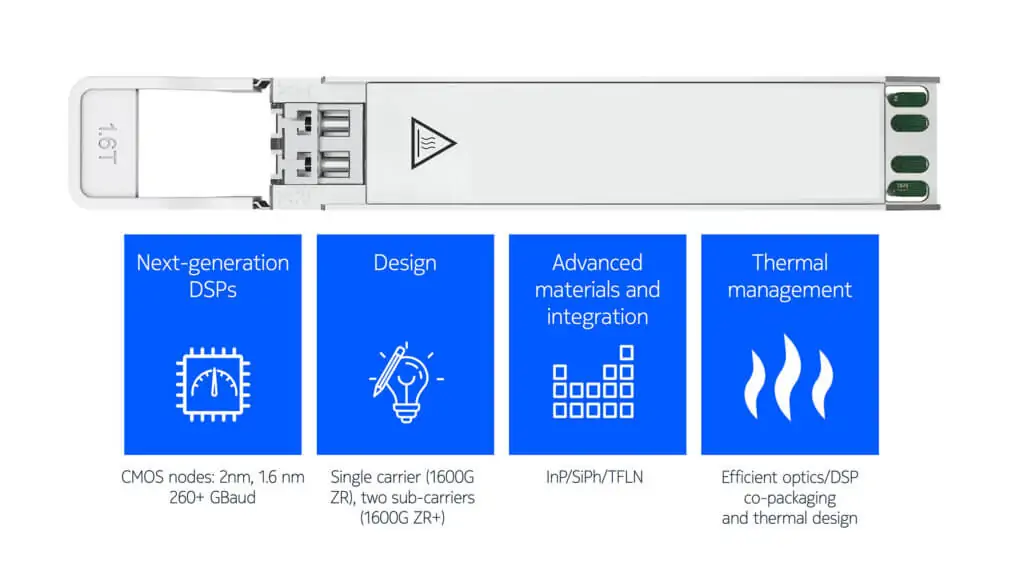
- Next-generation DSPs: Given the high bitrate and the constraints in power consumption and size, DSPs must be powerful and sophisticated enough to extract the transmitted data from a signal distorted by fiber impairments such as chromatic dispersion, polarization mode dispersion (PMD), laser phase noise, and nonlinearities. The 1600G coherent engines will use 2 nm or 1.6 nm CMOS processes to deliver the processing power needed for such high bitrate, symbol rates of 260 and above, reduced latency, and improved power efficiency per bit. Key innovations such as adaptive equalization and carrier phase estimation are used to compensate for channel impairments like PMD and laser phase noise.
- Two‑subcarrier architectures: For extended-reach ZR+ applications, standards‑based implementations will adopt dual‑subcarrier architectures, digitally dividing a 1600 Gb/s wavelength into two lower‑baud‑rate subcarriers to mitigate chromatic dispersion and equalization‑enhanced phase noise. This approach balances DSP complexity and laser requirements. For shorter‑reach 1600G ZR applications typically under 120 km, a single‑carrier approach similar to today’s 400G and 800G ZR implementations will be implemented.
- Advanced materials and integration: Reaching 1600G ZR+ performance requires more efficient photonic integration, likely combining silicon photonics, indium phosphide, and thin‑film lithium niobate (TFLN). These technologies enable higher bandwidth modulation, lower insertion loss and improved energy efficiency in compact footprints. In particular, TFLN and InP modulators offer the wide bandwidth and linearity needed for high‑order coherent modulation, while maintaining low drive voltage and reduced thermal sensitivity.
- Thermal management and form factors: Packaging and thermal design remain major challenges for 1600G pluggables. Higher baud rates, more powerful DSPs, and increased optical‑electrical integration result in higher power density within the limited pluggable space and cooling capabilities. QSFP‑DD1600 and OSFP1600 are expected to be the primary form factors under consideration. QSFP‑DD1600 provides strong backward compatibility but may constrain high‑power ZR+ operation. OSFP1600 offers a larger thermal envelope that makes it better suited for early 1600G ZR+ deployments. Both form factors are likely to coexist, addressing different power and reach profiles.
1600G ZR and ZR+: Modes, tradeoffs and convergence
As with previous generations, the distinction between ZR and ZR+ lies primarily in reach, power and operational flexibility. ZR mode is expected to focus on interoperable, lower-power operation optimized for DCI-class links, typically under 120 km. Beyond interoperability, ZR+ supports higher power envelopes, extended reach enabled by special modes, and greater tunability to operate over more challenging optical paths. Table 1 summarizes the differences between ZR and ZR+.
| Attribute | 1600G ZR (Expected) | 1600G ZR+ (Expected) |
|---|---|---|
| Primary application | Data center interconnect (DCI) point-to-point links | Metro, regional, and long-haul networks, including ROADM-based architectures |
| Maximum reach at 1600 Gb/s (amplified) | Up to approximately 120 km | Up to approximately 1,000 km at 1600 Gb/s, with longer reaches at lower data rates |
| Forward error correction (FEC) | Interoperable open FEC (oFEC) | Interoperable oFEC, with optional high-performance or vendor-specific FEC |
| Modulation schemes | Primarily fixed 16QAM | Flexible modulation including QPSK, 8QAM, and 16QAM with PCS, with higher-order options such as 32QAM with PCS |
| Power consumption (expected) | Low 30 W range | High 30 W to low 40 W range |
A key question is whether a single 1600G pluggable can support both modes. Industry momentum suggests that dual mode operation will be the norm rather than the exception. Software-defined profiles are expected to enable lower power ZR operation for short-reach applications, while allowing higher power ZR+ configurations when extended reach or higher margins are required. This convergence maximizes deployment flexibility and improves return on investment.
Although 1600G pluggables will likely operate in both ZR and ZR+ modes, vendors are expected to align pricing with network requirements. This tiered approach ensures operators do not pay a premium for ZR+ capabilities such as extended reach or advanced modulation when standard point-to-point ZR performance is sufficient. Distinct price points allow operators to optimize capital expenditure based on actual distance and performance needs.
Interoperability and ecosystems
Multi-vendor interoperability remains a cornerstone of the ZR and ZR+ value proposition. With this in mind, the Optical Internetworking Forum (OIF), representing both operators and vendors, initiated the1600ZR and the 1600ZR+ working groups in late 2023 and early 2024, respectively. They build on the work the OIF did for 800G pluggable standardization and aim to define a standardized framework for 1600G and make key technical decisions. They focus on defining parameters such as FEC, electrical interfaces, and reach tiers amongst others, to help ensure 1600G modules from different suppliers can interoperate and fit into broader network architectures. Backward compatibility with 800G ZR/ZR+ is also critical, enabling mixed-rate deployments and smooth network evolution without disruptive upgrades.
The 1600G transition is underway
Although 1600G ZR and ZR+ modules will not likely be commercially available until mid to late 2027, network operators are already planning for their adoption. Long design cycles for optical systems, routers and line cards, as well as the need to ensure interoperability across multi-vendor ecosystems make this necessary.
Realizing 1600G coherent pluggables will require coordinated innovation across DSPs, photonics, packaging and thermal management, alongside collaboration across the ecosystem to align on standards, interoperability, and deployment models. As AI traffic continues its relentless growth and network operators push for ever-greater efficiency and scalability, 1600G ZR/ZR+ bring unprecedented capacity, flexibility, and openness to the optical industry.

Fady Masoud is a senior director for solutions marketing at Nokia focusing on next-generation intelligent coherent pluggable optics (ICE-X) and cloud /data center interconnect solutions. His area of expertise is the architecture and requirements of next-generation optical networking infrastructure. During his 30 years in the telecommunications industry, Fady has held various positions in the optical networking domain at Nortel, Ciena, Infinera, and now Nokia. He started as a hardware test engineer on the first OC-192 (10 Gb/s) systems and then was a systems and network engineer on optical transmission products, all combined with hands-on experience. Fady holds a bachelor’s degree in electrical engineering from Laval University (Quebec City, Canada) and a master’s degree in systems technology (software simulation of optical networks) from the Superior School of Technology (Montreal, Canada). He has written numerous industry and technical publications such as for the IEEE, as well as a book on next-generation optical networking, cloud networking, and data center interconnect, as well as on many other key topics.