
Xanadu Quantum Technologies Limited announced the completion of its business combination with Crane Harbor Acquisition Corp., positioning the company to begin trading publicly on both the Nasdaq and Toronto Stock Exchange under the ticker symbol “XNDU” starting March 27, 2026. The transaction includes approximately $275 million in PIPE financing and transitions the company into what it describes as the first publicly listed pure-play photonic quantum computing firm.
The Toronto-based company focuses on photonic quantum computing architectures designed for scalability and networking. Xanadu’s approach leverages light-based qubits and integrated photonics to enable distributed quantum systems, aligning with broader industry efforts to build networked quantum infrastructure capable of supporting real-world applications.
The listing arrives amid increased investment and competition across the quantum computing sector, where multiple hardware modalities—including superconducting, trapped ion, and photonic systems—compete to demonstrate scalability, fault tolerance, and commercial viability. Xanadu aims to differentiate through its photonic platform and emphasis on interoperability across quantum networks.
- Completed business combination with Crane Harbor Acquisition Corp. (SPAC)
- Secured approximately $275 million in PIPE financing
- Shares to trade under ticker “XNDU” on Nasdaq and Toronto Stock Exchange starting March 27, 2026
- Positions as first publicly listed pure-play photonic quantum computing company
- Focus on scalable, networked photonic quantum systems and commercial applications
- Continues development of integrated photonics-based quantum hardware and software stack
“By becoming a publicly traded company, we are accelerating our mission to build scalable, networked quantum computers and deliver practical quantum applications,” the company said in its announcement.
🌐 Analysis
Xanadu’s public listing marks a notable milestone for photonic quantum computing, a segment that has attracted growing attention due to its potential advantages in scalability and room-temperature operation compared to superconducting systems pursued by companies like IBM and Google. The SPAC route provides Xanadu with capital to advance its integrated photonics roadmap, including silicon photonics-based quantum chips and cloud-accessible platforms such as PennyLane.
🌐 Backgrounder
Xanadu Quantum Technologies is a Toronto-based quantum computing company founded in 2016 by Christian Weedbrook. It specializes in photonic quantum computing, which encodes and processes information using light (photons) rather than superconducting circuits or trapped ions. The company pursues a full-stack strategy encompassing hardware, software, and algorithms, with a focus on continuous-variable (CV) quantum computing, integrated silicon photonic chips, and programmable photonic circuits. Xanadu designs its systems for scalability and compatibility with existing semiconductor manufacturing processes, partnering with foundries like Tower Semiconductor. A key advantage of its photonic approach is that the processor chips operate at room temperature, potentially reducing infrastructure costs compared to cryogenic systems required by many competing technologies (though certain detectors still need cooling).
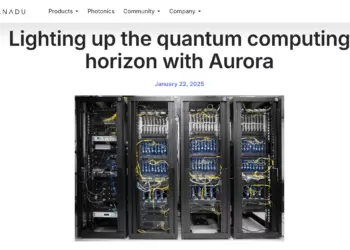
The company’s flagship hardware demonstration came with Borealis in 2022, a photonic quantum computer that achieved quantum computational advantage in Gaussian boson sampling and was made available on the cloud, including via Amazon Braket. Xanadu has since advanced to prototypes like the modular Aurora system. Its open-source software platform, PennyLane, has become a widely adopted framework for hybrid quantum-classical machine learning and differentiable quantum programming, supporting multiple hardware backends and used by a significant portion of the quantum programming community. Xanadu has raised substantial funding from investors including Bessemer Venture Partners, Georgian, and OMERS Ventures.