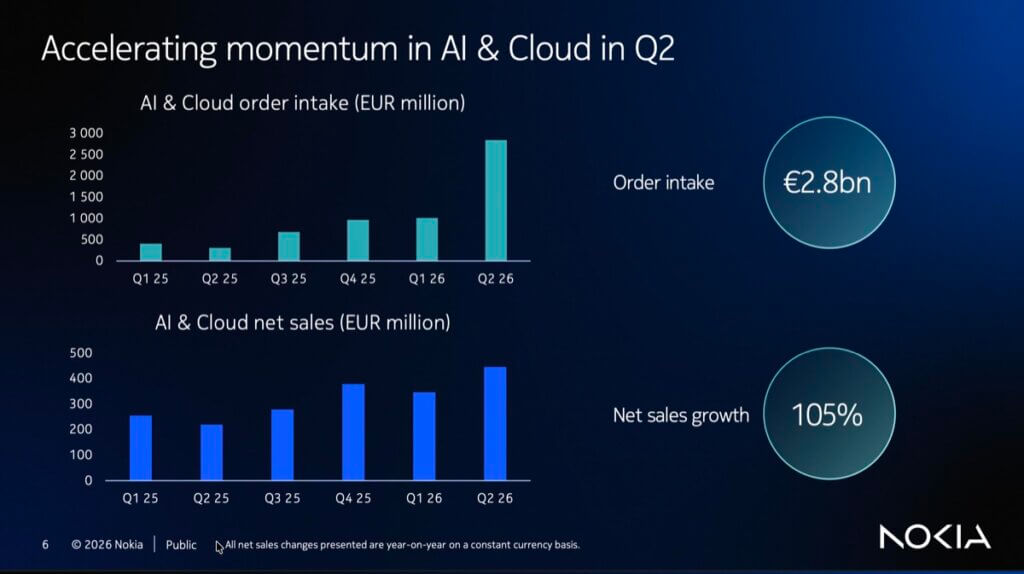
Nokia delivered a strong second quarter as demand for AI infrastructure continued to reshape its business, with AI & Cloud revenue surging 105% year-over-year and Optical Networks and IP Networks posting double-digit growth. The company reported comparable net sales of €4.81 billion, up 8% from a year earlier, while comparable operating margin improved to 9.0% and comparable diluted EPS increased to €0.07. AI & Cloud order intake reached €2.8 billion, providing additional visibility into future hyperscale infrastructure deployments.
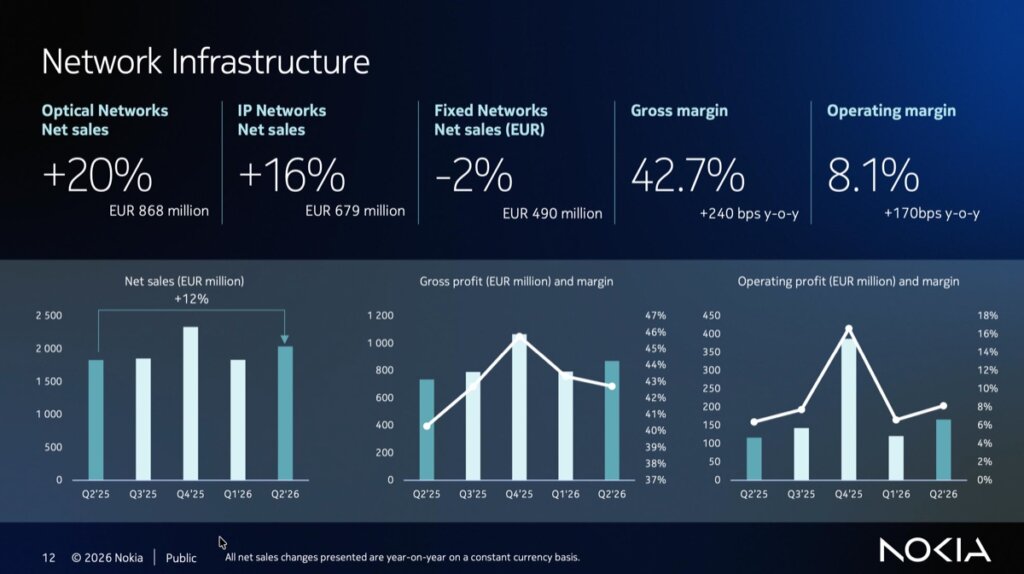
Network Infrastructure revenue increased 12% to €2.04 billion, driven by 20% constant-currency growth in Optical Networks and 16% growth in IP Networks. Optical Networks generated €868 million in quarterly revenue while IP Networks contributed €679 million. Nokia also continued expanding its U.S. optical manufacturing strategy, remaining on schedule to begin production at its San Jose optical fabrication facility later this year, announcing a tenfold expansion of advanced optical test and packaging capacity in Pennsylvania, and advancing plans to acquire NXP’s Chandler, Arizona semiconductor fabrication campus to manufacture Indium Phosphide optical components for next-generation AI networking platforms.
Although Nokia technically increased its comparable operating profit guidance following the reclassification of its Fixed Wireless Access CPE and Enterprise Campus Edge businesses as discontinued operations, management emphasized that its operational outlook remains unchanged. The company expects third-quarter revenue to increase 3–7% sequentially and continues to project strong growth in IP and Optical Networks during 2026 as hyperscalers expand AI clusters and data center interconnect infrastructure.
Quarter at a Glance
| Nokia Q2 2026 Highlights | |
| Comparable Net Sales | €4.815 billion Up 8% reported and 9% at constant currency |
| AI & Cloud Revenue | +105% €446 million |
| AI & Cloud Orders | €2.8 billion in order intake |
| Network Infrastructure | Up 12% to €2.04 billion |
| Optical Networks | +20% at constant currency €868 million in revenue |
| IP Networks | +16% at constant currency €679 million in revenue |
| Operating Margin | 9.0%, up from 8.3% |
| Comparable EPS | €0.07, up from €0.04 |
| U.S. Manufacturing | San Jose Pennsylvania Chandler Optical fabrication, advanced packaging and planned Indium Phosphide manufacturing expansion |
| 2026 Outlook | Operational guidance unchanged Q3 revenue expected to increase 3%–7% sequentially |
Justin Hotard, President and CEO, stated: “Q2 demonstrates our strategy is delivering results. Since we set out our plan late last year, Team Nokia has focused on maximizing our opportunity in the AI supercycle. I am encouraged by the execution and progress we have made in a short period of time.”
🌐 Analysis
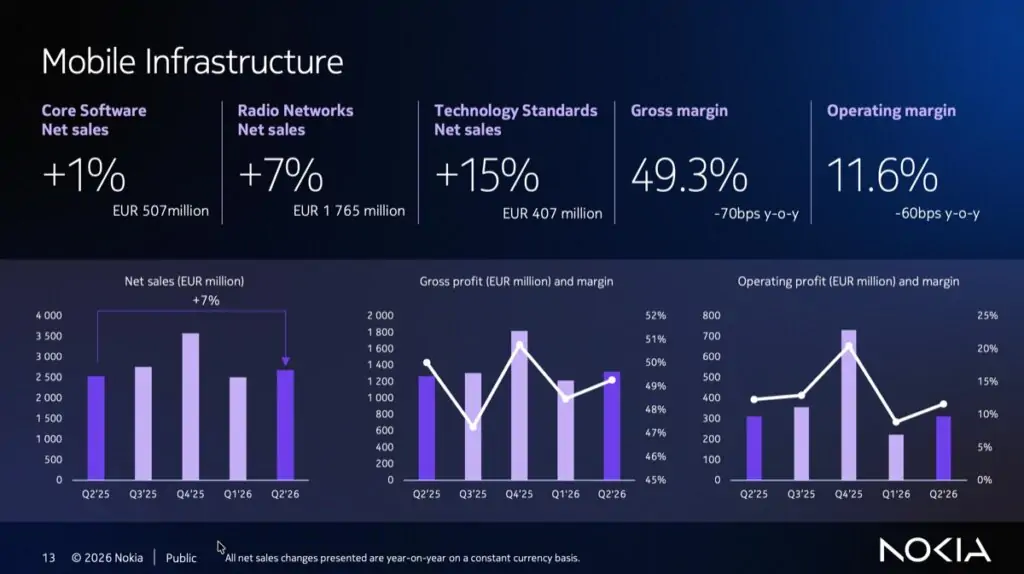
Nokia’s second-quarter results show the company’s transformation from a business primarily driven by telecommunications infrastructure to one increasingly powered by AI networking. Optical transport, IP routing, and AI infrastructure software are now generating substantially faster growth than Nokia’s traditional mobile networking businesses, reflecting continued investment by hyperscale cloud providers building AI clusters and high-capacity data center fabrics.
Another notable development is Nokia’s continued investment in U.S.-based optical manufacturing. Expansion in California and Pennsylvania, combined with the planned acquisition of NXP’s Chandler semiconductor facility, would significantly increase domestic production of Indium Phosphide optical devices used in coherent optics and AI interconnects. As governments and hyperscalers seek more resilient supply chains for AI infrastructure, vertically integrated optical manufacturing could become an increasingly important competitive advantage.