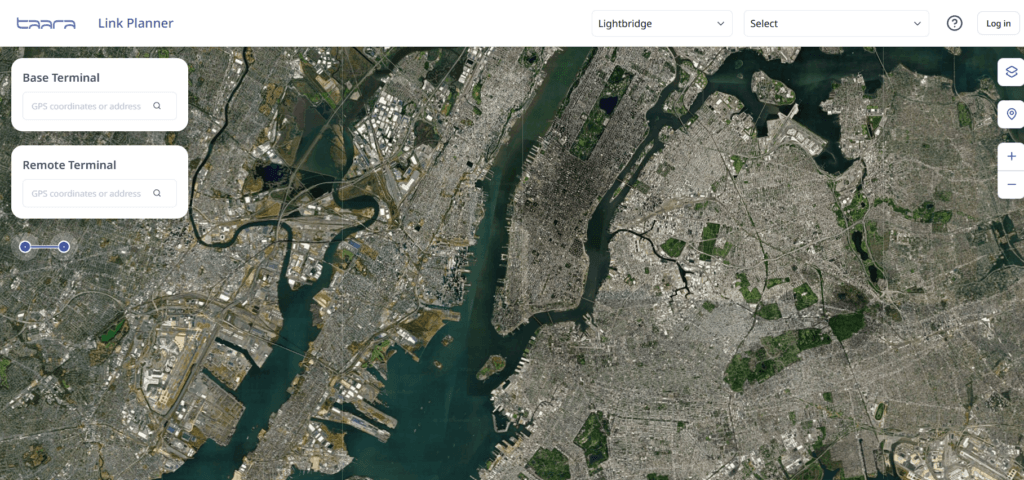
Taara introduced Taara Link Planner, a browser-based network planning platform designed specifically for wireless optical communications (WOC), giving operators a way to evaluate, model, and design free-space optical links before deployment. The software builds on nearly a decade of research originating at X, Google’s Moonshot Factory, and incorporates one of the industry’s largest datasets of operational free-space optical links collected across diverse climates and geographies. The platform supports deployment planning for Taara Lightbridge, allowing users to estimate line-of-sight, mounting heights, atmospheric availability, and expected link performance using local weather and environmental models.
Unlike RF-based microwave planning tools, Taara Link Planner models the physical characteristics unique to optical transmission through the atmosphere. Users can enter GPS coordinates or street addresses to position endpoints, visualize obstructions, modify installation heights, and estimate annual availability based on variables including fog, haze, rain, humidity, dust, turbulence, wind, temperature, and vibration. According to Taara, internal validation shows predicted availability is typically within approximately 1% of observed performance when local weather data is available and systems are installed according to specification. Where detailed local weather information is unavailable, the platform falls back to broader regional atmospheric models.
Taara says the software addresses one of the primary questions operators ask before deploying free-space optical systems—expected link availability. The company notes that Taara Lightbridge is now deployed in more than 20 countries with operators including T-Mobile, Airtel, Digicel, Liquid, and SoftBank, where it is used to extend network capacity in locations where fiber construction is difficult, expensive, or slow. The Link Planner follows the company’s recent launch of its browser-based Total Cost of Ownership (TCO) Calculator, providing operators with complementary planning tools for evaluating both technical feasibility and deployment economics.
| Taara Link Planner — Technical Highlights | |
| Purpose | Planning platform for wireless optical communication (free-space optical) deployments |
| Supports | Taara Lightbridge optical wireless terminals |
| Planning Inputs | Address, GPS coordinates, manual map placement, endpoint height adjustments |
| Models | Line-of-sight analysis, atmospheric attenuation, link margin and annual availability |
| Environmental Factors | Fog, haze, rain, humidity, dust, wind, vibration, turbulence and temperature |
| Prediction Accuracy | Approximately 1% average deviation from observed availability when local weather data is available |
| Historical Studies | Average availability above 95% for links up to 10 km in representative U.S. and U.K. metropolitan weather; above 99% in many regions of interest |
| Commercial Deployments | 20+ countries |
| Notable Customers | T-Mobile, Airtel, Digicel, Liquid and SoftBank |
“Over the last decade, our deployments from dense cities and remote communities to some of the world’s most demanding atmospheric conditions have taught us how light behaves in the real world,” said Mahesh Krishnaswamy, Founder and CEO of Taara. “Taara Link Planner brings that body of research together in a product that operators everywhere can use.”
🌐 Analysis
Network planning tools are standard for microwave, fiber and cellular deployments, but equivalent software has been largely absent for commercial free-space optical communications. By releasing a dedicated planning platform, Taara is attempting to reduce one of the principal barriers to broader adoption—engineering confidence in predicting availability under varying atmospheric conditions before equipment is installed.
The announcement also reflects Taara’s evolution from an experimental project within Google’s X organization into an independent networking company building a broader software ecosystem around its optical wireless technology. The addition of both a Link Planner and a Total Cost of Ownership Calculator suggests the company is expanding beyond hardware into network design tools that help operators compare wireless optical links with fiber and RF alternatives as demand grows for rapidly deployable AI infrastructure, mobile backhaul, enterprise campus connectivity, and temporary network capacity.