Almost exactly 8 years after signing a historic agreement with nbn Co Limited (NBN Co), the consortium established to design, build and operate Australia’s wholesale-only national broadband network (nbn), Telstra has just announced plans to spin-off its remaining fixed network infrastructure, including long-haul fibre, data centres, and subsea cables, into a separate company.
The nbn Co agreement reached in 2010 ensured that Telstra provides access to its facilities, which has remained a steady source of income over the years. Nevertheless, Telstra is embarking on a major reorganization and radical transformation of its customer plans and pricing. The company says it is looking ahead to a “post-nbn rollout” world in which very fast access speeds are ubiquitous across the country and multiple competitors run over the same fixed infrastructure.
The strategy, named Telstra2022, has four key pillars:
- Radically simplify product offerings, eliminate customer pain points and create all digital experiences
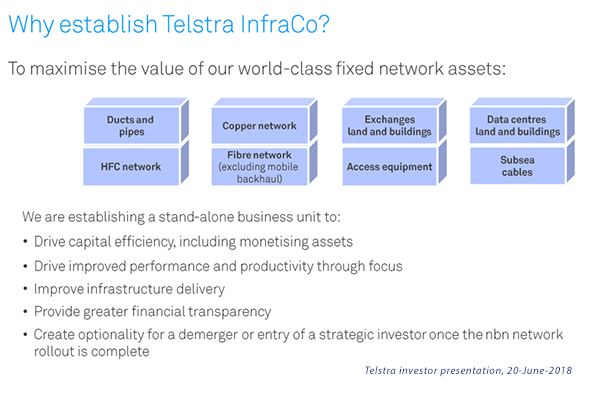
- Establish a standalone infrastructure business to drive performance and set up optionality post the nbn rollout
- Greatly simplify the corporate structure and ways of working to empower our people and serve our customers
- Cost reduction programme and portfolio management
Andrew Penn, who has now been CEO of Telstra for three years, says “The rate and pace of change in our industry is increasingly driven by technological innovation and competition. In this environment, traditional companies that do not respond are most at risk. We have worked hard preparing Telstra for this market dynamic while ensuring we did not act precipitously. However, we are now at a tipping point where we must act more boldly if we are to continue to be the nation’s leading telecommunications company.”
The corporate restructuring will result in a net reduction of 8,000 employees and contractors, and the elimination of 2-4 layers of management.
The infrastructure spin-off, tentatively called Telstra InfraCo, will begin as a wholly-owned subsidiary on 1 July, although over time, Telstra may seek a strategic investor or separate listing. Its assets will include Telstra’s fixed network infrastructure including data centres, non-mobiles related domestic fibre, copper, HFC, international subsea cables, exchanges, poles, ducts and pipes. Its services will be sold to Telstra, wholesale customers and nbn co.
Telstra InfraCo will also comprise Telstra’s nbn co commercial works activities and Telstra Wholesale, with a total workforce of approximately 3,000. It is expected this new Business Unit will control assets with a book value of about $11 billion and have annual revenues and EBITDA of about $5.5 billion and $3 billion respectively.
The new business unit will not include the mobile network assets including spectrum, radio access equipment, towers and some elements of backhaul fibre, which will remain integrated with Telstra’s core customer segment. Telstra itself will seek to be a premium brand with its future tied to mobile connectivity and the upcoming 5G launch.