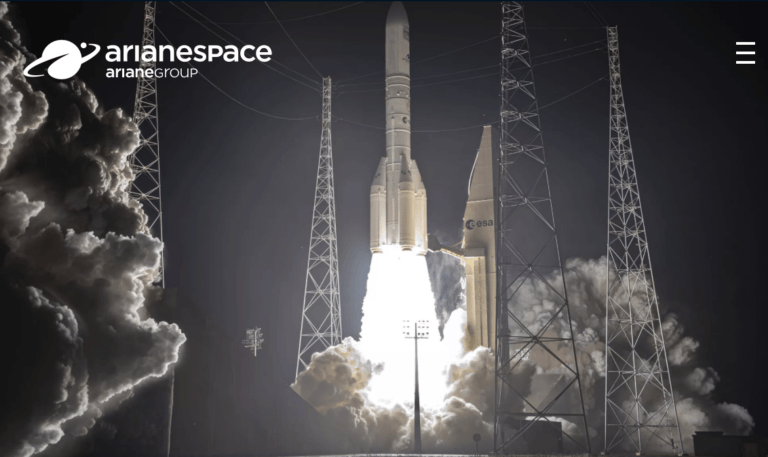
An Ariane 5 rocket launched from the Guiana Space Center (CSG) suffered an anomaly during the second stage separation process. Ground tracking stations lost telemetry contact with the rocket and its two satellite payloads shortly after the second stage separation. An investigation is underway. The CEO of Arianespace issued an apology. Two hours later, Arianespace confirmed that both of the satellites in its payload reached orbit and are communicating.

The mission carried SES-14, the second of SES’ hybrid satellite to be launched. SES-14 was equipped with C-band wide beams will help cable and IP operators gain more viewers in Latin America, as well as provide maritime managed connectivity service across the Atlantic Ocean. In addition, HTS spot beams are designed for in-flight connectivity aboard commercial aircraft over the Atlantic provided by Global Eagle, Gogo and Panasonic. The satellite is also hosted a NASA scientific payload called “GOLD” that will enable scientists to study the border between earth and space. SES-14 is the first high-power satellite in the 4-tons class. It was built by Airbus.
The Ariane 5 mission also carried the Al Yah 3 satellite for the United Arab Emirates operator
Yahsat (Al Yah Satellite Communications Company), which is the first company in the Middle East and Africa to offer Ka-band services reaching 60% of Africa’s population and over 95% of Brazil’s population from its geostationary position at at 20° West Longitude. The Al Yah 3 satellite carries 53 active Ka-band user beams and four gateway beams, and produces approximately 8.0 kilowatts of payload electrical power. It was built by Orbital ATK using its new GEOStar-3 hybrid platform.