Ericsson reports fourth-quarter and full-year 2025 results, showing improved profitability and organic growth despite a flattish global RAN market. Management said disciplined execution, cost actions, and continued investment in technology leadership supported margin expansion and cash generation, while the company positioned mission-critical networks, 5G core, and enterprise initiatives as key growth vectors.
In the fourth quarter, Ericsson reported sales of SEK 69.3 billion and 6% organic sales growth year over year. Adjusted gross margin increased to 48.0% from 46.3%, while adjusted EBITA rose to SEK 12.7 billion, representing an 18.3% margin. Ericsson reported net income of SEK 8.6 billion and free cash flow before M&A of SEK 14.9 billion. The company noted regional divergence, with Europe, Middle East and Africa and South East Asia, Oceania and India growing, the Americas broadly stable, and North East Asia declining.
For the full year 2025, Ericsson reported sales of SEK 236.7 billion and 2% organic sales growth. Adjusted gross margin reached 48.1% and adjusted EBITA totaled SEK 42.9 billion, corresponding to an 18.1% margin that included a gain from the iconectiv divestment. Net income was SEK 28.7 billion and net cash at year-end stood at SEK 61.2 billion. The Board plans to propose a dividend of SEK 3.00 per share and a share buyback program of up to SEK 15.0 billion at the AGM.
- Q4 organic sales growth of 6% across all three segments, with Cloud Software and Services up 12%
- Q4 adjusted gross margin of 48.0% and adjusted EBITA margin of 18.3%
- Full-year organic sales growth of 2% and adjusted EBITA margin of 18.1%, including the iconectiv divestment gain
- Net cash of SEK 61.2 billion at the end of 2025
- Board to propose SEK 3.00 per share dividend and SEK 15.0 billion share buyback authorization
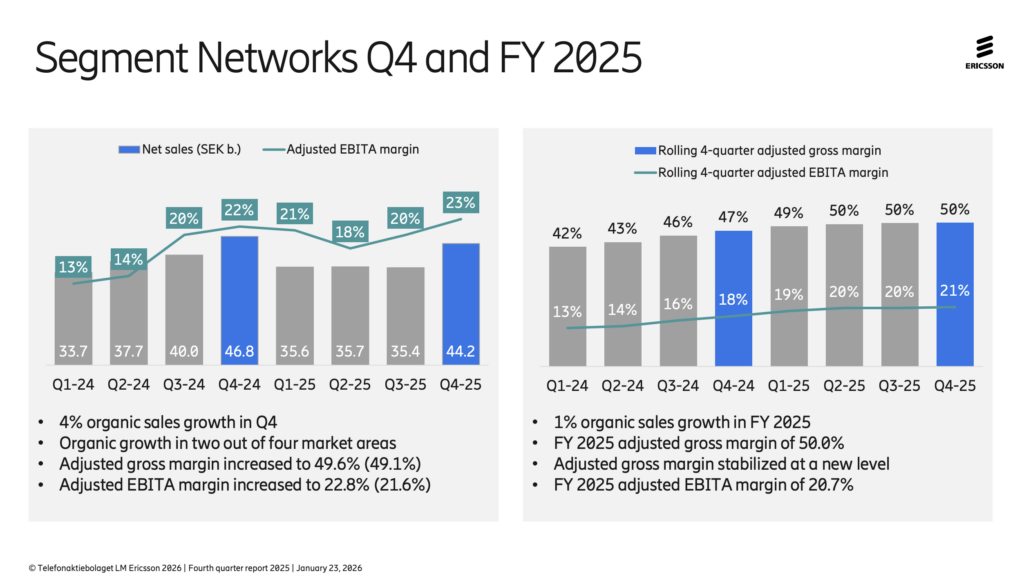
- Outlook: Ericsson expects the RAN market to be flat in 2026, with uncertainty tied to tariffs and macro conditions; Networks adjusted gross margin in Q1 2026 expected at 49%–51%
“Our Q4 results demonstrate solid execution of our strategy priorities,” said Börje Ekholm, President and CEO of Ericsson. “The operational actions we have taken in recent years have resulted in improved margins and cash flow, and we continue to invest in AI-native, secure, and autonomous mobile networks while preparing for a flat RAN market in 2026.”
Earnings call addendum: Ericsson Q4 2025 conference call takeaways (Ekholm, Sandström)
- Börje Ekholm (President and CEO) said Ericsson plans to keep reducing headcount after cutting roughly 5,000 roles over the past year, as part of ongoing efforts to structurally improve margins and cash flow.
- Lars Sandström (CFO) said operating expenses excluding restructuring charges fell to SEK 21.4 billion in Q4, about SEK 2 billion lower year over year, with roughly half of the improvement attributed to currency and the remainder to cost actions.
- Sandström cited a negative currency impact of SEK 6.8 billion on Q4 reported sales and said adjusted gross income included a SEK 3.6 billion currency headwind for the quarter.
- Ekholm said Ericsson expects AI value creation to shift from data centers and model training toward distributed, mobile applications and devices that increase demand for uplink capacity, low latency, and trusted connectivity—supporting adoption of 5G Standalone and, later, 6G.
- Ekholm pointed to China’s denser mid-band coverage grid as a competitive factor for AI-driven applications and suggested coverage density will matter as AI use cases expand into physical environments.
- Ekholm said Ericsson signed agreements during the year with frontrunner customers including Telstra and Vodafone and made inroads with leading Japanese operators, positioning these deployments around differentiated performance and monetization.
- Ekholm said fixed wireless access reached 150 million global subscribers in 2025 and described FWA as Ericsson’s most mature “new use case” with strong customer satisfaction dynamics.
- Ekholm said Ericsson plans to increase investments in defense and mission-critical networks in 2026; he declined to quantify current defense revenue but described the opportunity as sizeable given increased U.S. and European defense spending and a move toward 3GPP-enabled solutions.
- Sandström added that defense-related CapEx requirements should be “very, very limited.”
- Sandström said Ericsson views memory-related supply and pricing pressure as manageable through supplier relationships and customer engagement, while declining to quantify assumptions embedded in 2026 margin planning.
- Ekholm described Ericsson’s silicon and platform approach as keeping RAN software portable across architectures (x86, GPUs, proprietary silicon and other accelerators), allowing hardware decisions to be made later with customers as AI-RAN and 6G requirements become clearer.
- Ekholm described EU “high-risk vendor” restrictions as a potential upside opportunity over a 12–18 month horizon, while noting Ericsson is not factoring it into guidance yet.
- Sandström said Networks saw continued price competition in Latin America, while North America remained broadly stable with healthy investment levels; he highlighted Vietnam as a contributor in Southeast Asia within Networks.
- Sandström said Cloud Software and Services results can be influenced by project delivery timing; he characterized Q4 as strong and reiterated that growth can be lumpy quarter to quarter.
- Sandström said the Chinese smartphone license expiration at the end of 2025 should not represent a major full-year impact, while pointing to potential upside from settlement discussions and longer-term licensing opportunities in IoT and automotive.
- Sandström said the proposed dividend plus buyback aligns with maintaining an investment-grade profile and a solid net cash position; Ekholm said buybacks could become recurring, with sizing dependent on outlook and AGM mandates.
- Ekholm said Ericsson does not see a need for large acquisitions and expects any inorganic moves to be smaller “tuck-in” transactions.
- Ekholm said Ericsson intends to reach its 15%–18% long-term margin target consistently before considering any change to the target framework.
🌐 Analysis
Ericsson’s earnings and presentation emphasize a margin-first operating model in a market where macro conditions and operator radio access spending remain uneven by region. The call commentary also underscored a broader industry shift toward software-led core networks, mission-critical services, network APIs, and enterprise connectivity as telecom equipment vendors look for growth vectors beyond RAN refresh cycles.
🌐 We’re tracking the latest developments in networking, 5G, and AI-driven infrastructure. Follow our ongoing coverage at: https://convergedigest.com/category/networks/