Verizon reported consolidated Q1 revenue of $29.8 billion, a 7.3 percent decrease compared with first-quarter 2016, but down 4.5 percent on a comparable basis excluding divestitures and acquisitions in the period. Net income was $3.6 billion in first-quarter 2017, and EBITDA (non-GAAP, earnings before interest, taxes, depreciation and amortization) totaled $11.2 billion. Consolidated operating income margin was 24.1 percent.
 Earnings per share (EPS) were 84 cents in earnings per share (EPS) and adjusted EPS (non-GAAP) ws 95 cents, excluding non-operational items, compared with EPS of $1.06 in 1Q 2016.and adjusted EPS (non-GAAP) of 95 cents, excluding non-operational items, compared with EPS of $1.06 in 1Q 2016. Capital expenditures totaled $3.1 billion in first-quarter 2017.
Some Wireless highlights
- There was a net decline of 307,000 retail postpaid connections in first-quarter 2017 included 289,000 phone losses. Prior to the launch of Unlimited service in mid-February, Verizon had a retail postpaid phone net loss of 398,000; after the launch, Verizon added 109,000 retail postpaid phone connections. For the entire quarter, Verizon added a net of 49,000 smartphones to its retail postpaid phone base.
- Verizon’s retail postpaid connections base grew 1.2 percent year over year to 108.5 million, and retail prepaid connections grew 0.5 percent to 5.4 million.
- Retail postpaid churn was 1.15 percent in first-quarter 2017, a year-over-year increase of 19 basis points primarily due to increased churn in tablets. Phone customer loyalty remained high, with retail postpaid phone churn of less than 0.90 percent for the eighth consecutive quarter.
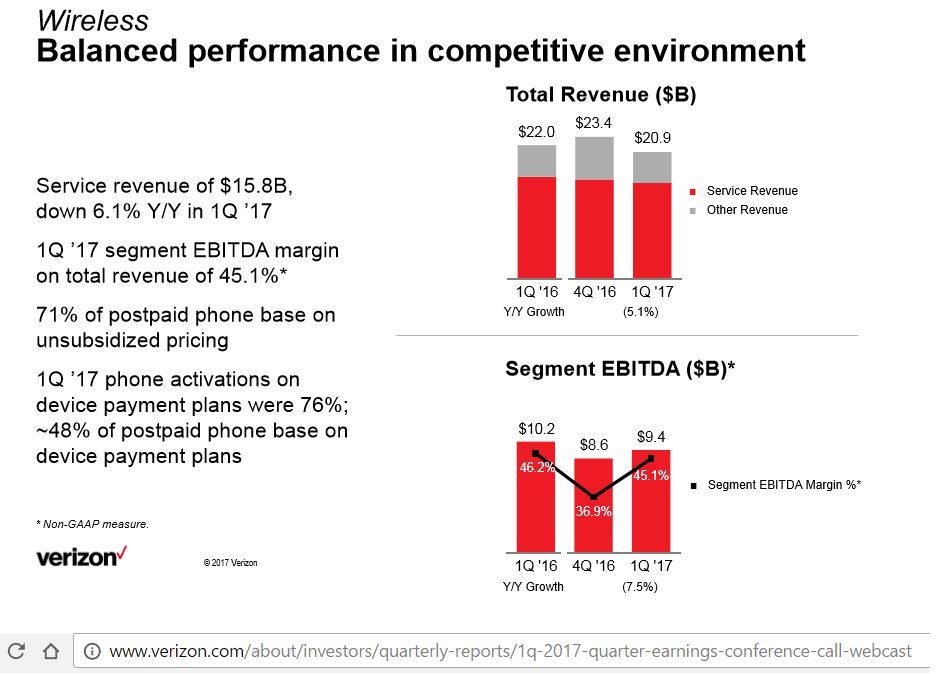
- Total revenues were $20.9 billion in first-quarter 2017, a decline of 5.1 percent compared with first-quarter 2016, due to decreased overage revenue, lower postpaid customers in the quarter and continued promotional activity.
- In first-quarter 2017, overall traffic on LTE increased about 57 percent compared with first-quarter 2016, while Verizon extended its lead in the industry’s third-party network performance studies across the country.
Some Wireline highlights
- Total wireline revenues declined 0.6 percent, to $7.9 billion, comparing first-quarter 2017 with first-quarter 2016. Consistent with recent trends and on a comparable basis (non-GAAP), this decline was 3.2 percent, excluding revenues from XO Communications in first-quarter 2017.
- Total Fios revenues grew 4.7 percent, to $2.9 billion, comparing first-quarter 2017 with first-quarter 2016. This supported revenue growth of 0.7 percent in consumer markets and 2.3 percent in business markets.
- In first-quarter 2017, Verizon added a net of 35,000 Fios Internet connections and lost a net of 13,000 Fios Video connections. At the end of first-quarter 2017, Verizon had 5.7 million Fios Internet connections and 4.7 million Fios Video connections, year-over-year increases of 3.3 percent and 0.1 percent, respectively.