Verizon outlined a multibillion-dollar AI infrastructure strategy centered on long-haul fiber, metro networks, data center interconnection, and edge inference facilities as it reported stronger second-quarter 2026 operating results and raised its full-year financial outlook. The company disclosed a dark-fiber agreement with Google valued at more than $1 billion and said additional contracts expected by year-end could collectively generate several billion dollars over the coming years. Verizon expects its AI Connect initiative to begin making a noticeable revenue contribution in 2027, adding a new growth vector above its accelerating mobility and broadband operations.
Management said hyperscalers, alternative cloud providers, and enterprises increasingly need high-capacity links between geographically distributed data centers as AI architectures expand beyond individual racks and facilities. Verizon plans to supply both dark and lit fiber depending on customer requirements, using its North American long-haul and metro footprint to connect compute clusters across data centers, regions, and cloud platforms. The company is also converting selected central offices into power-ready, permitted edge data centers for latency-sensitive AI inference. CEO Dan Schulman said an initial central-office trial sold out its available capacity within 24 hours.
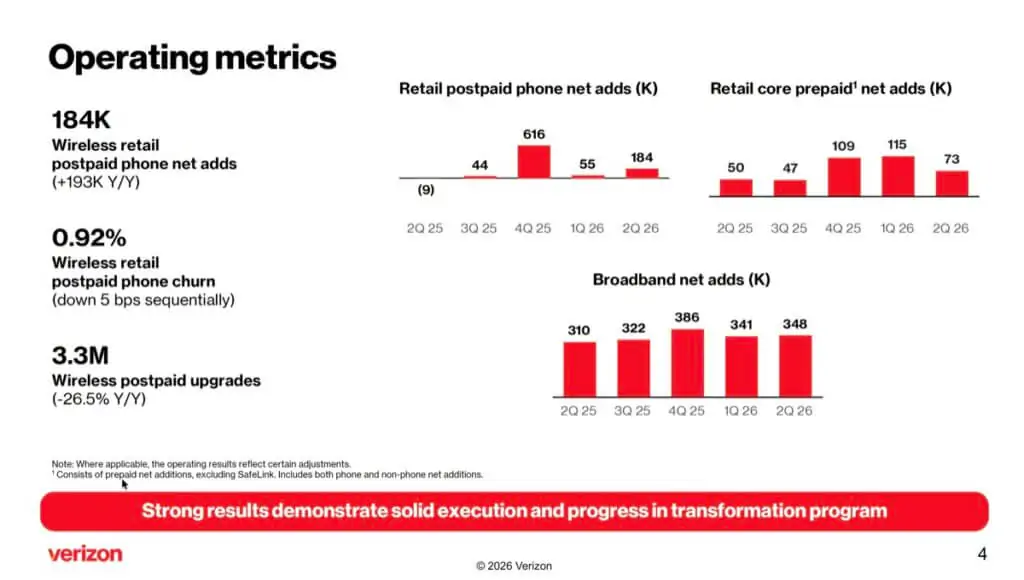
The AI infrastructure strategy accompanied improvements across Verizon’s core business. Mobility and broadband service revenue increased 2.8% year-over-year to approximately $23.4 billion, while adjusted EBITDA rose 7.2% to a record $13.7 billion. Verizon added 184,000 postpaid phone subscribers and 348,000 broadband customers, including 193,000 fixed wireless access additions and 155,000 fiber additions. The company raised its 2026 outlook for mobility and broadband service revenue, adjusted EPS, operating cash flow, and free cash flow. Verizon’s earnings presentation shows improving subscriber, churn, profitability, and cash-flow metrics alongside the revised guidance.
“The build-out of AI infrastructure across the United States is one of the largest capital cycles of our lifetime, and Verizon is uniquely positioned to participate in it,” said Dan Schulman, Verizon CEO. “We own one of the most extensive long-haul and metro fiber footprints in North America.”
🌐 Analysis
Verizon’s Q2 earnings release focused on stable subscriber metrics and solid financial results. It presented AI infrastructure as an emerging opportunity. However on the investor call, management introduced Verizon AI Connect as a defined commercial initiative with contracted revenue, identified customers, network architecture, margin expectations, and a 2027 contribution timeline. That warrants placing AI infrastructure—not subscriber growth—at the center of our headline and opening sentence of this article.
The strategy positions Verizon as a supplier of the inter-data-center connectivity required as AI systems expand from scale-up networking inside a rack to scale-out fabrics across a facility and, increasingly, scale-across connections between campuses and regions. Verizon is pursuing this market through existing fiber assets, new success-based construction, dark and lit optical services, and edge facilities created from central-office infrastructure. The initiative complements, rather than underpins, Verizon’s forecast of approximately 4% mobility and broadband service revenue growth in the fourth quarter; management said AI Connect revenue will begin layering onto the core business in 2027.
Earnings Call Key Points
• Verizon publicly identified its AI infrastructure program as Verizon AI Connect for the first time.
• The company signed a dark-fiber agreement with Google valued at well above $1 billion covering several data center interconnection routes.
• Verizon expects to announce additional AI infrastructure agreements by year-end that could collectively represent several billion dollars of revenue over multiple years.
• Management described the contracts as long-duration, contracted revenue streams serving hyperscalers, alternative cloud providers, and large enterprises.
• AI Connect revenue is expected to become noticeable in 2027 and grow substantially over the following five to ten years.
• Management said AI Connect margins should equal or exceed Verizon’s existing corporate margin structure.
• Verizon will provide either dark fiber or lit optical connectivity according to the customer’s preferred operating model. Dark-fiber customers can deploy their own optical systems, while lit-service customers can rely on Verizon for electronics and service management.
• Management said AI infrastructure demand is shifting from optimizing accelerators within racks and linking racks inside a data center toward connecting separate data centers to pool and maximize available compute capacity.
• Verizon is retrofitting central offices into edge data centers for inference workloads requiring low latency, including robotics, autonomous systems, and other distributed applications.
• These central-office sites already offer power, permits, redundant infrastructure, and access to Verizon’s metro and long-haul fiber networks.
• Schulman said a small central-office capacity trial sold out within 24 hours, which management cited as an early indicator of demand.
• Verizon characterized spending for AI Connect as success-based capital, meaning expansion should follow committed customer demand rather than speculative network construction.
• The company said decades of experience in carrier-grade fiber construction, permitting, operations, and network resilience differentiate it in large-scale data center connectivity projects.
• Verizon acquired 82 AWS-3 spectrum licenses for approximately $3.2 billion and said the spectrum can be deployed using existing infrastructure without incremental capital investment.
• Verizon expects to deploy the acquired AWS-3 spectrum within weeks of receiving the licenses from the FCC.
• The company remains on track to exceed 32 million fiber passings by year-end 2026.
• Approximately 58% of Verizon broadband customers also subscribe to Verizon mobility services, supporting the company’s convergence strategy.
• Customers taking both mobility and broadband services show materially lower churn than customers subscribing to only one product.
• More than half of the early Verizon One subscribers selected higher broadband speed tiers, creating incremental average revenue per account.
• Simplicity customers are generally acquired without handset subsidies, creating a structurally different margin profile from conventional wireless plans.
• Early Simplicity results exceeded internal forecasts, with gross additions approximately 16% above plan and net new accounts approximately 31% above plan.
• Simplicity attracted more one- and two-line accounts, younger customers, and more diverse customer cohorts than Verizon expected.
• Consumer promotional customer-acquisition costs fell approximately 15% year-over-year, while promotional retention costs declined approximately 17%.
• Management said promotional amortization headwinds have peaked and should ease through the second half of 2026 before becoming a tailwind in 2027.
• Verizon is incorporating AI models into network operations to identify and autonomously resolve some network problems within minutes rather than hours.
• The company said network-performance measurements improved sequentially each month following remediation work initiated after a January network event.
• Verizon remains on track to deliver at least $9 billion of combined operating and capital-efficiency improvements through its broader transformation program.
• The planned BT joint venture will combine the companies’ international wireline operations, serve more than 3,000 enterprise customers, and generate approximately $4 billion in combined revenue at formation.
• Verizon expects the BT transaction to produce approximately $200 million in annualized savings compared with retaining its international business in its current form.
• The BT joint venture is expected to close during the second half of 2027, subject to regulatory and customary approvals.
• Verizon said it had repaid substantially all debt assumed through the Frontier acquisition six months ahead of schedule.
• Frontier integration remains ahead of plan, with Verizon targeting more than $1 billion in annual operating-cost synergies by 2028.
• Verizon’s board extended Dan Schulman’s CEO contract through December 31, 2028.