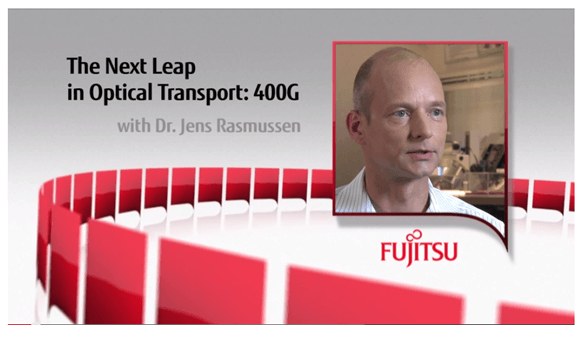
The next leap in optical transport will take us to 400G, says Dr. Jens Rasmussen, Director, Photonic Systems Labs at Fujitsu Laboratories. This will bring several keep benefits in operational savings and capital savings. 400G cards will be software-definable to enable a flexible mix of bit rates and thereby simplify inventory management. The leap to 400G is also about transporting more data on a single fiber. Fujitsu R&D is actively working on ways of improving spectral efficiency by bringing channels closer together. Adaptive modulation for line side cards includes support for today’s QPSK and more complex formats like 8QAM and 16QAM.
Every article published by Converge Digest is researched, curated, fact-checked and editorially reviewed by Jim Carroll, Editor & Publisher. AI-assisted drafting may be used to accelerate production, but all content is reviewed, refined and approved prior to publication.
You just read about Optical. A name from the archive that helped shape it:
NeoPhotonics built Coherent optical components and modules. What became of it?
NeoPhotonics brought Coherent optical components and modules to Optical. That work was distinctive enough to lead to its acquisition by Lumentum for US$918M. The standalone name now passes into the archive — but the team and technology continue inside Lumentum today. One of 430 names here whose work outlived the company.
You just read about Optical. A technology from the archive that helped get us here:
Direct-detect 10G + dispersion compensation served 1996–2010. What ultimately replaced it?
Direct-detect 10G + dispersion compensation 10G on-off-keyed light needed spools of dispersion-compensating fiber and careful per-span tuning to undo the chromatic dispersion that smeared pulses over distance. Its job passed to Coherent DWDM (DSP) — but the problem it solved, and the ideas it proved, live on in what replaced it. The standard rests here in the archive. One of 198 technologies here that opened a door and then held it for the next.