
• Home
  • About
  • Events Calendar
  • Blueprint Guidelines
  • Privacy Policy
  • Manage Email Delivery
  • NextGenInfra.io
No Result
View All Result
Converge Digest
Sunday, May 31, 2026
  • Home
  • About
  • Events Calendar
  • Blueprint Guidelines
  • Privacy Policy
  • Manage Email Delivery
  • NextGenInfra.io
No Result
View All Result
Converge Digest
No Result
View All Result

Home » AI Infrastructure Summit: Cerebras Wafer-Scale LeapData Center Expansion

AI Infrastructure Summit: Cerebras Wafer-Scale LeapData Center Expansion

September 11, 2025
in All
A A

Cerebras CTO Sean Lie took the stage at today’s AI Infrastructure Summit to argue that AI inference speed has hit a wall on GPUs and that wafer-scale chips are the breakthrough needed to unlock instant and real-time AI. Lie highlighted how Cerebras’ third-generation Wafer Scale Engine (WSE-3), with 4 trillion transistors across 46,000 mm² of silicon, delivers 125 petaflops of compute and 21 PB/s of memory bandwidth—7,000x more on-chip bandwidth than GPUs. By keeping model weights entirely on chip, Cerebras eliminates the memory bottleneck that slows generative AI inference on traditional accelerators.

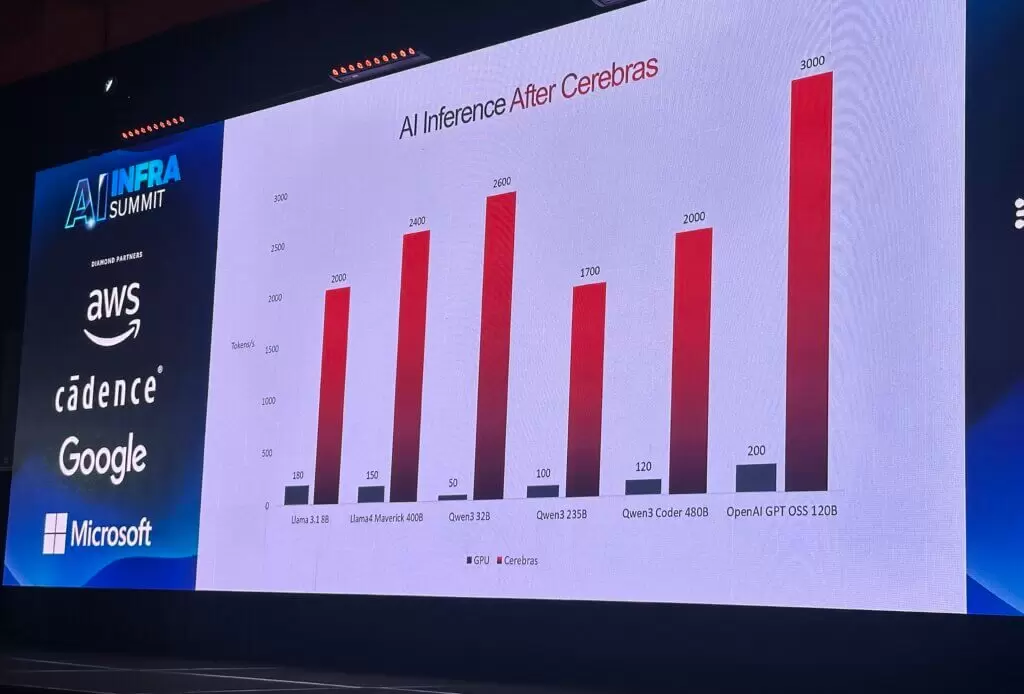
Live demos compared GPU inference against Cerebras hardware across models such as Meta’s Llama 4 Maverick (400B), Qwen3 (32B, 235B, 480B), and OpenAI GPT-OSS 120B. GPU inference crawled at 50–200 tokens per second, while Cerebras produced 2,000–3,000 tokens per second—up to 15x faster—enabling “instant chat,” practical reasoning models, and real-time coding agents. Lie emphasized that this leap transforms developer productivity, turning minutes-long coding loops into interactive cycles measured in seconds.

To meet demand, Cerebras is scaling out a distributed AI cloud footprint. The company started 2024 with two California sites and now operates large-scale data centers in Dallas (20 exaflops), Minneapolis (64 exaflops), and Oklahoma City—its largest facility to date. Additional sites are under construction in Montreal, Atlanta, and France, extending coverage across North America and Europe. Lie said this global rollout will make the “world’s fastest inference” broadly available to enterprises and developers.

  • Wafer Scale Engine: 4 trillion transistors, 46,000 mm² silicon, 125 petaflops compute, 21 PB/s bandwidth
  • GPU bottleneck: off-chip HBM forces data through narrow buses, slowing inference
  • Cerebras performance: 2,000–3,000 tokens/sec vs 50–200 tokens/sec on GPUs
  • Unlocks reasoning models: reduces 20s+ GPU reasoning phases to ~1s
  • Data center expansion: Dallas, Minneapolis, Oklahoma City live; Montreal, Atlanta, France underway

“We believe wafer-scale architecture unlocks the next era of AI—instant chat, instant reasoning, and real-time coding—that GPUs simply cannot deliver,” said Sean Lie, CTO of Cerebras.

🌐 Analysis: Cerebras is positioning its wafer-scale approach as the only way to bypass GPU memory bottlenecks, directly challenging Nvidia’s dominance in inference. With reasoning and agentic AI models emerging as the frontier workloads, Cerebras is betting that speed is intelligence, and that enterprises will pay for inference acceleration rather than just training scale. Competitors like Groq and Tenstorrent are making similar low-latency claims, but Cerebras’ aggressive data center expansion signals a play to control AI inference as a service, not just sell chips.

🌐 We’re tracking the latest developments in AI infrastructure. Follow our ongoing coverage at: https://convergedigest.com/category/ai-infrastructure/
ShareTweetShareSummarizeSummarize
Previous Post

i4Networks Taps Nokia ROADM to Boost European DCI

Next Post

Synopsys Warns of Continued IP Weakness Amid China and Foundry Headwinds

Jim Carroll

Jim Carroll

Editor and Publisher, Converge! Network Digest, Optical Networks Daily - Covering the full stack of network convergence from Silicon Valley

Related Posts

AI Infrastructure

SoftBank Targets 5 GW of AI Infrastructure in France 

May 30, 2026
Clouds and Carriers

Telefónica and Google Cloud Launch Sovereign Cloud for Spain

May 29, 2026
Semiconductors

XCENA Raises $135M to Scale Memory-Centric Computing for AI Infrastructure

May 29, 2026
AI Infrastructure

Anthropic Raises $65B as its AI Infrastructure Buildout Accelerates 

May 28, 2026
Financials

Credo Completes DustPhotonics Acquisition, Adds Silicon Photonics PICs

May 28, 2026
All

COMPUTEX 2026 Preview: AI Infrastructure Showcase in Taipei

May 28, 2026
Next Post

Synopsys Warns of Continued IP Weakness Amid China and Foundry Headwinds

Categories

  • 5G / 6G / Wi-Fi
  • AI Infrastructure
  • All
  • Automotive Networking
  • Blueprints
  • Clouds and Carriers
  • Data Centers
  • Enterprise
  • Explainer
  • Feature
  • Financials
  • Last Mile / Middle Mile
  • Legal / Regulatory
  • Optical
  • Quantum
  • Research
  • Security
  • Semiconductors
  • Space
  • Start-ups
  • Subsea
  • Sustainability
  • Video
  • Webinars

Archives

Tags

5G All AT&T Australia AWS Blueprint columns BroadbandWireless Broadcom China Ciena Cisco Data Centers Dell'Oro Ericsson FCC Financial Financials Huawei Infinera Intel Japan Juniper Last Mile Last Mille LTE Mergers and Acquisitions Mobile NFV Nokia Optical Packet Systems PacketVoice People Regulatory Satellite SDN Service Providers Silicon Silicon Valley StandardsWatch Storage TTP UK Verizon Wi-Fi
Converge Digest

A private dossier for networking and telecoms

Follow Us

  • Home
  • About
  • Events Calendar
  • Blueprint Guidelines
  • Privacy Policy
  • Manage Email Delivery
  • NextGenInfra.io

© 2026 Converge Digest - A private dossier for networking and telecoms.

No Result
View All Result
  • Home
  • About
  • Events Calendar
  • Blueprint Guidelines
  • Privacy Policy
  • Manage Email Delivery
  • NextGenInfra.io

© 2026 Converge Digest - A private dossier for networking and telecoms.

This website uses cookies. By continuing to use this website you are giving consent to cookies being used. Visit our Privacy and Cookie Policy.
Go to mobile version