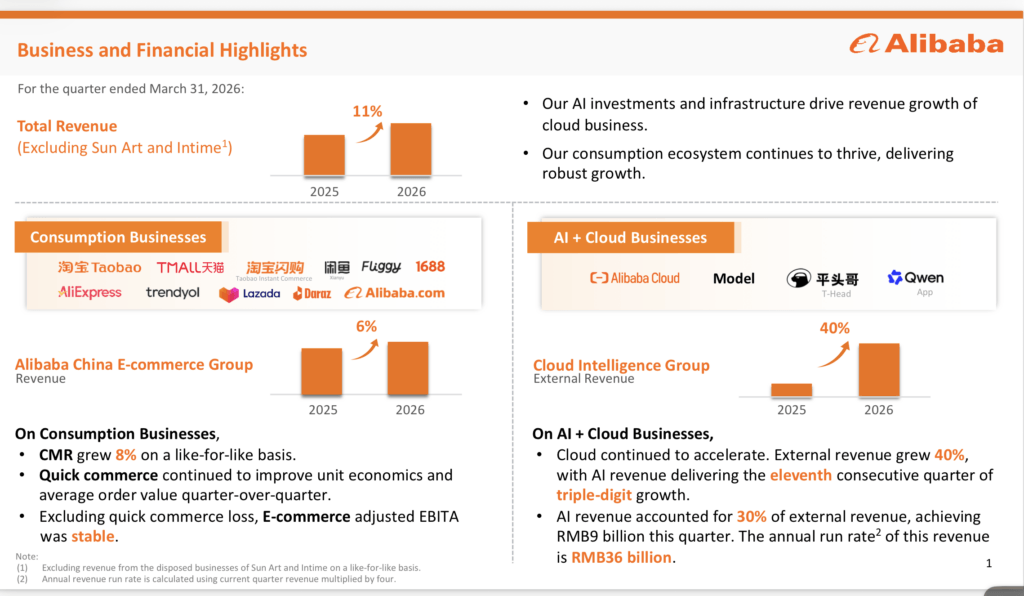
Alibaba Group is rapidly expanding its AI infrastructure footprint, reporting 38% year-over-year growth for its Cloud Intelligence Group during the March 2026 quarter as demand for AI training, inference, and Model-as-a-Service (MaaS) platforms accelerates across China’s enterprise and developer ecosystem. The company said Cloud Intelligence revenue reached RMB41.6 billion (US$6.0 billion), while AI-related product revenue delivered its eleventh consecutive quarter of triple-digit growth.
Alibaba’s earnings underscore a broader hyperscaler trend: AI infrastructure is becoming the primary engine of cloud growth, even as profitability comes under pressure from aggressive capital expenditures. The company disclosed fiscal 2026 capital expenditures of RMB126.1 billion (US$18.3 billion), driven largely by cloud infrastructure expansion. Alibaba also reported free cash flow swung to a negative RMB46.6 billion (US$6.8 billion) for the fiscal year, citing increased cloud infrastructure expenditure and AI investments. The company now positions itself as a full-stack AI infrastructure provider spanning large language models, orchestration software, distributed storage, networking, proprietary silicon, and public cloud services.
The infrastructure narrative extended well beyond cloud compute. Alibaba highlighted growing demand for heterogeneous AI clusters, high-performance networking, and inference acceleration as enterprises adopt generative AI services at scale. The company’s Model Studio MaaS platform expanded its customer base eight-fold year-over-year as of March 2026. Alibaba also emphasized orchestration software capable of managing heterogeneous chip clusters, including its internally developed inference silicon from its T-Head semiconductor unit. T-Head reported deployment of more than 100,000 Zhenwu PPUs on Alibaba Cloud infrastructure, including deployments supporting autonomous driving development workloads.
The company’s AI portfolio increasingly resembles the vertically integrated strategies emerging among global hyperscalers. Alibaba continues to invest heavily in:
- AI training clusters
- AI inference infrastructure
- high-performance networking
- distributed storage systems
- cloud operating systems
- orchestration software
- multimodal AI models
- proprietary AI silicon
- enterprise AI agents
- large context-window foundation models
Alibaba’s Qwen model family also continued to evolve during the quarter. The company launched Qwen3.6-Plus with a native context window of up to 1 million tokens, enhanced multimodal reasoning, and improved coding capabilities targeted at agentic AI applications. Alibaba additionally introduced “HappyOyster,” a world model platform, alongside “HappyHorse,” a multimodal video generation model.
From an infrastructure utilization perspective, Alibaba disclosed that AI-related products now account for approximately 30% of Cloud Intelligence Group external revenue. Cloud segment adjusted EBITA increased 57% year-over-year to RMB3.8 billion despite ongoing investments in technology innovation and customer acquisition.
The scale of Alibaba’s AI expansion also affected company-wide operating metrics. Product development expenses rose to RMB66.5 billion (US$9.6 billion) for fiscal 2026, while sales and marketing expenses jumped to RMB245.0 billion (US$35.5 billion), partly driven by user acquisition for the Qwen AI application. The company ended the fiscal year with RMB520.8 billion (US$75.5 billion) in cash and liquid investments available to support continued infrastructure deployment.
“Alibaba Cloud continues to onboard more customers to our comprehensive AI + cloud products and services, including high-performance networking, distributed storage, cloud operating system, and services for model training and inference,” said Eddie Wu, Chief Executive Officer of Alibaba Group. “We are executing our strategy to lead China’s AI cloud market through our comprehensive full-stack AI capabilities across AI models, AI cloud infrastructure, and orchestration software that manages heterogeneous chip clusters, including our own proprietary inference chips.”
🌐 Analysis: Alibaba’s latest results reinforce a major global infrastructure trend: hyperscalers increasingly view AI infrastructure as a strategic platform investment rather than a short-term profit center. Similar to recent commentary from Microsoft, Amazon, Meta, and Alphabet, Alibaba is prioritizing AI compute density, networking scale, orchestration software, and proprietary silicon integration over near-term margins. The combination of AI model development, public cloud growth, and internal semiconductor initiatives increasingly positions hyperscalers as vertically integrated infrastructure companies.
🌐 Analysis: Alibaba’s focus on heterogeneous cluster orchestration and proprietary inference silicon also reflects broader industry pressure around GPU supply constraints, inference economics, and sovereign AI infrastructure development. As Chinese hyperscalers expand domestic AI infrastructure under export-control limitations, demand is likely to intensify for advanced optical interconnects, Ethernet fabrics, AI networking systems, distributed storage, and alternative accelerator architectures throughout the Asia-Pacific market.
🌐 We’re tracking the latest developments in AI infrastructure, networking silicon, and hyperscaler architectures. Follow our ongoing coverage at: https://convergedigest.com/category/semiconductors/