• Home
  • About
  • Events Calendar
  • Blueprint Guidelines
  • Privacy Policy
  • Manage Email Delivery
  • NextGenInfra.io
No Result
View All Result
Converge Digest
Monday, June 1, 2026
  • Home
  • About
  • Events Calendar
  • Blueprint Guidelines
  • Privacy Policy
  • Manage Email Delivery
  • NextGenInfra.io
No Result
View All Result
Converge Digest
No Result
View All Result

Home » US Tightens Export Rules to Restrict China’s Advanced Chip Development

US Tightens Export Rules to Restrict China’s Advanced Chip Development

December 3, 2024
in Semiconductors
A A

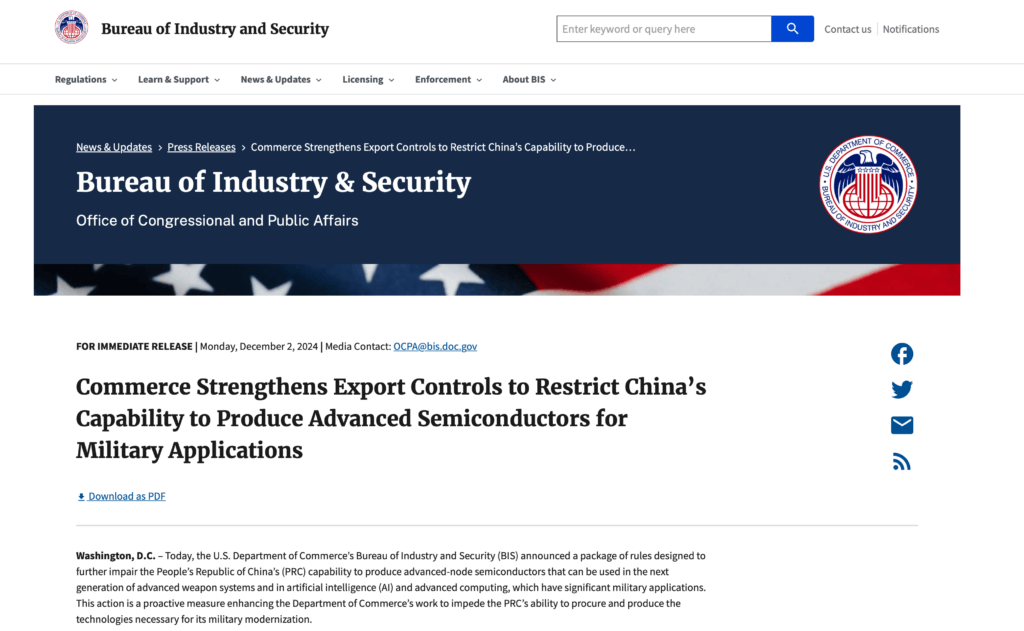
The U.S. Department of Commerce’s Bureau of Industry and Security (BIS) has introduced a sweeping set of rules to curtail China’s ability to develop advanced semiconductors and artificial intelligence (AI) technologies. These measures are aimed at impairing the People’s Republic of China’s (PRC) military modernization efforts, including advanced weapon systems and AI applications with significant national security implications. The rules expand controls on semiconductor manufacturing equipment, high-bandwidth memory (HBM), and certain software tools. They also add 140 entities to the export blacklist, targeting firms that support Beijing’s advanced chipmaking goals.

Specific measures include restrictions on 24 types of semiconductor manufacturing equipment and three types of software for designing advanced chips. BIS has also introduced two new Foreign Direct Product (FDP) rules, which extend U.S. export jurisdiction over foreign-produced tools destined for China’s military-linked entities. Additionally, export controls on software keys and electronic design tools have been clarified to close loopholes. These actions align with BIS’s “small yard, high fence” strategy, focusing on limiting PRC’s access to critical technologies while preserving legitimate trade.

Commerce Secretary Gina Raimondo emphasized the collaborative approach with allies, stating, “These measures are part of a targeted effort to prevent China from leveraging U.S. technology for military advancements. No administration has been more strategic in addressing this threat.” The updated export rules build on earlier efforts from 2022 and 2023 and represent the Biden-Harris Administration’s ongoing response to evolving geopolitical challenges.

Key Points:

• New controls on 24 types of semiconductor manufacturing tools, including etching, deposition, and lithography equipment.

• Restrictions on high-bandwidth memory (HBM) used in AI and advanced computing applications.

• 140 entities added to the export blacklist, including semiconductor fabs and investment firms aiding China’s chip industry.

• Introduction of two new FDP rules to extend U.S. jurisdiction over foreign-produced semiconductor equipment tied to China.

• Tightened controls on software keys and electronic design tools critical to advanced-node chip production.


Tags: ChinaDepartment of CommerceEntity List
ShareTweetShareSummarizeSummarize
Previous Post

Dell’Oro: Optical Transport Equipment Market Drops 18% in 3Q 2024

Next Post

U.S. Navy Taps Rivada for Virtual Network on Outernet Satellite Constellation

Jim Carroll

Jim Carroll

Editor and Publisher, Converge! Network Digest, Optical Networks Daily - Covering the full stack of network convergence from Silicon Valley

Related Posts

AI Infrastructure

U.S. Government Backs 10 GW AI Campus in Ohio

May 21, 2026
Clouds and Carriers

Alibaba Accelerates AI Infrastructure Buildout as Cloud Revenue Surges 38%

May 15, 2026
Optical

China’s Triple-Stone Debuts 512×512 Optical Circuit Switch with MDC

March 29, 2026
Clouds and Carriers

FCC Moves to Expel Hong Kong Telecom from U.S.

October 20, 2025
Semiconductors

NVIDIA Greenlit to Resume H20 GPU Sales to China

July 14, 2025
Semiconductors

Xiaomi Debuts its own 3nm Chipset

May 27, 2025
Next Post

U.S. Navy Taps Rivada for Virtual Network on Outernet Satellite Constellation

Categories

  • 5G / 6G / Wi-Fi
  • AI Infrastructure
  • All
  • Automotive Networking
  • Blueprints
  • Clouds and Carriers
  • Data Centers
  • Enterprise
  • Explainer
  • Feature
  • Financials
  • Last Mile / Middle Mile
  • Legal / Regulatory
  • Optical
  • Quantum
  • Research
  • Security
  • Semiconductors
  • Space
  • Start-ups
  • Subsea
  • Sustainability
  • Video
  • Webinars

Archives

Tags

5G All AT&T Australia AWS Blueprint columns BroadbandWireless Broadcom China Ciena Cisco Data Centers Dell'Oro Ericsson FCC Financial Financials Huawei Infinera Intel Japan Juniper Last Mile Last Mille LTE Mergers and Acquisitions Mobile NFV Nokia Optical Packet Systems PacketVoice People Regulatory Satellite SDN Service Providers Silicon Silicon Valley StandardsWatch Storage TTP UK Verizon Wi-Fi
Converge Digest

A private dossier for networking and telecoms

Follow Us

  • Home
  • About
  • Events Calendar
  • Blueprint Guidelines
  • Privacy Policy
  • Manage Email Delivery
  • NextGenInfra.io

© 2026 Converge Digest - A private dossier for networking and telecoms.

No Result
View All Result
  • Home
  • About
  • Events Calendar
  • Blueprint Guidelines
  • Privacy Policy
  • Manage Email Delivery
  • NextGenInfra.io

© 2026 Converge Digest - A private dossier for networking and telecoms.

This website uses cookies. By continuing to use this website you are giving consent to cookies being used. Visit our Privacy and Cookie Policy.
Go to mobile version