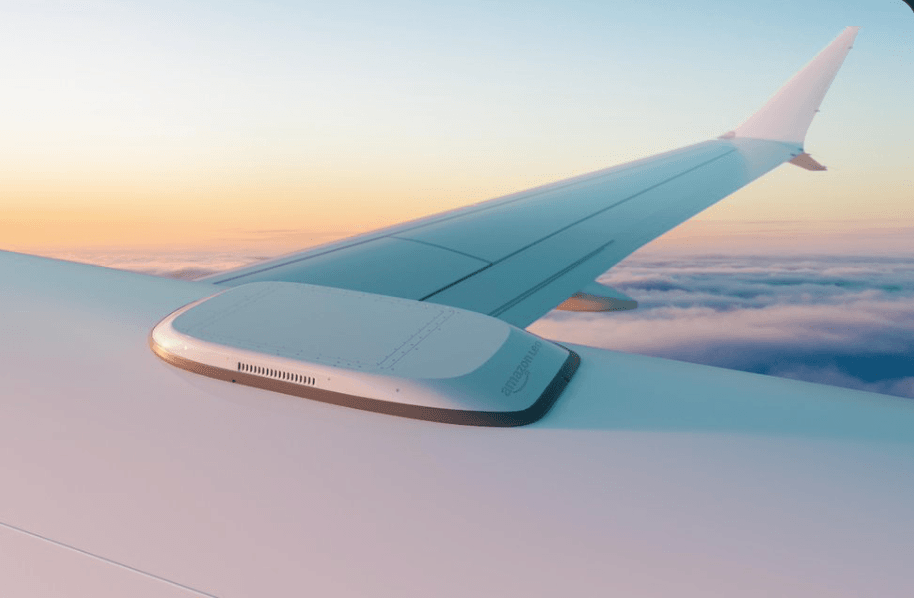
Amazon Leo introduced a new aviation-grade satellite antenna designed to deliver gigabit-class connectivity to commercial aircraft, targeting both passenger broadband and airline operational applications. The system marks a key step in extending Amazon’s low Earth orbit (LEO) satellite network into the aviation sector, where demand for high-capacity, low-latency connectivity continues to accelerate.
The Amazon Leo Aviation Antenna uses a full-duplex phased array architecture to deliver simultaneous speeds of up to 1 Gbps download and 400 Mbps upload to a single aircraft. The system is designed to support a full cabin of passengers across all seat classes, enabling streaming, gaming, and enterprise applications, while also providing near-real-time data capabilities for flight crews. The antenna connects to passing LEO satellites and seamlessly hands off between satellites as the aircraft moves, with data routed through a global network of more than 300 planned ground gateways and inter-satellite laser links to maintain coverage over oceans and remote regions.
From a hardware perspective, the antenna is electronically steered with no moving parts, reducing maintenance requirements and improving reliability under harsh aviation conditions. The unit integrates modem functionality and features a low-profile design measuring 58 x 30 x 2.6 inches (147 x 76 x 6.6 cm), minimizing aerodynamic drag and fuel impact. Amazon said the system can be installed in a single day using aviation-grade connectors and streamlined mounting. Early traction includes agreements with Delta Air Lines and JetBlue.
- Full-duplex phased array antenna delivering up to 1 Gbps downlink and 400 Mbps uplink
- Single antenna supports full-aircraft connectivity for passengers and crew
- Electronically steered design with no moving parts reduces maintenance
- Low-profile form factor minimizes drag and fuel consumption
- Integrated modem and simplified mounting enable single-day installation
- Connectivity maintained via LEO satellites with inter-satellite laser links
- More than 300 planned ground gateways to reduce latency and improve resilience
- Initial airline agreements include Delta Air Lines and JetBlue
“Amazon Leo can connect a full plane of passengers and crew with speeds that handle any activity seamlessly, whether passengers want to game, watch a movie, listen to music, or collaborate with colleagues on a project,” said Trevor Vieweg, director of global business for Amazon Leo. “We expect our service to be so fast and reliable that passengers will seek out flights featuring Leo connectivity.”
🌐 Analysis: Amazon Leo’s aviation push places it in direct competition with established LEO connectivity providers such as SpaceX and Eutelsat, both of which have already secured airline deployments. The emphasis on full-duplex throughput, simplified installation, and integration with AWS edge infrastructure suggests Amazon is targeting not only passenger Wi-Fi but also a broader platform for airline operations and cloud-connected services.
🌐 We’re tracking the latest developments in space-based connectivity and satellite networks. Follow our ongoing coverage at: https://convergedigest.com/category/space/