• Home
  • About
  • Events Calendar
  • Blueprint Guidelines
  • Privacy Policy
  • Manage Email Delivery
  • NextGenInfra.io
No Result
View All Result
Converge Digest
Monday, June 29, 2026
  • Home
  • About
  • Events Calendar
  • Blueprint Guidelines
  • Privacy Policy
  • Manage Email Delivery
  • NextGenInfra.io
No Result
View All Result
Converge Digest
No Result
View All Result

Home » Amazon’s Project Kuiper and NSF Agree on Astronomy-Safe Satellites 

Amazon’s Project Kuiper and NSF Agree on Astronomy-Safe Satellites 

July 1, 2025
in Space
A A

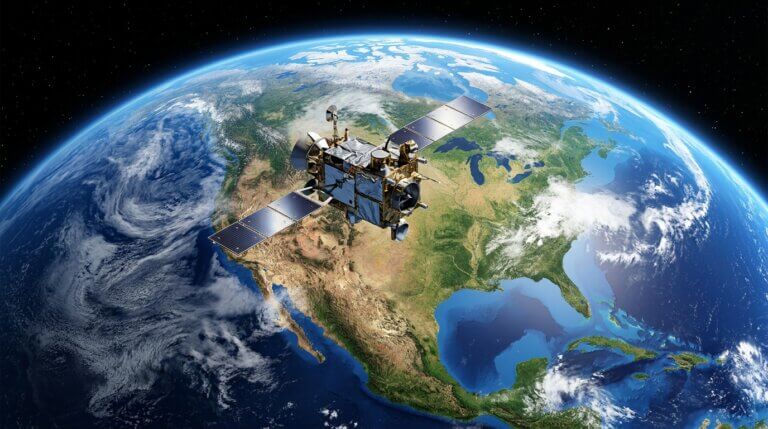
Amazon’s Project Kuiper and the U.S. National Science Foundation (NSF) have formalized a satellite coordination agreement aimed at reducing the impact of broadband satellites on ground-based astronomical research. The deal sets protocols to mitigate interference with optical, infrared, and radio telescopes while enabling Project Kuiper to deploy its low Earth orbit (LEO) satellite constellation to deliver global broadband coverage.

The agreement builds on ongoing technical collaboration between Project Kuiper, NSF’s NOIRLab and NRAO, and the broader U.S. astronomy community. It incorporates guidance from the International Astronomical Union’s Centre for the Protection of the Dark and Quiet Sky and covers a range of mitigation strategies. For optical astronomy, these include limiting orbital altitude to 700 km or below, reducing satellite brightness through design and maneuvering, and sharing high-precision ephemerides. For radio astronomy, it enables dynamic beam avoidance in key frequency ranges, protection of observatory receivers, and technical coordination despite not being a Federal Communications Commission (FCC) requirement.

The agreement also reflects progress from Kuiper’s initial 2024 prototype launches, including one satellite specifically engineered for low optical visibility. As Project Kuiper continues toward full constellation deployment, the dynamic framework will evolve alongside satellite and astronomy technologies, ensuring long-term coexistence between space-based internet infrastructure and astronomical science.

  • Formal NSF-Kuiper agreement supports both broadband expansion and astronomical research
  • Addresses optical, infrared, and radio interference with U.S. observatories
  • Aligns with best practices from the IAU’s Dark and Quiet Skies guidance
  • Includes collaboration on downlink interference, orbital data sharing, and laser impact mitigation
  • Builds on Kuiper’s prototype satellites, including one designed for brightness reduction

“We appreciate Project Kuiper and other commercial satellite companies working with NSF to help maintain our ability to explore the wonders of our universe through the unique capabilities of astronomical research facilities worldwide,” said Chris Smith, interim director of the NSF Division of Astronomical Sciences.

“We’ve been engaged with the astronomy community since the initial design and development of Project Kuiper,” added Chris Hofer, Head of International Spectrum Management and Strategy at Project Kuiper. “This agreement underscores our commitment to responsible space operations and our belief that satellite broadband and ground-based astronomy can successfully coexist.”

Tags: LEOProject Kuiper
ShareTweetShareSummarizeSummarize
Previous Post

Emerald AI Debuts Grid-Orchestrated AI Platform

Next Post

Arista Welcomes VeloCloud, Expands Campus and Branch Networking

Jim Carroll

Jim Carroll

Editor and Publisher, Converge! Network Digest, Optical Networks Daily - Covering the full stack of network convergence from Silicon Valley

Related Posts

Space

Arianespace Launches 36 More Amazon Leo Satellites on Upgraded Ariane 6

June 17, 2026
Financials

Astera Labs Q1 Revenue Jumps 93%, AI Fabric Growth

May 5, 2026
Space

Arianespace Launches 32 More Amazon Leo Sats on Ariane 64

May 1, 2026
Legal / Regulatory

FCC Overhauls Satellite Spectrum Rules to Boost NGSO Broadband Capacity

April 30, 2026
Financials

Amazon Q1 2026: AWS Surges 28% as Custom AI Chips Top $20B Run Rate

April 29, 2026
Space

ULA Atlas V Deploys 29 More Amazon LEO Satellites, Constellation Nears 270

April 27, 2026
Next Post

Arista Welcomes VeloCloud, Expands Campus and Branch Networking

Categories

  • 5G / 6G / Wi-Fi
  • AI Infrastructure
  • All
  • Automotive Networking
  • Blueprints
  • Clouds and Carriers
  • Data Centers
  • Enterprise
  • Explainer
  • Feature
  • Financials
  • Last Mile / Middle Mile
  • Legal / Regulatory
  • Optical
  • Quantum
  • Research
  • Security
  • Semiconductors
  • Space
  • Start-ups
  • Subsea
  • Sustainability
  • Video
  • Webinars

Archives

Tags

5G All AT&T Australia AWS Blueprint columns BroadbandWireless Broadcom China Ciena Cisco Data Centers Dell'Oro Ericsson FCC Financial Financials Huawei Infinera Intel Japan Juniper Last Mile Last Mille LTE Mergers and Acquisitions Mobile NFV Nokia Optical Packet Systems PacketVoice People Regulatory Satellite SDN Service Providers Silicon Silicon Valley StandardsWatch Storage TTP UK Verizon Wi-Fi
Converge Digest

A private dossier for networking and telecoms

Follow Us

  • Home
  • About
  • Events Calendar
  • Blueprint Guidelines
  • Privacy Policy
  • Manage Email Delivery
  • NextGenInfra.io

© 2026 Converge Digest - A private dossier for networking and telecoms.

No Result
View All Result
  • Home
  • About
  • Events Calendar
  • Blueprint Guidelines
  • Privacy Policy
  • Manage Email Delivery
  • NextGenInfra.io

© 2026 Converge Digest - A private dossier for networking and telecoms.

This website uses cookies. By continuing to use this website you are giving consent to cookies being used. Visit our Privacy and Cookie Policy.
Go to mobile version