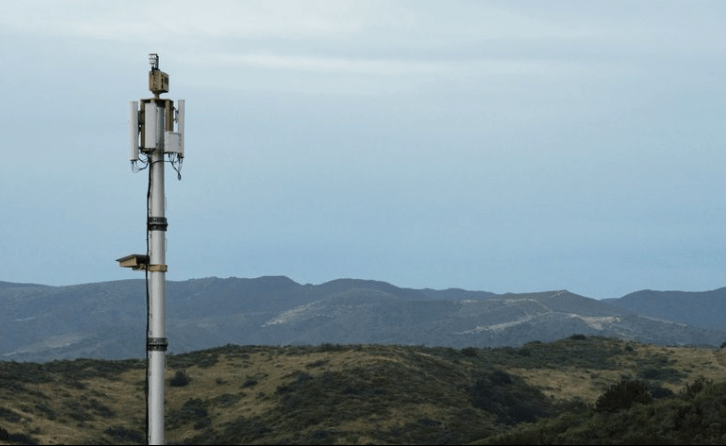
Anduril Industries introduced a new 5G-enabled communications system for austere environments, extending its Sentry Tower platform with integrated private cellular networking designed for military and remote industrial operations. The new 5G Comms Sentry Tower (CST) combines communications, compute, and onboard power to deliver infrastructure-independent connectivity in locations lacking traditional telecom support.
The system was developed in collaboration with Nokia Federal Solutions, incorporating Nokia’s private 5G technology with Anduril’s Sentry hardware and Lattice software platform. The companies position the solution as an alternative to legacy tactical radios and satellite links, offering higher throughput, lower latency, and support for dense device connectivity. Anduril says the system can be deployed in under three hours and scaled by linking multiple towers to expand coverage.
5G CST targets use cases such as forward operating bases, border security, missile ranges, and remote energy sites, where commercial cellular infrastructure is unavailable or impractical. The system operates independently of external power and networking, enabling rapid deployment without reliance on fixed infrastructure. Anduril also emphasizes a service-based pricing model that avoids traditional per-device telecom costs.
- Infrastructure-independent private 5G network with integrated power, compute, and comms
- Coverage spans several kilometers per tower; scalable via multi-node deployments
- Throughput supports tens to hundreds of Mbps uplink and up to 1+ Gbps downlink
- Deployable in under three hours with no external network or power dependencies
- Built on Anduril’s Lattice platform for centralized control and monitoring
- Developed with Nokia private 5G technology for secure, tactical-grade communications
- Offered via service-based pricing model rather than per-device telecom billing
“The 5G Comms Sentry Tower delivers mission-critical connectivity where traditional infrastructure cannot reach, enabling real-time coordination and high-throughput communications in the most remote environments,” the company said.
🌐 Analysis: Anduril’s move reflects a broader convergence between defense systems and private 5G networking, as tactical operations increasingly require cloud-like connectivity at the edge. The partnership with Nokia aligns with a growing trend among telecom vendors—including Ericsson and Samsung—to adapt private 5G platforms for defense and industrial deployments, particularly where resilience and rapid deployment are critical.