NVIDIA and Amazon Web Services expanded their long-running collaboration at AWS re:Invent by integrating NVIDIA’s NVLink Fusion interconnect into AWS’s custom silicon roadmap, including the forthcoming Trainium4 accelerator, Graviton CPUs and the AWS Nitro System. AWS plans to fuse NVLink scale-up connections with its own silicon and NVIDIA’s MGX rack architecture to boost performance across cloud-scale AI deployments and accelerate time-to-market for new services. The move positions AWS to unify GPU-based and custom-silicon AI infrastructure under a common scale-up fabric.
AWS is already deploying MGX racks with NVIDIA GPUs. Bringing NVLink Fusion into Trainium4 marks the first phase of a multigenerational collaboration that extends scale-up networking deeper into AWS’s purpose-built chips. The combination allows AWS to leverage NVIDIA’s supplier ecosystem for rack-scale systems, while continuing to support its Elastic Fabric Adapter and Nitro virtualization stack. NVIDIA’s Vera Rubin architecture on AWS will sustain compatibility with AWS cloud networking while offering new performance paths for AI clusters.
The companies also aligned on sovereign AI strategies. AWS will pair NVIDIA Blackwell GPUs and Spectrum-X Ethernet with the new AWS AI Factories offering, which provides dedicated AI infrastructure operated by AWS inside customer data centers. RTX PRO 6000 Blackwell Server Edition GPUs will arrive on AWS in the coming weeks. Together, NVIDIA and AWS aim to deliver globally distributed, sovereign-compliant AI environments designed for government, regulated enterprises and organizations seeking to retain local data control.
NVIDIA Nemotron models are now available on Amazon Bedrock, allowing customers to deploy open NVIDIA models with serverless scaling. AWS also introduced serverless GPU-accelerated vector indexing for Amazon OpenSearch Service using NVIDIA cuVS, enabling up to 10x faster vector index creation at lower cost. The software collaboration spans agentic AI development through Strands Agents, NVIDIA NeMo Agent Toolkit and Bedrock AgentCore, giving organizations a full path from prototype to production.
Robotics and physical AI workloads also gain new capabilities. NVIDIA Cosmos world foundation models now run as NIM microservices on Amazon EKS and AWS Batch, supporting real-time control, large-scale simulation and synthetic data generation. Robotics developers using platforms such as NVIDIA Isaac Sim and Isaac Lab can now integrate cloud-native workflows on AWS. NVIDIA recently received AWS’s Global GenAI Infrastructure and Data Partner of the Year award, highlighting the depth of the ongoing engineering relationship.
• AWS integrates NVIDIA NVLink Fusion into Trainium4, Graviton and the Nitro System for a unified scale-up architecture
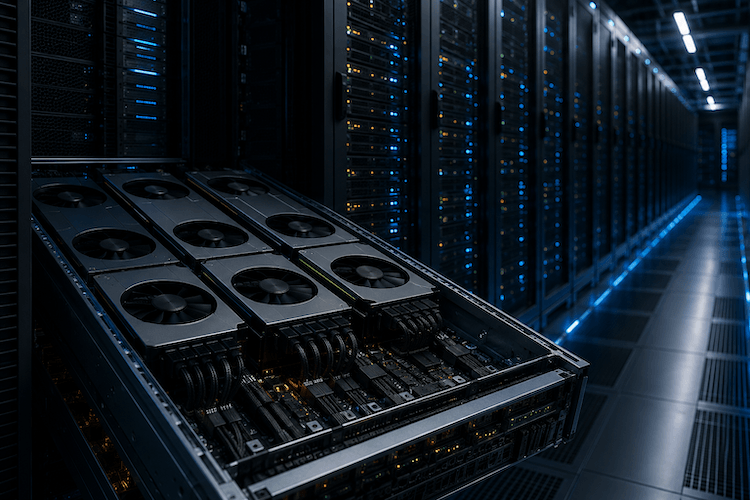
• NVLink Fusion and MGX rack systems support next-generation cloud-scale AI infrastructure
• NVIDIA Blackwell GPUs, GB300 NVL72 and HGX B300 expand AWS’s accelerated computing portfolio
• AWS AI Factories pair AWS cloud services with NVIDIA Blackwell and Spectrum-X for sovereign AI environments
• Nemotron models integrate into Amazon Bedrock for serverless access to open NVIDIA models
• Amazon OpenSearch Service introduces GPU-accelerated vector indexing using NVIDIA cuVS
• Robotics developers gain Cosmos WFMs on EKS and Batch, plus integration with Isaac Sim and Isaac Lab
“GPU compute demand is skyrocketing — more compute makes smarter AI,” said Jensen Huang, founder and CEO of NVIDIA. “With NVIDIA NVLink Fusion coming to AWS Trainium4, we’re unifying our scale-up architecture with AWS’s custom silicon to build a new generation of accelerated platforms.”
🌐 Analysis:
This expansion marks one of NVIDIA’s most advanced collaborations with a major cloud provider, extending NVLink Fusion beyond GPUs to AWS’s custom silicon portfolio. It also positions Trainium4 as a scale-up accelerator that more closely mirrors the GPU-centric cluster architectures dominating hyperscale AI. The integration of Nemotron models into Bedrock and GPU-accelerated vector indexing continues NVIDIA’s broader 2025 strategy of pushing deeper into cloud software ecosystems while reinforcing its hardware leadership.