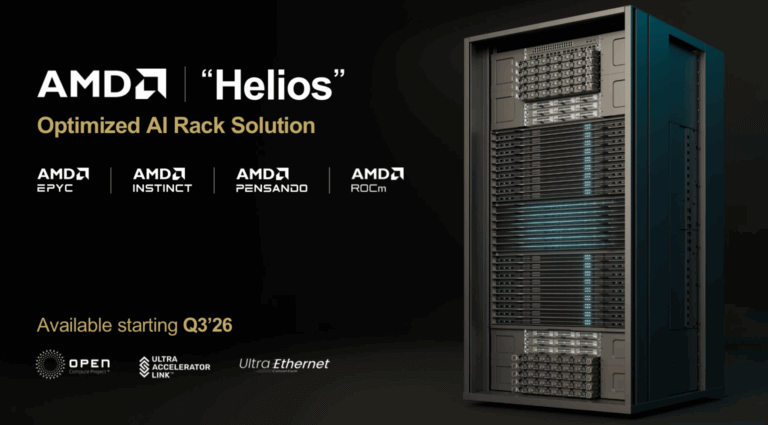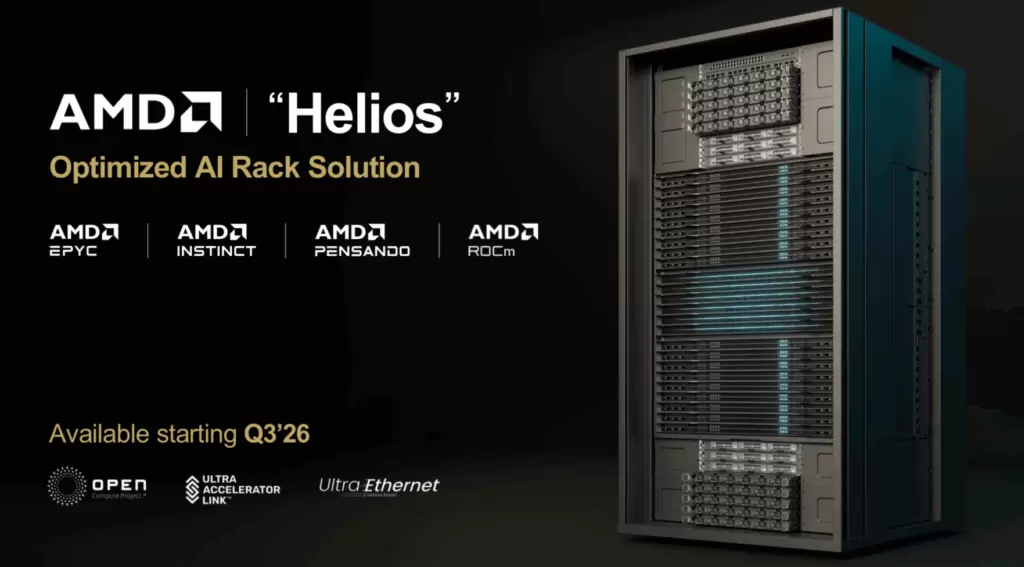
AMD and HPE announced an expanded collaboration to accelerate open, rack-scale AI infrastructure, with HPE becoming one of the first OEMs to adopt the new AMD “Helios” architecture. The platform integrates AMD CPUs, GPUs, networking, and ROCm software into an OCP Open Rack Wide design, combined with a purpose-built HPE Juniper Networking scale-up switch developed with Broadcom to support high-bandwidth, low-latency accelerator connectivity over Ethernet.
- HPE to adopt AMD “Helios” — an open, full-stack AI rack architecture integrating AMD EPYC “Venice” CPUs, AMD Instinct MI455X GPUs, AMD Pensando Vulcano NICs, and the ROCm software ecosystem.
- Purpose-built scale-up networking — HPE Juniper Networking, in collaboration with Broadcom, developed a switch optimized for Helios using the new Ultra Accelerator Link over Ethernet (UALoE) standard for high-bandwidth GPU connectivity.
- Rack-scale performance — Helios delivers up to 2.9 exaFLOPS of FP4 compute per rack for large-scale AI workloads and supports Open Rack Wide for streamlined deployment.
- Global availability in 2026 — HPE will offer complete Helios-based rack-scale systems worldwide.
- New European supercomputer — HLRS in Germany selected AMD and HPE for “Herder,” based on the HPE Cray GX5000 platform with AMD Instinct MI430X GPUs and EPYC “Venice” CPUs.
- Hybrid HPC + AI workflows — Herder will support both traditional simulation and next-generation AI/ML workloads. Delivery is planned for late 2027, replacing HLRS’s current Hunter system.
“For more than a decade, HPE and AMD have pushed the boundaries of supercomputing, delivering multiple exascale-class systems and championing open standards that accelerate innovation,” said Antonio Neri, president and CEO at HPE. “With the introduction of the new AMD ‘Helios’ and our purpose-built HPE scale-up networking solution, we are providing our cloud service provider customers with faster deployments, greater flexibility, and reduced risk in how they scale AI computing in their businesses.”
“HPE has been an exceptional long-term partner to AMD, working with us to redefine what is possible in high-performance computing,” said Dr. Lisa Su, chair and CEO at AMD. “With ‘Helios’, we’re taking that collaboration further, bringing together the full stack of AMD compute technologies and HPE’s system innovation to deliver an open, rack-scale AI platform that drives new levels of efficiency, scalability, and breakthrough performance for our customers in the AI era.”
Analysis
AMD’s Helios architecture signals the company’s strongest move yet into full-rack AI systems, an area increasingly dominated by vertically integrated GPU platforms. Helios stresses openness at every layer—OCP Open Rack Wide, Ethernet-based scale-up connectivity, and the ROCm software stack—positioning AMD as a counterweight to proprietary interconnects and closed system designs.
The introduction of UALoE is a major step: it establishes an Ethernet-native accelerator fabric built with Broadcom silicon and delivered through the HPE Juniper Networking product line. For cloud providers, this means scale-up GPU connectivity can use familiar tools, automation, and operational models rather than adopting proprietary link technologies.
HPE’s early adoption reflects its strategy to differentiate with open, standards-based supercomputing and to unify the combined HPE + Juniper Networking portfolio around AI-era fabrics. Meanwhile, the Herder supercomputer demonstrates AMD/HPE momentum in Europe’s sovereign compute initiatives, where hybrid HPC+AI capability and open architectures are becoming essential procurement criteria.