• Home
  • About
  • Events Calendar
  • Blueprint Guidelines
  • Privacy Policy
  • Manage Email Delivery
  • NextGenInfra.io
No Result
View All Result
Converge Digest
Tuesday, June 9, 2026
  • Home
  • About
  • Events Calendar
  • Blueprint Guidelines
  • Privacy Policy
  • Manage Email Delivery
  • NextGenInfra.io
No Result
View All Result
Converge Digest
No Result
View All Result

Home » Candle Submarine Cable to Deliver 24 Fiber Pairs Across Asia-Pacific by 2028

Candle Submarine Cable to Deliver 24 Fiber Pairs Across Asia-Pacific by 2028

September 22, 2025
in Subsea
A A

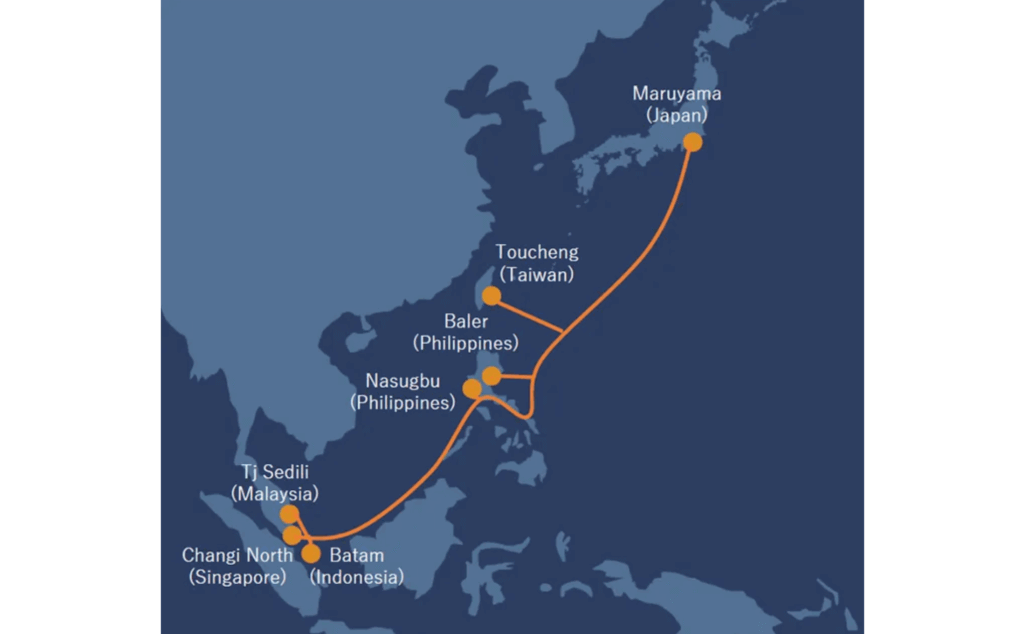
SoftBank, Meta, and regional partners are building a new 8,000 km submarine cable system called Candle to link Japan and Singapore with landings in Taiwan, the Philippines, Indonesia, and Malaysia. NEC has been contracted as system supplier, with operations targeted for 2028.

Candle will deploy 24 fiber pairs, above the typical 16–20 fiber pairs seen in most systems, to deliver higher capacity and lower latency across Asia. The system will provide new redundancy and diversity in response to surging data demand from 5G and generative AI. Meta’s Don Pang, who chairs the Candle Management Committee, said the system will strengthen regional resilience and serve over half a billion people in Asia-Pacific.

SoftBank will serve as the designated landing party in Japan, hosting Candle at its Maruyama Landing Station in Chiba Prefecture. The company is also expanding its cable station footprint with planned sites in Hokkaido and Kyushu. Candle adds to SoftBank’s involvement in other global cables such as JUPITER, ADC, and the under-construction E2A system.

• Candle spans 8,000 km, connecting Japan–Singapore via Taiwan, the Philippines, Indonesia, and Malaysia

• 24 fiber pairs will increase capacity compared to standard 16–20 pair designs

• NEC contracted as system supplier; operations expected in 2028

• SoftBank providing Japan landing station and new facilities in Hokkaido and Kyushu

• Partners include Meta, IPS Inc., TM Technology Services, and PT XLSmart Telecom Sejahtera

“Candle adopts a 24 fiber pair architecture, making it one of the core foundations of next-generation social infrastructure that SoftBank is promoting,” said Kimimasa Kudo, Vice President and Head of the Global Business Division, Enterprise Unit, SoftBank Corp.

🌐 Analysis: Candle joins a growing list of large-capacity submarine cable projects in the Pacific. Meta is already a key backer of Apricot and Echo, linking Japan, Singapore, and Guam to the U.S. Google has invested in subsea systems including Bifrost, Pacific Light Cable Network, and Taiwan’s Taiwan-Philippines-U.S. route. Other major systems under construction include Asia Link Cable (ALC) and Hawaiki Nui, each boosting intra-Asia and trans-Pacific diversity. Together, these systems reflect a wave of investment aimed at supporting hyperscale cloud services and AI-driven applications, while ensuring redundancy in a region prone to natural disasters and geopolitical chokepoints.

🌐 We’re tracking the latest developments in subsea cable infrastructure, policy, and deployments. Follow our ongoing coverage at: https://convergedigest.com/category/subsea/

Tags: JapanMetaNECSingaporeSoftbank
ShareTweetShareSummarizeSummarize
Previous Post

IREN Orders $674M in GPUs, Expands AI Cloud Business

Next Post

ECOC25: Open XR Optics Forum Adds 100G and BiDi Specs

Jim Carroll

Jim Carroll

Editor and Publisher, Converge! Network Digest, Optical Networks Daily - Covering the full stack of network convergence from Silicon Valley

Related Posts

AI Infrastructure

Singapore’s DayOne Accelerates Growth with US$4.5 Billion Raise 

June 7, 2026
AI Infrastructure

SoftBank Targets 5 GW of AI Infrastructure in France 

May 31, 2026
AI Infrastructure

U.S. Government Backs 10 GW AI Campus in Ohio

May 21, 2026
Subsea

NEC Completes East Micronesia Cable System Linking FSM, Kiribati, and Nauru

May 14, 2026
Signature: whKF177fklf7qGBqH5MkMhmEGtoOHPAyfLDZ958fBhmoxzvbFRg39DGBUMJ80VskXDUDkXVEfcQuQuLRYQUiFZrX93f4JaNMU2JplhlgcvVpUSG47flbf3uXz63tWRUyLGcOOQvVzoZqwNRLlra8DNHlAHj7U3YYyloW7LJTX0yGiFrJKdNvwPU6XcD7XCgkLmh1i9TP1ifo34IbJ9JdrzXBcgSZ4ZYfu0QfJS0TO8rKiu+QHIZM2u1ZIRRgMLJIIWz6YBqhfsZudTNR3pm2GXqvnCAb9xjLNLj944z05xc=
5G / 6G / Wi-Fi

Ericsson and KDDI Complete AI-Driven Uplink Optimization Trial

May 11, 2026
Space

Meta Bets on Space-Based Solar and Long-Duration Energy Storage 

April 27, 2026
Next Post

ECOC25: Open XR Optics Forum Adds 100G and BiDi Specs

Categories

  • 5G / 6G / Wi-Fi
  • AI Infrastructure
  • All
  • Automotive Networking
  • Blueprints
  • Clouds and Carriers
  • Data Centers
  • Enterprise
  • Explainer
  • Feature
  • Financials
  • Last Mile / Middle Mile
  • Legal / Regulatory
  • Optical
  • Quantum
  • Research
  • Security
  • Semiconductors
  • Space
  • Start-ups
  • Subsea
  • Sustainability
  • Video
  • Webinars

Archives

Tags

5G All AT&T Australia AWS Blueprint columns BroadbandWireless Broadcom China Ciena Cisco Data Centers Dell'Oro Ericsson FCC Financial Financials Huawei Infinera Intel Japan Juniper Last Mile Last Mille LTE Mergers and Acquisitions Mobile NFV Nokia Optical Packet Systems PacketVoice People Regulatory Satellite SDN Service Providers Silicon Silicon Valley StandardsWatch Storage TTP UK Verizon Wi-Fi
Converge Digest

A private dossier for networking and telecoms

Follow Us

  • Home
  • About
  • Events Calendar
  • Blueprint Guidelines
  • Privacy Policy
  • Manage Email Delivery
  • NextGenInfra.io

© 2026 Converge Digest - A private dossier for networking and telecoms.

No Result
View All Result
  • Home
  • About
  • Events Calendar
  • Blueprint Guidelines
  • Privacy Policy
  • Manage Email Delivery
  • NextGenInfra.io

© 2026 Converge Digest - A private dossier for networking and telecoms.

This website uses cookies. By continuing to use this website you are giving consent to cookies being used. Visit our Privacy and Cookie Policy.
Go to mobile version