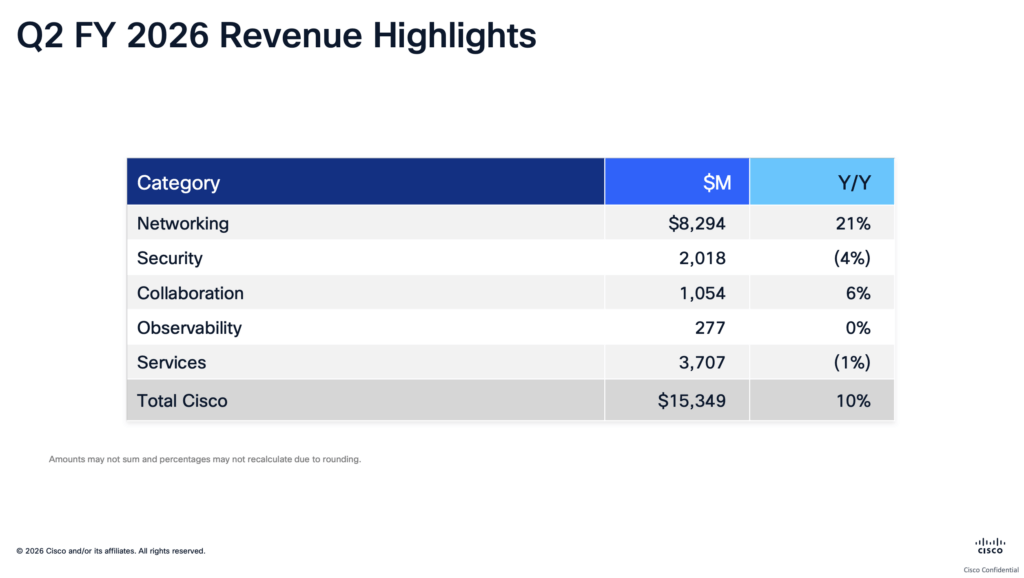
Cisco reported fiscal Q2 2026 revenue of $15.3 billion for the quarter ended January 24, 2026, up 10% year over year, driven by strength in networking and accelerating AI infrastructure demand. GAAP EPS rose 31% to $0.80, while non-GAAP EPS increased 11% to $1.04. Non-GAAP operating margin reached 34.6%, above the high end of guidance, reflecting operating leverage as product orders grew 18% year over year and networking product orders accelerated to more than 20%.
AI-related momentum from hyperscalers stood out in the quarter. Cisco reported $2.1 billion in AI infrastructure orders and described a multi-year, multi-billion-dollar campus networking refresh cycle underway. By segment, networking revenue reached $8.3 billion, up 21% year over year. Security declined 4% and observability was flat. Remaining performance obligations totaled $43.4 billion, up 5%, with long-term product RPO up 11%.
For Q3 FY2026, Cisco guided revenue to $15.4–$15.6 billion and non-GAAP EPS to $1.02–$1.04. For FY2026, the company raised its revenue outlook to $61.2–$61.7 billion with non-GAAP EPS of $4.13–$4.17. Cisco increased its quarterly dividend by 2% to $0.42 per share. Guidance reflects estimated tariff impacts under current trade policy.
“In Q2, we delivered double-digit growth on both the top and bottom lines which exceeded the high end of our guidance and puts us on track to deliver our strongest revenue year yet in fiscal 2026,” said Mark Patterson, CFO of Cisco.
Addendum: Key Insights from the Earnings Call (Optics, Silicon, AI Infrastructure)
The earnings call provided additional architectural and product-level context not fully detailed in the prepared remarks.
Optics and Interconnect
- Optics content per AI deployment is expanding — Executives noted that AI back-end clusters require significantly higher optical port density per rack, increasing optics attach rates relative to traditional enterprise data center builds.
- 800G adoption accelerating — Management highlighted rising 800G deployment in hyperscale environments, particularly in AI fabrics where east-west bandwidth dominates.
- Linear Pluggable Optics (LPO) under active evaluation — Cisco leadership said hyperscalers are testing LPO architectures to reduce power per port by shifting more signal processing onto switch silicon, potentially lowering overall system power draw.
- Coherent pluggables tied to AI-driven DCI traffic — Management pointed to continued momentum in coherent pluggable optics for metro and data center interconnect use cases, as AI workloads increase data movement between facilities.
Silicon One and Switching Strategy
- Silicon One reuse across routing and switching — Chuck Robbins emphasized that a unified silicon architecture enables Cisco to serve both front-end and back-end AI networks with a common design foundation, improving operational consistency for large customers.
- Qualification cycles improving — Management indicated that hyperscaler customers value silicon architecture continuity, which shortens validation and qualification cycles when new systems are introduced.
- Deterministic performance as a differentiator — Executives stressed that AI fabrics demand predictable latency, congestion management, and deep telemetry visibility, positioning custom silicon as strategically important beyond raw Tbps throughput.
- Yield and supply stability improving — CFO Mark Patterson referenced continued discipline in cost management and supply execution, supporting margin performance even as product mix shifts toward higher-performance systems.
Infrastructure and System Design
- Liquid cooling gaining traction — Leadership discussed liquid-cooled switching platforms as a response to higher power envelopes in dense AI clusters, aligning networking design with GPU-driven rack density increases.
- Switching + optics co-optimization — Management described closer integration between silicon, optics, and system engineering teams to optimize thermals, airflow, and power efficiency at chassis scale.
- AI influencing aggregation and campus layers — Executives noted that inference workloads at the edge are beginning to shape aggregation-layer upgrades, particularly in verticals with latency-sensitive AI applications.
Competitive and Software Integration Themes
- Ecosystem alignment matters in AI bids — Robbins emphasized that hyperscaler decisions increasingly hinge on software stack integration, orchestration, and telemetry APIs—not only hardware performance.
- Operational tooling part of the AI fabric pitch — Cisco positioned automation, lifecycle management, and security segmentation as integral to AI infrastructure proposals, particularly in multi-tenant and sovereign environments.