• Home
  • About
  • Events Calendar
  • Blueprint Guidelines
  • Privacy Policy
  • Manage Email Delivery
  • NextGenInfra.io
No Result
View All Result
Converge Digest
Friday, June 5, 2026
  • Home
  • About
  • Events Calendar
  • Blueprint Guidelines
  • Privacy Policy
  • Manage Email Delivery
  • NextGenInfra.io
No Result
View All Result
Converge Digest
No Result
View All Result

Home » Cisco AI Summit: Google’s Amin Vahdat on Shorter Cycles for Hardware Deployment

Cisco AI Summit: Google’s Amin Vahdat on Shorter Cycles for Hardware Deployment

February 3, 2026
in AI Infrastructure, All
A A

At Cisco’s AI Summit, Google detailed how closer collaboration between infrastructure, silicon, and frontier model teams—and faster paths from lab to scale—now shape its AI platform strategy.

Amin Vahdat, VP and GM of Systems and Infrastructure at Google, joined Cisco’s Jeetu Patel to explain how Google’s vertically integrated stack—spanning accelerators, systems, networking, power, and data centers—co-evolves with its most demanding AI workloads.

Vahdat described Google’s core advantage as organizational co-design rather than any single technology. Infrastructure and silicon teams work directly with Google’s frontier model builders, aligning TPUs, systems architecture, and data center design with the evolving needs of large-scale training and inference. That tight loop, informed by production workloads such as Search and YouTube, allows Google to plan across multi-year horizons while continuously stress-testing assumptions about where models and agents are headed.

A central constraint, Vahdat argued, is time: today’s two-to-three-year cycle from hardware concept to fleet-wide deployment limits how far specialization can go. Compressing that cycle—even incrementally—would enable more workload-specific accelerators and step-function gains in power efficiency and cost. Google continues to deploy TPUs internally and via GCP, while also offering GPUs through deep partnerships, including with NVIDIA, selecting silicon based on customer requirements rather than ideology.

  • Google emphasizes co-design across models, software, silicon, networking, power, and facilities
  • Infrastructure and silicon teams work closely with frontier model builders to guide design choices
  • TPUs remain central to Google’s strategy, alongside broad GPU availability on GCP
  • Customer workloads determine accelerator choice, not a single preferred architecture
  • Hardware lead times of 2–3 years constrain specialization and efficiency gains
  • Shorter lab-to-scale cycles would unlock more targeted accelerators and higher power efficiency
  • Data center scaling now forces changes in deployment, maintenance, and automation
  • Efficiency improvements continue, but expanding AI capabilities rapidly absorb those gains
  • Competition among leading models—including Google’s Gemini and offerings from OpenAI—accelerates progress across the ecosystem

“We have the opportunity to write the book on how this revolution gets supported from a technical perspective,” Vahdat said, pointing to infrastructure velocity as the critical factor that will determine how fast AI capabilities reach production at scale.

https://www.ciscoaisummit.com/ai-virtual-summit.htm

Tags: Google
ShareTweetShareSummarizeSummarize
Previous Post

Cisco AI Summit: AWS’ Matt Garman on Infrastructure, Network, and Silicon

Next Post

Cisco AI Summit: Cisco and NVIDIA on the Enterprise Path to AI Factories

Jim Carroll

Jim Carroll

Editor and Publisher, Converge! Network Digest, Optical Networks Daily - Covering the full stack of network convergence from Silicon Valley

Related Posts

Subsea

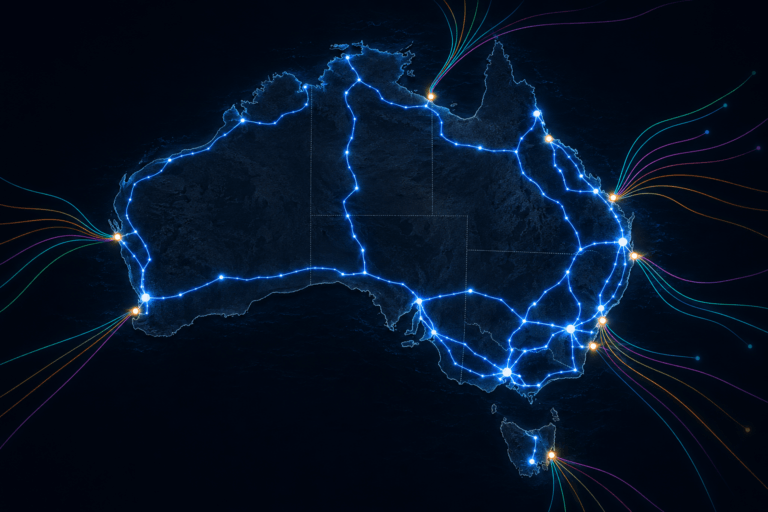
Google and Telstra Partner on Australian Fibre and Subsea Infrastructure for the AI Era

June 2, 2026
Financials

Google Cloud Hits $20B Quarter, Fueled by AI Infrastructure Boom

April 29, 2026
Semiconductors

Google Unveils 8th-Gen TPUs, AI Hypercomputer with Million-Scale Clusters

April 22, 2026
Semiconductors

Intel, Google Expand AI Infrastructure Pact Around Xeon and Custom IPUs

April 9, 2026
All

Wiz Expands AI Workload SecurityWiz as Google Completes $32B Acquisition

March 24, 2026
AI Infrastructure

Google Strengthens U.S.-India AI Backbone with New Fiber Routes

February 19, 2026
Next Post

Cisco AI Summit: Cisco and NVIDIA on the Enterprise Path to AI Factories

Categories

  • 5G / 6G / Wi-Fi
  • AI Infrastructure
  • All
  • Automotive Networking
  • Blueprints
  • Clouds and Carriers
  • Data Centers
  • Enterprise
  • Explainer
  • Feature
  • Financials
  • Last Mile / Middle Mile
  • Legal / Regulatory
  • Optical
  • Quantum
  • Research
  • Security
  • Semiconductors
  • Space
  • Start-ups
  • Subsea
  • Sustainability
  • Video
  • Webinars

Archives

Tags

5G All AT&T Australia AWS Blueprint columns BroadbandWireless Broadcom China Ciena Cisco Data Centers Dell'Oro Ericsson FCC Financial Financials Huawei Infinera Intel Japan Juniper Last Mile Last Mille LTE Mergers and Acquisitions Mobile NFV Nokia Optical Packet Systems PacketVoice People Regulatory Satellite SDN Service Providers Silicon Silicon Valley StandardsWatch Storage TTP UK Verizon Wi-Fi
Converge Digest

A private dossier for networking and telecoms

Follow Us

  • Home
  • About
  • Events Calendar
  • Blueprint Guidelines
  • Privacy Policy
  • Manage Email Delivery
  • NextGenInfra.io

© 2026 Converge Digest - A private dossier for networking and telecoms.

No Result
View All Result
  • Home
  • About
  • Events Calendar
  • Blueprint Guidelines
  • Privacy Policy
  • Manage Email Delivery
  • NextGenInfra.io

© 2026 Converge Digest - A private dossier for networking and telecoms.

This website uses cookies. By continuing to use this website you are giving consent to cookies being used. Visit our Privacy and Cookie Policy.
Go to mobile version