
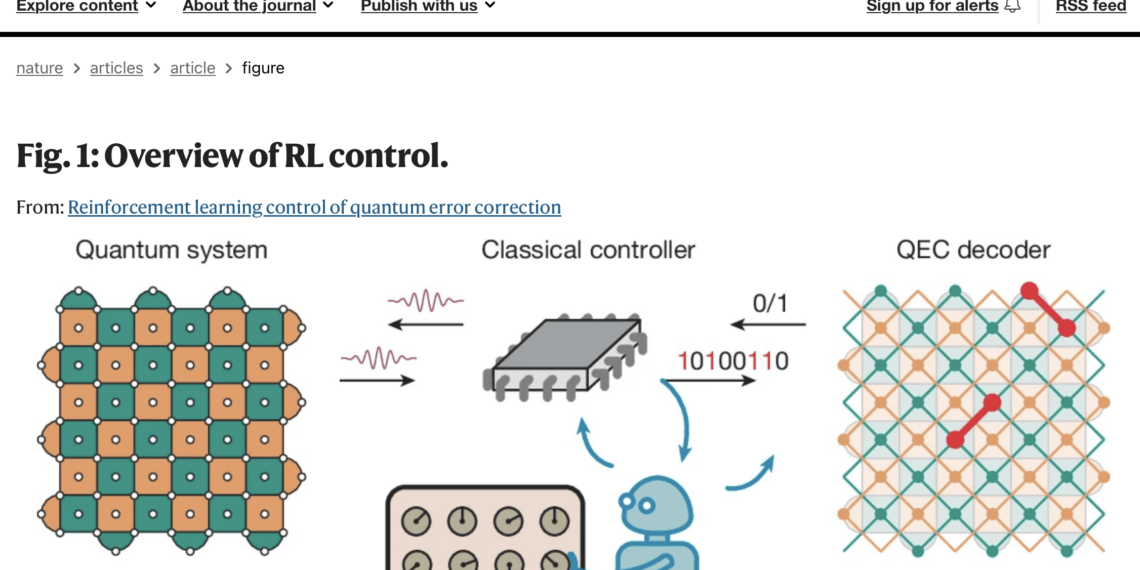
Google Quantum AI researchers developed a reinforcement learning framework that allows a quantum processor to continuously adjust its control parameters while running quantum error correction workloads. The team demonstrated the approach on Google’s Willow superconducting quantum processor, using error-detection events generated during quantum error correction (QEC) as feedback signals for an AI agent. The work addresses a central scaling problem in quantum computing: physical qubits and control electronics drift over time, forcing current systems to interrupt computation for recalibration.
The reinforcement learning agent managed more than 1,000 control parameters associated with translating QEC circuits into the analog waveforms used to operate the processor. Instead of relying on the logical error rate as the optimization target, the researchers used the average rate of error-detection events as a scalable surrogate objective. The agent applied small perturbations to control parameters, measured their effect on QEC detection events, and iteratively adjusted the processor toward lower error rates. Google reported that reinforcement learning fine-tuning reduced the logical error rate by about 20% beyond conventional calibration and human expert tuning.
The experiments produced an average logical error per cycle of 7.72 × 10⁻⁴ for a distance-7 surface code and 8.19 × 10⁻³ for a distance-5 color code. Under injected system drift, reinforcement learning reduced the logical error rate by an average of 24% and improved its stability by 2.4x compared with a fixed control policy. Adding decoder steering increased the reduction in logical error rate to 31% and improved stability by 3.5x. Simulations extended the framework to distance-15 surface codes with approximately 40,000 control parameters and indicated that the optimization convergence rate remained independent of system size.
• Platform: Google Willow superconducting quantum processor
• Approach: Multi-objective policy-gradient reinforcement learning for continuous quantum processor control
• Learning signal: Error-detection events generated during quantum error correction cycles
• Scale demonstrated experimentally: More than 1,000 processor control parameters
• Surface code result: 7.72 × 10⁻⁴ average logical error per cycle for a distance-7 code
• Color code result: 8.19 × 10⁻³ average logical error per cycle for a distance-5 code
• Fine-tuning improvement: Approximately 20% additional logical error rate suppression beyond conventional calibration and expert tuning
• Drift compensation: 24% average reduction in logical error rate and 2.4x improvement in stability
• With decoder steering: 31% logical error rate reduction and 3.5x stability improvement
• Scaling simulation: Distance-15 surface code with approximately 40,000 control parameters
“Our work suggests that the path to fault tolerance will be built not only on better hardware but on more intelligent control.”
🌐 Analysis: The research shifts reinforcement learning from isolated quantum gate optimization toward system-level control of an error-corrected quantum processor. The ability to use QEC syndrome data as a continuous feedback channel could become increasingly important as quantum computers scale to larger logical codes, longer computations, and control systems with tens of thousands or eventually millions of tunable parameters.
Google Quantum AI previously demonstrated below-threshold surface-code error correction on Willow and continues to develop neural-network decoders and other AI-assisted techniques for quantum error correction. This new work extends that strategy into the classical control plane, positioning machine learning as part of the runtime infrastructure required to operate fault-tolerant quantum computers rather than simply as an offline calibration tool.
Full Nature article:
Reinforcement learning control of quantum error correction
🌐 We’re tracking the latest developments in quantum networking. Follow our ongoing coverage at: https://convergedigest.com/category/quantum
Profile: Google Willow Processor & Quantum AI Efforts Updated July 2026 | |
| Organization | Google Quantum AI, Google’s quantum computing research organization, with major operations in Santa Barbara, California. |
| Parent Company | Google, part of Alphabet Inc. |
| Quantum Processor | Willow, Google’s superconducting quantum processor introduced in December 2024 and used for advanced quantum error correction and quantum algorithm research. |
| Qubit Technology | Superconducting qubits operated at cryogenic temperatures using microwave control electronics. |
| Processor Scale | 105 physical qubits on the Willow processor announced by Google. |
| Core Research Objective | Build a large-scale, fault-tolerant quantum computer capable of running useful algorithms using error-corrected logical qubits. |
| Quantum Error Correction | Google uses surface codes and color codes to encode logical qubits across multiple physical qubits and suppress errors as code distance increases. |
| 2025 QEC Milestone | Google reported below-threshold quantum error correction, demonstrating that increasing the size of a surface-code logical qubit reduced logical errors. |
| July 2026 Research | Google Quantum AI demonstrated reinforcement learning control of quantum error correction, using QEC error-detection events as feedback to continuously optimize processor control parameters during computation. |
| RL Control Scale | The experimental reinforcement learning agent managed more than 1,000 control parameters. Scaling simulations extended the framework to a distance-15 surface code with approximately 40,000 control parameters. |
| RL Performance | RL fine-tuning delivered approximately 20% additional logical error rate suppression beyond conventional calibration and human expert tuning. |
| Drift Compensation | RL steering reduced logical error rates by an average of 24% and improved logical error rate stability by 2.4x. Adding decoder steering increased stability improvement to 3.5x. |
| Surface Code Result | Distance-7 surface code achieved an average logical error per cycle of 7.72 × 10⁻⁴ using the AlphaQubit2 neural-network decoder. |
| Color Code Result | Distance-5 color code achieved an average logical error per cycle of 8.19 × 10⁻³ using the Tesseract decoder. |
| AI & Quantum Strategy | Google combines reinforcement learning neural-network decoding automated calibration to improve the classical control and decoding infrastructure required for fault-tolerant quantum computing. |
| Recent Research Direction | Research programs include scalable surface-code QEC, color-code architectures, neural-network quantum decoders, magic-state cultivation, reinforcement learning for processor control, logical quantum algorithms, and improved quantum processor hardware. |
| Long-Term Scaling Challenge | Transition from processors with roughly one hundred physical qubits to systems capable of operating large numbers of high-quality logical qubits while maintaining continuous error correction, calibration, decoding, and control. |
| Strategic Significance | Google’s research increasingly treats AI-assisted control, decoding, and calibration as components of the quantum computing system architecture, alongside processor hardware and quantum error-correcting codes. |