Deutsche Telekom added 578,000 new fiber-optic lines in the second quarter of 2016, as service revenues in the German fixed-network business stablized for the first time since liberalization.
In its Q2 financial report, Deutsche Telekom reported revenue of EUR 17,817 million, up 2.2 percent in the quarter, on an organic basis up 3.9 percent.

Some highlights:
- Capital expenditure (before spectrum) increased by 7.6 percent year-on-year in the first half of 2016 to 5.5 billion euros.
- In Germany, DT now has 5.6 million fiber access lines.
- Rapid customer growth at T-Mobile US made a substantial contribution to the Group’s net revenue growth.
- LTE coverage in Germany increased by 6 percentage points within a year to 91 percent. The percentage of households in Germany that have the option of connecting to Deutsche Telekom’s fiber-optic network increased by 10 percentage points to 57 percent, an increase of well over 4 million households.
- In the European subsidiaries, household coverage with fixed-network optical fiber increased by almost 1 million and now stands at 21.4 percent of households. In mobile communications, population coverage increased by some 19 million to 97 million people, or 75 percent of the population.
- In the years 2014 to 2016, Deutsche Telekom invested an average of almost 5 billion euros per year in Germany across all segments, a rate of almost 20 percent of revenue. The majority of the investments went into building out the network, which underpinned strong demand for fiber-optic lines in Germany.
- In Germany, mobile service revenues declined slightly by 0.8 percent to 1.7 billion euros. This decrease was in line with the trend in the overall market, thus Deutsche Telekom retained its position as clear market leader. There were two factors that negatively impacted revenue, i.e., the reduction of roaming rates, and the discounts under the MagentaEINS rate plan program, both of which exclusively related to mobile communications. If these factors had been added back, mobile service revenues would have increased by around 1.1 percent.
- Overall, total revenue in the Germany operating segment decreased by 3.1 percent in the second quarter to 5.4 billion euros. The reduction of the distribution business with mobile devices had a negative impact of around 2 percentage points.
- T-Mobile US LTE network coverage increased by around 20 million people year-on-year to 311 million.
- T-Mobile US won 1.9 million new customers in the second quarter. It was the thirteenth quarter in succession with more than one million customer additions. And T-Mobile US once again achieved positive porting ratios versus all three other national mobile providers, i.e., not only is the company growing overall, but also relative to each of the three providers, the number of customers won significantly exceeded the numbers lost to the respective competitor.
- The strong customer growth had a positive impact on revenue, which increased by 12.6 percent to 9.3 billion U.S. dollars. Service revenues also increased in line with this trend to 6.8 billion U.S. dollars, both growth rates representing the highest in the U.S. mobile industry. Adjusted EBITDA increased by 34.6 percent, improving the margin by more than 4 percentage points to 26.5 percent. T-Mobile US plans to maintain this growth trend as the year progresses: The earnings target for the full year was narrowed around the average to date and the guidance range for branded postpaid customer additions revised upwards by 200,000 to between 3.4 and 3.8 million.
- More than half of the fixed-network lines in DT’s European companies have now been migrated to IP. At the same time, activities are intensified to build the pan-European network, which will provide an efficient, harmonized production platform for operation across all national companies.
- T-Systems generated revenue of 1.6 billion euros in the Market Unit in the second quarter, a slight decline of 3.0 percent compared with the same quarter of the prior year.
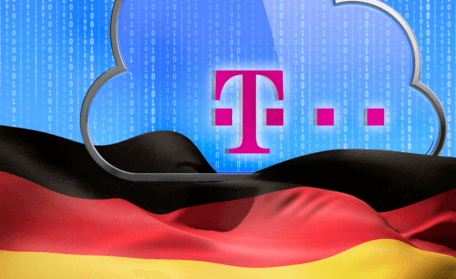
- The cloud business was again one of the positive revenue drivers, generating some 70 percent of revenue at T-Systems. After an increase at Group level of around 31 percent in the first quarter, in the first six months of the year cloud revenue increased by 22 percent to more than 0.7 billion euros. T-Systems still expects the cloud business to grow faster than the overall market for the full year and for the period up to and including 2018.