• Home
  • About
  • Events Calendar
  • Blueprint Guidelines
  • Privacy Policy
  • Manage Email Delivery
  • NextGenInfra.io
No Result
View All Result
Converge Digest
Saturday, June 6, 2026
  • Home
  • About
  • Events Calendar
  • Blueprint Guidelines
  • Privacy Policy
  • Manage Email Delivery
  • NextGenInfra.io
No Result
View All Result
Converge Digest
No Result
View All Result

Home » Hot Interconnects: Microsoft Maps Out $100B AI Networking Fabric

Hot Interconnects: Microsoft Maps Out $100B AI Networking Fabric

August 21, 2025
in AI Infrastructure, All, Clouds and Carriers, Data Centers
A A

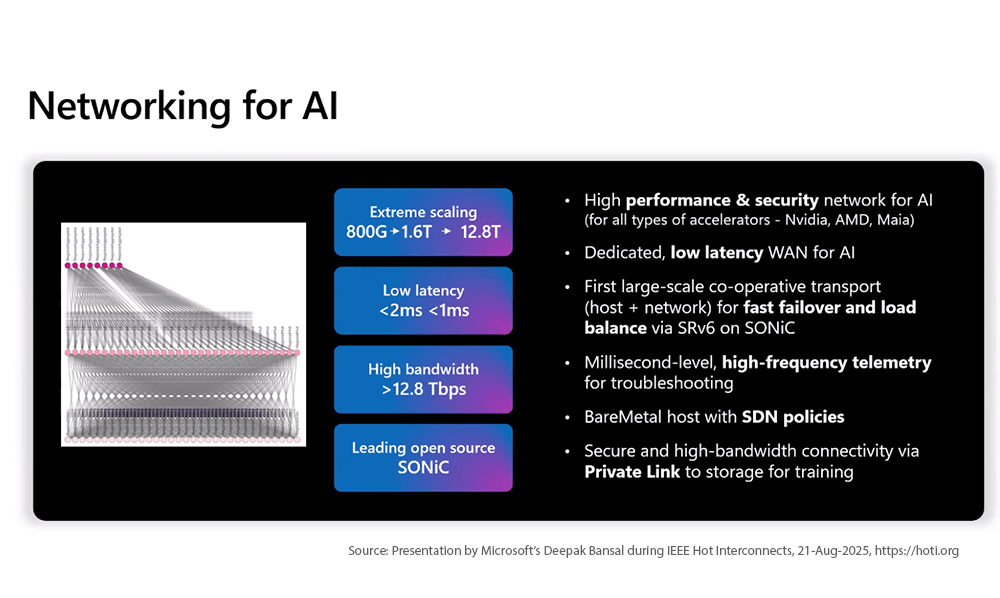
Microsoft is building out AI-scale networking with more than $100 billion in near-term investment, said Deepak Bansal, Corporate VP, during a keynote at the IEEE Hot Interconnects conference. He described AI clusters now exceeding 100,000 GPUs, creating “hundreds of thousands of potential points of failure” that demand defect-free builds, automation, and real-time telemetry across Ethernet and InfiniBand interconnects.

Bansal outlined Microsoft’s evolving network architecture, including DPUs for GPU-to-storage networking with throughput above 12.8 Tbps, “smart switches” for bare-metal virtualization, and automated fabric health monitoring across distributed data centers. Azure Managed CNI, built on eBPF, supports AI workloads with flexible IP routing, fine-grained security policies, and open-source observability via Retina. Microsoft’s AI appliance model integrates distributed GPUs into Azure, connecting securely to storage through Private Link and policy-enforced SDN.

Security remains central. Microsoft is enforcing network security perimeters with unified firewalls, egress controls, and mandatory Private Link for AI storage. Application networking for AI follows four imperatives: scale/performance, security, observability, and operational simplicity. Global reach is supported by 60+ Azure regions, 275,000 miles (442,500 km) of fiber, >2 Pbps of WAN capacity, and 200 Tbps of peering. Finally, Bansal detailed AI-aware load balancing: an application gateway combining advanced load balancing, semantic caching, prompt transformation, and ORCA metrics ingestion to optimize inference workloads across models such as GPT, LLaMA, and Claude.

  • AI clusters now scale to 100k+ GPUs; automation and telemetry are required for defect-free operation
  • Smart switches based on DPUs support bare-metal virtualization across compute, storage, and AI clusters
  • Fabric health: automated streaming telemetry, defect analysis, and AI-based mitigation
  • Azure Managed CNI (eBPF) + Retina observability deliver multi-cloud scale with >1M IPs supported
  • AI appliances integrate distributed GPUs into Azure via Private Link and SDN enforcement
  • Security perimeter: unified firewalls, granular access control, and egress protections
  • WAN scale: 2 Pbps+ backbone, 200 Tbps peering, 40k+ interconnects across 60+ regions
  • AI load balancer: semantic cache, prompt transformer, ORCA telemetry, advanced L7 policies

“We are on our mission to build the AI infrastructure for the world,” Bansal said. “Very soon, there will not be any app that is not AI-enabled. If an app is not AI-enabled, it will be called a legacy app.”

🌐 Analysis: Microsoft’s keynote shows how AI infrastructure is driving full-stack networking innovation—from optics and WAN capacity to DPUs, SDN, and security models. Its eBPF-based Azure CNI and smart load balancer stack extend Kubernetes observability to AI. The move mirrors Nvidia’s DPU-powered BlueField networking, Google’s TPU pod fabrics, and AWS’s Elastic Fabric Adapter, underscoring the hyperscaler arms race to interconnect hundreds of thousands of accelerators at petabit scale.

Tags: HOTIMicrosoft
ShareTweetShareSummarizeSummarize
Previous Post

Hot Interconnects: Meta Highlights 600K GPUs, Custom Chips, Next-Gen Fabrics

Next Post

Dell’Oro: RAN Market Grows Outside of China in 2Q25

Jim Carroll

Jim Carroll

Editor and Publisher, Converge! Network Digest, Optical Networks Daily - Covering the full stack of network convergence from Silicon Valley

Related Posts

Quantum

Microsoft Unveils Majorana 2 Quantum Chip

June 2, 2026
AI Infrastructure

Nebius, Microsoft, and TikTok Drive Finland’s AI Data Center Surge

April 17, 2026
AI Infrastructure

Nscale Expands Microsoft Deal with 30,000+ NVIDIA Rubin GPUs at 230 MW Norway AI Campus

April 15, 2026
5G / 6G / Wi-Fi

Microsoft Commits $10 Billion to Expand AI Infrastructure and Cybersecurity in Japan

April 6, 2026
AI Infrastructure

Optica Executive Forum: Microsoft’s Yawei Yin Explores “Scale-Across”

March 23, 2026
All

Microsoft Brings Up First NVIDIA Vera Rubin NVL72 System

March 15, 2026
Next Post

Dell'Oro: RAN Market Grows Outside of China in 2Q25

Categories

  • 5G / 6G / Wi-Fi
  • AI Infrastructure
  • All
  • Automotive Networking
  • Blueprints
  • Clouds and Carriers
  • Data Centers
  • Enterprise
  • Explainer
  • Feature
  • Financials
  • Last Mile / Middle Mile
  • Legal / Regulatory
  • Optical
  • Quantum
  • Research
  • Security
  • Semiconductors
  • Space
  • Start-ups
  • Subsea
  • Sustainability
  • Video
  • Webinars

Archives

Tags

5G All AT&T Australia AWS Blueprint columns BroadbandWireless Broadcom China Ciena Cisco Data Centers Dell'Oro Ericsson FCC Financial Financials Huawei Infinera Intel Japan Juniper Last Mile Last Mille LTE Mergers and Acquisitions Mobile NFV Nokia Optical Packet Systems PacketVoice People Regulatory Satellite SDN Service Providers Silicon Silicon Valley StandardsWatch Storage TTP UK Verizon Wi-Fi
Converge Digest

A private dossier for networking and telecoms

Follow Us

  • Home
  • About
  • Events Calendar
  • Blueprint Guidelines
  • Privacy Policy
  • Manage Email Delivery
  • NextGenInfra.io

© 2026 Converge Digest - A private dossier for networking and telecoms.

No Result
View All Result
  • Home
  • About
  • Events Calendar
  • Blueprint Guidelines
  • Privacy Policy
  • Manage Email Delivery
  • NextGenInfra.io

© 2026 Converge Digest - A private dossier for networking and telecoms.

This website uses cookies. By continuing to use this website you are giving consent to cookies being used. Visit our Privacy and Cookie Policy.
Go to mobile version